
Hybrid sinus node sparing ablation for complex inappropriate sinus tachycardia and postural orthostatic tachycardia syndrome: initial experience in Central Europe


 CC BY-NC-SA 4.0
Hybrid sinus node sparing ablation for complex inappropriate sinus tachycardia and postural orthostatic tachycardia syndrome: initial experience in Central Europe
CC BY-NC-SA 4.0
Introduction
Inappropriate sinus tachycardia (IST) and postural orthostatic tachycardia syndrome (POTS) are complex dysautonomia‑related conditions characterized by abnormal heart rate (HR) responses and significant impairment of quality of life. IST is defined by resting HR exceeding 100 bpm and an exaggerated HR increase during minimal activity without an identifiable underlying cause.1 POTS, on the other hand, is diagnosed when an excessive HR increase of at least 30 bpm (or ≥40 bpm in individuals under 19 years) occurs within 10 minutes of standing without orthostatic hypotension. Both conditions require an exclusion of physiological and pathological sinus tachycardia and share overlapping symptoms, such as palpitations, dizziness, fatigue, and exercise intolerance, though their underlying pathophysiological mechanisms and diagnostic criteria differ.2,3
The precise mechanisms underlying IST/POTS remain incompletely understood, with hypotheses implicating cardiovascular autonomic dysfunction, neurohormonal imbalance, hypersensitivity of the sinus node to catecholamines, and impaired cardiovascular reflexes. Moreover, both IST and POTS are predominant features of early and late post–COVID‑19 syndrome.4,5 First‑line management typically includes lifestyle modifications, such as avoiding triggers (eg, dehydration, stress, caffeine) and following structured exercise programs. Medical treatment with, for example, β-blockers, ivabradine, and sometimes fludrocortisone or midodrine (particularly in POTS) is used to alleviate symptoms.6-8 However, a subset of patients remains refractory to these approaches, necessitating alternative interventions.
Hybrid sinus node sparing (SNS) ablation, a novel procedural strategy combining minimally invasive thoracoscopic surgical and electrophysiological techniques, has emerged as a promising treatment option for severely symptomatic, drug‑resistant, or drug‑intolerant IST/POTS.
Our study is a part of the multicenter HEAL‑IST Registry (NCT05107635) parallel to the HEAL‑IST IDE trial (Hybrid Epicardial and Endocardial Sinus Node Sparing Ablation Therapy for Inappropriate Sinus Tachycardia; NCT05280093). The primary aim was to gain insights into the clinical spectrum of patients referred for hybrid SNS ablation and evaluate safety of the procedure.
Patients and methods
Study design and inclusion criteria
This retrospective case series encompasses the first 20 consecutive patients who underwent hybrid SNS ablation at the Department of Cardiac Surgery and Transplantology, Warsaw, Poland between September 2023 and December 2024. The patients were included based on: 1) a diagnosis of drug‑resistant IST/POTS, defined as a failure of at least 2 pharmacologic agents or documented drug intolerance, with symptoms significantly impairing daily functioning; 2) electrophysiological study (EPS), that is, confirmation of IST or POTS through EPS and exclusion of other arrhythmias; 3) documentation of sinus tachycardia episodes or excessive orthostatic HR increase through 72‑hour Holter monitoring or cardiovascular autonomic tests including tilt‑Table testing. Exclusion criteria comprised left ventricular ejection fraction below 50% and a history of cardiac surgery.
Preoperative assessment
All patients underwent evaluation by a multidisciplinary EP‑heart team consisting of a general cardiologist, electrophysiologists, cardiac surgeons, psychologist, anesthesiologists, and other specialists as required. Secondary causes of sinus tachycardia, such as hyperthyroidism, anemia, and pheochromocytoma were excluded. The diagnosis of IST/POTS was made according to the established criteria, which, together with inclusion / exclusion criteria, patient management protocol, diagnostic tests to confirm IST/POTS and the definitions of IST/POTS are delineated in Supplementary material. Written informed consent was obtained from all patients. Exceptionally, parental consent was obtained for 1 underage participant who was scheduled for the procedure due to her severe, drug‑resistant symptoms. While she fulfilled all inclusion criteria for the HEAL‑IST trial, she was not considered because of age.
The study adheres to the Declaration of Helsinki; patients are enrolled to the HEAL‑IST Registry (NCT05280093). The study was approved by the bioethics committee of the National Medical Institute of the Ministry of Interior and Administration (59/2024).
Statistical analysis
Continuous variables were reported as mean with SD. Due to the limited sample size, median with interquartile range (IQR) was also provided. Categorical variables were presented as counts and percentages. The Shapiro–Wilk test was used to test normality of the follow‑up length distribution. Mean pre- and postoperative HRs on Holter electrocardiography (ECG) were assessed using the paired t test with a P value below 0.05 considered significant. The analyses were carried out using STATA MP v13.0 software (StataCorp, College Station, Texas, United States).
Results
Patient demographics and baseline characteristics
The cohort consisted of 20 women, at a mean (SD) age of 29 (8) years. The symptoms included palpitations, dizziness, syncope, fatigue, and dyspnea during minimal physical activity despite optimal medical therapy. Main comorbidities included POTS diagnosed in 6 patients (30%) based on excessive orthostatic HR increase, vasovagal syncope in 3 patients (15%), atrioventricular nodal reentry tachycardia (AVNRT) in 4 patients (20%), paroxysmal supraventricular tachycardia documented in 1 patient (5%), later confirmed to be AVNRT, and paroxysmal atrioventricular block in 1 patient (5%). Prior ablation for AVNRT was performed in 5 patients, 4 patients underwent cardioneuroablation, and 2 bilateral thoracic sympathectomy for either Raynaud syndrome with hyperhidrosis or severe hypertension and POTS with effective impact on severe drug‑resistant hypertension and 3‑month intermittent successful impact on POTS. One patient suffered from Sjögren syndrome. Detailed characteristics of the patients are available in Supplementary material Table S1.
Procedural details
The hybrid SNS ablation was performed using a combination of minimally‑invasive surgical techniques and real‑time electrophysiological guidance. The procedure involved 3‑dimensional video‑assisted thoracoscopic surgery conducted under general anesthesia with single‑lung ventilation and endocardial mapping performed via the femoral access to identify the sinus node’s earliest activation sites (Figure 1A).
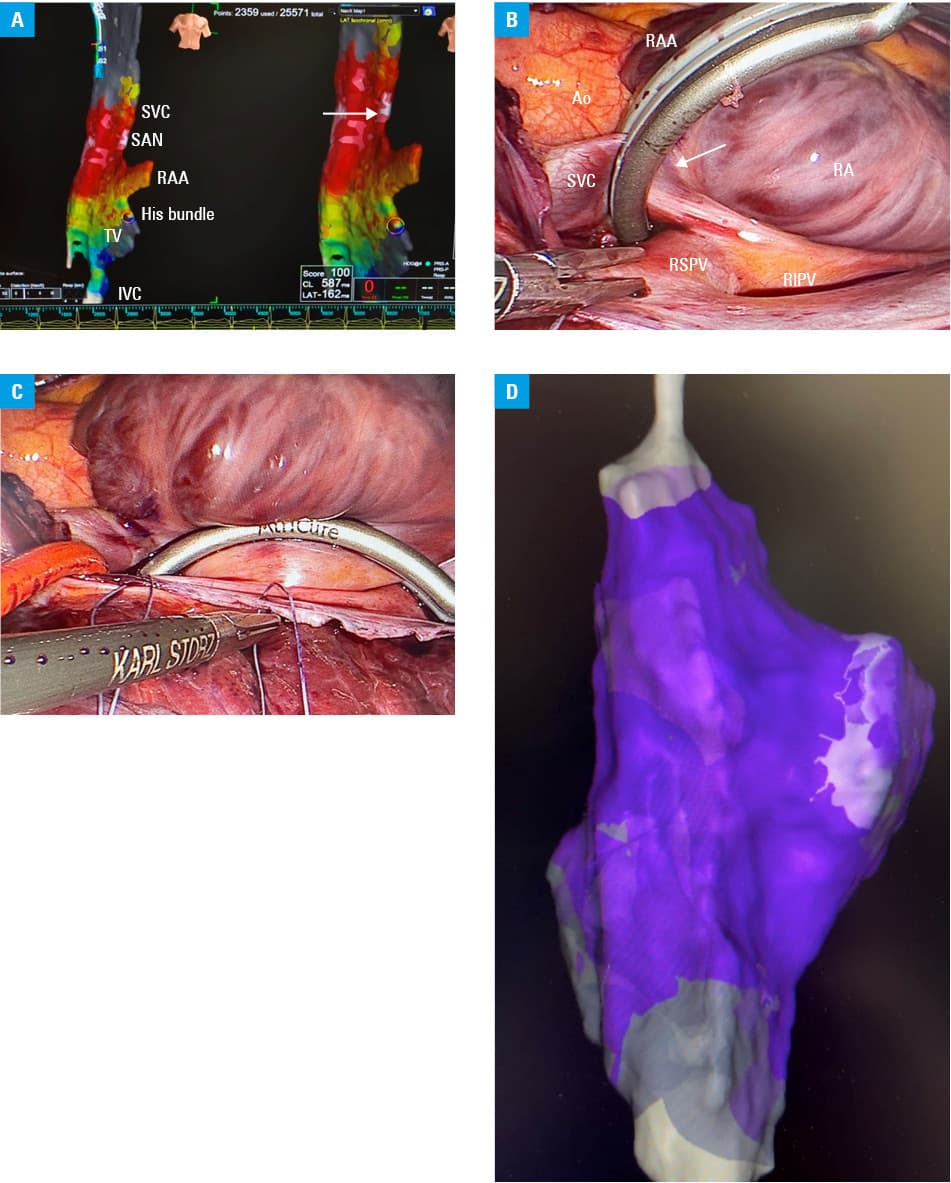
Abbreviations: Ao, aorta; IVC, inferior vena cava; RA, right atrium; RAA, right atrial appendage; RIPV, right inferior pulmonary vein; RSPV, right superior pulmonary vein; SAN, sino‑atrial node; SVC, superior vena cava; TV, tricuspid valve
Briefly, isolation of the right pulmonary veins, superior and inferior vena cava, crista terminalis, and connecting lines were performed with AtriCure Isolator Synergy clamp (AtriCure Inc, Manson, Ohio, United States), which delivers bipolar radiofrequency energy according to the protocol, as described in the SUSRUTA‑IST (Sinus Node Sparing Hybrid Thoracoscopic Ablation Outcomes in Patients with Inappropriate Sinus Tachycardia) Registry (Figure 1B–1D).9 Ablation of the cavotricuspid isthmus was performed in 7 patients (35%) with inducible atrial flutter to achieve a bidirectional conduction block. In 1 patient, extensive adhesions precluded complete pulmonary vein isolation. Signs of atrial fibrosis were noted in 14 patients (70%). The mean (SD) procedure time was 185 (43) minutes.
Postoperative outcomes and follow‑up
The intensive care unit stay was 1 day. Early postoperative outcomes were encouraging, with significant HR reductions on Holter ECG (mean reduction by 26 [9] bpm; 95% CI, 3.7–49.6), corresponding to 25% decrease from baseline (P = 0.02) observed in all IST patients. Specific complications included asymptomatic hydrothorax at 2 weeks postoperatively managed conservatively in 1 patient and asymptomatic pericardial effusion (maximum 13 mm) detected in 1 patient, resolved with colchicine and ibuprofen.
Patients were discharged on postoperative day 4 in a good condition, and enrolled in a comprehensive rehabilitation program, including an on‑site cardiac rehabilitation and tele‑rehabilitation via a smartphone‑based platform. The longest available follow‑up data for each patient were collected. During a mean (SD) follow‑up of 7 (4) months (median [IQR] 6 [3.74–10]), all patients maintained normal sinus rhythm and reported resolution of IST/POTS symptoms. No patient to date has required permanent pacemaker (PPM) implantation. Two patients were referred for repeated endocardial mapping and pulsed‑field ablation to secure lines.
Discussion
IST/POTS management remains challenging due to their poorly understood pathophysiology and limited effectiveness of conventional therapies. Pharmacologic options, while helpful in some cases, often fail to achieve symptom control or are poorly tolerated. This study highlights hybrid SNS ablation as a viable alternative for patients with refractory IST/POTS, offering targeted intervention while preserving sinus node functionality.
Our findings are consistent with prior research emphasizing the efficacy of hybrid SNS ablation. In a large cohort, long‑term freedom from redo procedures was reported in 84.6% of patients, with a 9.5% PPM implantation rate.10 Similarly, a multicenter study reported stable sinus rhythm at 6 months in 255 patients undergoing hybrid SNS ablation, though pericarditis was common (47%).11 Prophylactic acetylsalicylic acid and colchicine significantly reduced pericarditis incidence, emphasizing the importance of personalized postoperative care.12 The SUSRUTA‑IST registry compared hybrid SNS ablation with radiofrequency sinus node (RF‑SN) ablation, demonstrating the superior efficacy and safety of the hybrid approach. Hybrid ablation resulted in greater improvements in resting and peak HR, fewer redo procedures, and lower rates of PPM implantation. RF‑SN ablation, however, showed a lower risk of acute pericarditis.9 Small sample size, all‑female cohort, and short follow‑up duration of our study warrant further studies to evaluate long‑term outcomes and recurrence rates. However, this initial study represents the first Central European experience with hybrid SNS ablation for IST/POTS. The use of a multidisciplinary team and comprehensive follow‑up strengthens reliability of the findings. Nevertheless, due to the small sample size, the parametric results should be interpreted cautiously. Future prospective trials, such as the ongoing HEAL‑IST IDE study and OPTIMAL‑IST, are necessary to establish the long‑term efficacy and safety of hybrid SNS ablation and refine patient selection criteria and the optimal multidisciplinary approach for screening and time of intervention.13 For centers experienced in minimally‑invasive techniques, this approach provides a valuable addition to the therapeutic armamentarium for IST/POTS.
Conclusions
Hybrid SNS ablation may be a promising treatment option for patients with drug‑resistant IST/POTS, demonstrating a reduction in sinus tachycardia. The integration of surgical precision with electrophysiological guidance offers a targeted approach that minimizes complications and maximizes efficacy. This study underscores the importance of a multidisciplinary approach in managing complex cases of IST/POTS.
- Hou CR, Olshansky B, Cortez D, et al. Inappropriate sinus tachycardia: an examination of existing definitions. Europace. 2022; 24: 1655‑1664. | Crossref
- Spahic JM, Hamrefors V, Johansson M, et al. Malmo POTS symptom score: assessing symptom burden in postural orthostatic tachycardia syndrome. J Intern Med. 2023; 293: 91‑99. | Crossref
- Mayuga KA, Fedorowski A, Ricci F, et al. Sinus tachycardia: a multidisciplinary expert focused review. Circ Arrhythm Electrophysiol. 2022; 15: e007960. | Crossref
- Fedorowski A, Fanciulli A, Raj SR, et al. Cardiovascular autonomic dysfunction in post‑COVID‑19 syndrome: a major health‑care burden. Nat Rev Cardiol. 2024; 21: 379‑395. | Crossref
- Tomasiewicz K, Woron J, Kobayashi A, et al. Post‑COVID‑19 syndrome in everyday clinical practice: interdisciplinary expert position statement endorsed by the Polish Society of Civilization Diseases. Pol Arch Intern Med. 2024; 134: 16728. | Crossref
SUPPLEMENTARY MATERIAL
ARTICLE INFORMATION