
TrIPs, tricks, and IDOls of the heart: metabolomics as stratifiers of coronary artery disease


 CC BY-NC-SA 4.0
TrIPs, tricks, and IDOls of the heart: metabolomics as stratifiers of coronary artery disease
CC BY-NC-SA 4.0
The field of coronary artery disease (CAD) has long been thirsty for biomarkers that do not just echo the standard modifiable risk factors—such as cholesterol and blood pressure—but offer fresh clues into the hidden biochemistry of atherosclerosis.1,2 In this quest, a recent study makes a compelling case for the power of metabolomics to illuminate the darker corners of the disease progression and prognosis.3 In this issue of Polish Archives of Internal Medicine, Kondraciuk et al3 turn the spotlight on tryptophan (Trp) metabolism, revealing that elevated activity of indoleamine 2,3‑dioxygenase (IDO) and decreased Trp levels are independently associated with poorer long‑term survival in patients with stable CAD. This study elegantly brings metabolomics into the center of clinical attention, reinforcing its potential to reshape how we diagnose and risk‑stratify patients with CAD. By analyzing 170 patients over a 6‑year follow‑up period, the study establishes that elevated activity of IDO—a metabolic gatekeeper in the Trp pathway—correlates with increased mortality risk, while higher Trp concentrations seem to play a cardioprotective role. These relationships persisted even after adjusting for traditional cardiovascular risk factors, such as age, smoking status, low‑density lipoprotein concentrations and statin dosage, hypertension, and renal function.3
Novelty of this study lies in its ability to isolate the impact of IDO and Trp levels from other well‑established predictors of mortality. Metabolomics, as a field, is gaining traction as an essential tool in cardiovascular research, providing insights that extend beyond conventional lipid profiles and inflammatory markers.4 The study adds fuel to the growing momentum for bringing metabolomic profiling into everyday clinical decision‑making for cardiovascular risk assessment.5 From a mechanistic perspective, the IDO pathway emerges as a molecular crossroads of immunity and inflammation, that is, key drivers of atherosclerosis and CAD progression. By depleting Trp and ramping up production of kynurenine‑derived metabolites, IDO orchestrates a cascade of effects linked to immune modulation, oxidative stress, and endothelial dysfunction.6,7 It is a metabolic symphony with far‑reaching clinical echoes—one that we are only just beginning to decode.
In CAD, Trp depletion triggers the production of kynurenine pathway metabolites, which have been implicated in various pathophysiological processes, including immune tolerance, oxidative stress, and endothelial dysfunction.6,7 These factors are pivotal in atherosclerosis, the buildup of plaques in arterial walls that leads to atherosclerotic obstruction and major adverse cardiovascular events (MACEs). The degradation of Trp by IDO can also promote a proinflammatory environment, worsening the vascular inflammation that underlies the genesis and progression of CAD.6
Elevated IDO activity and reduced Trp levels may reflect an ongoing inflammatory response in the vascular system. Chronic inflammation can initiate a cascade of detrimental effects, including destabilization of atherosclerotic plaques, which can precipitate acute events, such as acute coronary syndromes.6,7 Additionally, the accumulation of kynurenine and its metabolites can impair endothelial cell function, hinder nitric oxide production, and exacerbate vascular dysfunction—all critical components in the pathophysiology of CAD. The heightened IDO activity in CAD patients with poorer survival outcomes may reflect an enhanced inflammatory state, ultimately contributing to disease exacerbation and adverse clinical events.7
These findings also align with broader trends in cardiovascular research, where inflammatory and metabolic pathways are increasingly recognized as crucial determinants of disease trajectory. Prior studies have linked altered metabolite profiles—including ceramides, phospholipids, and short‑chain acylcarnitines—with cardiovascular outcomes.8 Among these metabolites, ceramides have emerged as important players in the development and progression of CAD.8,9 Elevated ceramide levels have been shown to promote endothelial dysfunction, a key feature of atherosclerosis, and to increase the susceptibility of arterial plaques to rupture, thus contributing to adverse outcomes.8,10 Havulinna et al11 also demonstrated that higher levels of specific ceramides are associated with an increased risk of MACEs. This highlights the importance of sphingolipid metabolism in the regulation of vascular health and its potential as a biomarker of CAD.
Furthermore, phospholipids, particularly those involved in cell membrane integrity and inflammatory processes, play a crucial role in CAD. Alterations in phospholipid profiles, especially the increased levels of lysophospholipids, have been linked to the destabilization of atherosclerotic plaques.12 These compounds are thought to contribute to inflammation and endothelial dysfunction, further exacerbating the progression of CAD. Notably, Tang et al13 demonstrated that reduced levels of phosphatidylcholine, a major phospholipid, are associated with impaired endothelial function, highlighting how changes in lipid metabolism can directly impact vascular health. Additionally, short‑chain acylcarnitines, which are involved in the transport and metabolism of fatty acids, have also been implicated in cardiovascular disease. Changes in acylcarnitine profiles have been shown to be associated with adverse outcomes in CAD.14 These metabolites reflect alterations in mitochondrial function and energy metabolism, both of which are critical in the pathogenesis of atherosclerosis. Research has suggested that disruptions in acylcarnitine metabolism may indicate impaired fatty acid oxidation, leading to a buildup of metabolic intermediates that contribute to vascular inflammation and plaque formation.15 The study by Kondraciuk et al3 builds on this foundation, adding IDO activity and Trp concentrations to the growing list of potential prognostic metabolomic biomarkers.
The clinical implications of this research are profound. First, incorporating IDO activity and Trp levels into existing risk models could sharpen our ability to stratify patients with CAD—paving the way for truly personalized cardiovascular care. Second, this metabolic signal could trigger further exploration into therapeutic interventions targeting the IDO pathway. Could modulating IDO activity shift the trajectory of cardiovascular disease? Might dietary or pharmacologic strategies aimed at sustaining optimal Trp levels offer cardioprotection? These are not just academic curiosities—they are the kind of bold questions that could shape the next era of precision cardiology. And now, we may have the tools to start answering them.
While the study presents robust evidence, some limitations must be acknowledged. The sample size, though sufficient for statistical analysis, remains relatively small, necessitating validation in larger, more diverse cohorts. Additionally, the observational nature of the study precludes direct causal associations. Future studies should validate these results, and research should explore longitudinal interventions to assess whether modifying IDO activity or Trp metabolism can translate into tangible clinical benefits.
In conclusion, in an era where cardiology increasingly intersects with molecular science, this study reinforces the emerging evidence that metabolic and inflammatory pathways are closely related with cardiovascular health. By elucidating the prognostic significance of IDO activity and Trp levels, the authors pave the way for new diagnostic and therapeutic avenues. As metabolomic technologies become more accessible and better integrated into clinical workflows, we are likely to witness a shift from generalized treatment paradigms to precision‑guided strategies tailored to each patient’s unique biochemical fingerprint (Figure 1). The challenge now is to validate these early signals in larger cohorts, explore interventional pathways, and ultimately harness metabolomics not just as a diagnostic tool—but as a roadmap to a more individualized and proactive form of cardiovascular medicine.
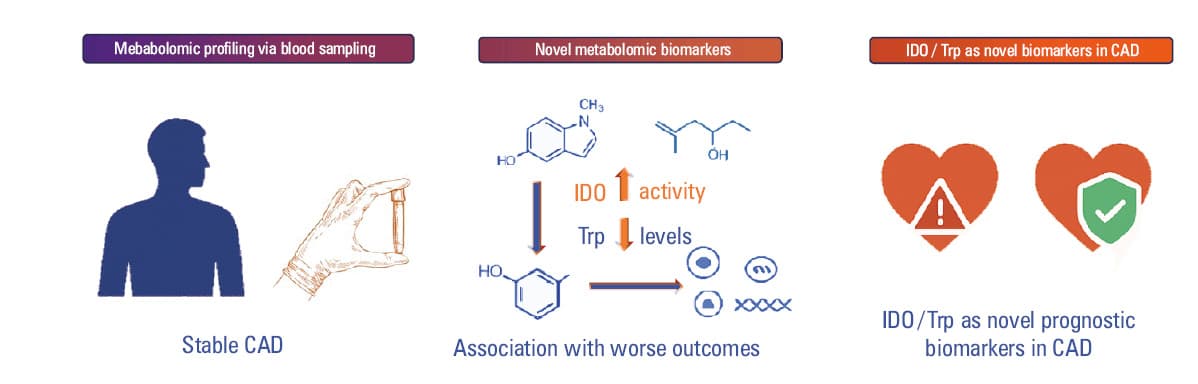
Abbreviations: CAD, coronary artery disease; IDO, indoleamine 2,3‑dioxygenase; Trp, tryptophan
- Moysidis DV, Daios S, Anastasiou V, et al. Association of clinical, laboratory and imaging biomarkers with the occurrence of acute myocardial infarction in patients without standard modifiable risk factors ‑ rationale and design of the ‘Beyond‑SMuRFs Study’. BMC Cardiovasc Disord. 2023; 23: 149. | Crossref
- Moysidis DV, Papazoglou AS, Karagiannidis E. The SMuRFs and the SMuRF‑Less Gargamel. JACC Cardiovasc Interv. 2022; 15: 1886. | Crossref
- Kondraciuk M, Chlabicz M, Jamiołkowski J, et al. Metabolomic profile associated with coronary artery disease: a higher level of indoleamine 2,3‑dioxygenase activity and lower tryptophan concentrations predict worse prognosis. Pol Arch Intern Med. 2025; 135: 16974. | Crossref
- Anlar GG, Anwardeen N, Al Ashmar S, et al. Metabolomics profiling of stages of coronary artery disease progression. Metabolites. 2024; 14: 292. | Crossref
- Lee J, Gilliland TC, Dron J, et al. Integrative metabolomics differentiate coronary artery disease, peripheral artery disease, and venous thromboembolism risks. Arterioscler Thromb Vasc Biol. 2024; 44: 2108‑2117. | Crossref
ARTICLE INFORMATION