
Anomaly of the left main coronary artery originating from the right coronary sinus in a 65-year-old man

 CC BY 4.0
Anomaly of the left main coronary artery originating from the right coronary sinus in a 65-year-old man
CC BY 4.0
Coronary artery anomalies are rare, occurring in less than 1% of the general population. They are usually discovered incidentally but can also be a cause of sudden cardiac death (SCD) in young individuals.1,2
We present a case of a 65‑year‑old man with hypertension, hypercholesterolemia, and atypical anginal pain.
Coronary angiography (Figure 1A–1C) showed an anomalous left coronary artery originating from the right coronary sinus (ALCA‑R), with a myocardial bridge causing 60%–70% systolic compression of the distal portion of the left main coronary artery (LMCA; Figure 1A and 1B).
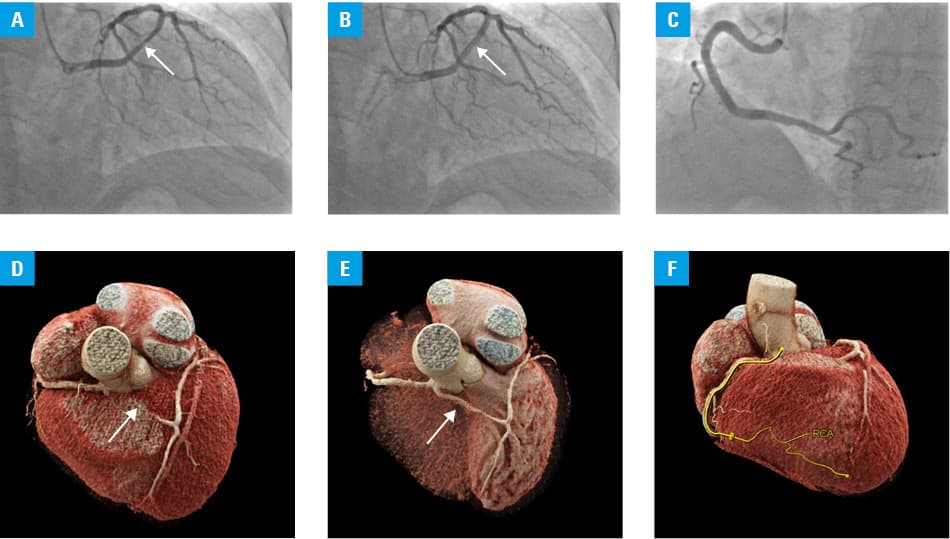
Abbreviations: LMCA, left main coronary artery; RCA, right coronary artery
Echocardiography identified normal valve function and good left ventricular systolic function with an ejection fraction of 55%. Coronary computed tomography angiography (Figure 1D–1F) showed a dominant right coronary artery (RCA; Figure 1F). The LMCA originated from the right aortic sinus, sharing a common origin with the RCA. The configuration of the RCA and LCA was bifurcated, without angulation at the point of origin. The initial segment of the LMCA (about 15 mm) ran anterior to the aortic root, followed by a 25‑mm intramyocardial course between the right and left ventricles, embedded within the anterior septal wall of the left ventricle (Figure 1D and 1E). During systole, the vessel lumen narrowed from 3 to 1.5 mm. Upon exiting to the epicardial surface, the LCA bifurcated at a right angle into the left anterior descending and left circumflex (LCx) branches. After originating from the trunk, the LCx followed a typical course (Figure 1E). Nonobstructive atherosclerotic plaques were observed in both the RCA and LCx.
Pharmacological treatment included acetylsalicylic acid, perindopril, amlodipine, and rosuvastatin. A β-blocker was not recommended due to the patient’s tendency toward bradycardia.
According to the European Cardiovascular Pathology Guidelines, the ALCA‑R anomaly is considered a highly probable cause of SCD, while the myocardial bridge is deemed an uncertain one.3 SCDs in individuals with ALCA‑R tend to occur during physical exertion, which is why surgical treatment is recommended for young athletes.4 However, in patients over the age of 35 years, no survival benefit from surgical intervention has been demonstrated to date.5 Considering the literature data, the patient’s age, and the mild symptoms, the heart team decided on conservative management.
- Rizzo S, De Gaspari M, Frescura C, et al. Sudden death and coronary artery anomalies. Front Cardiovasc Med. 2021; 8: 636589. | Crossref
- Angelini P, Velasco JA, Flamm S. Coronary anomalies: incidence, pathophysiology, and clinical relevance. Circulation. 2002; 105: 2449‑2454. | Crossref
- Basso C, Aguilera B, Banner J, et al. Association for European Cardiovascular Pathology Guidelines for autopsy investigation of sudden cardiac death: 2017 update from the Association for European Cardiovascular Pathology. Virchows Arch. 2017; 471: 691‑705. | Crossref
- Finocchiaro G, Behr ER, Tanzarella G, et al. Anomalous coronary artery origin and sudden cardiac death: clinical and pathological insights from a national pathology registry. JACC Clin Electrophysiol. 2019; 5: 516‑522. | Crossref
- Krasuski RA, Magyar D, Hart S, et al. Long‑term outcome and impact of surgery on adults with coronary arteries originating from the opposite coronary cusp. Circulation. 2011; 123: 154‑162. | Crossref
ARTICLE INFORMATION