
Obesity rather than metabolic syndrome as a possible 5-year mortality risk factor in off-pump surgical revascularization: a retrospective analysis

 CC BY 4.0
Obesity rather than metabolic syndrome as a possible 5-year mortality risk factor in off-pump surgical revascularization: a retrospective analysis
CC BY 4.0
Introduction
Obesity is a challenging epidemiological problem accompanied by an increased prevalence of comorbidities, such as arterial hypertension, hyperglycemia, lipid disturbances, and coronary atherosclerosis.1 Visceral adiposity is an independent indicator of poor cardiovascular outcomes.2
Metabolic syndrome (MetS) represents an accumulation of pathological conditions, including central obesity, hypertension, insulin resistance, and atherogenic hyperlipidemia, that significantly increase cardiovascular risk.3 Traditional components of MetS induce a proinflammatory state, mainly related to interleukin (IL)-1β), IL‑6, and tumor necrosis factor-α (TNF-α) derived from chronically inflamed adipose tissue and allied with oxidative stress and hemodynamic dysfunction.4 Inflammatory processes are aggravated by obesity and trigger immunological cascades leading to atherosclerosis progression. However, obesity has been recently postulated as a protective factor in individuals with established cardiovascular diseases (the so‑called obesity paradox)5.
Coronary artery disease can be successfully treated by either percutaneous or surgical revascularization.6 Satisfactory long‑term outcomes of coronary artery bypass grafting in multivessel disease have been reported.7 The off‑pump coronary artery bypass (OPCAB) technique is considered a safe procedure with a low risk of perioperative complications, allowing for complete revascularization.8
This study focused on long‑term results of off‑pump surgical revascularization due to chronic coronary syndrome (CCS) in patients with obesity, defined as body mass index (BMI) higher than 30 kg/m2.
Patients and methods
A total of 281 (241 men [86%]) consecutive patients at a median (interquartile range [IQR]) age of 64 (60–70) years underwent a planned surgery with the use of the off‑pump technique due to CCS. After exluding the outliers, based on age and sex adjustments, 254 patients (216 men [85%]) at a median (IQR) age of 64 (60–71) years were included in the analysis, as presented in the flowchart (Figure 1).
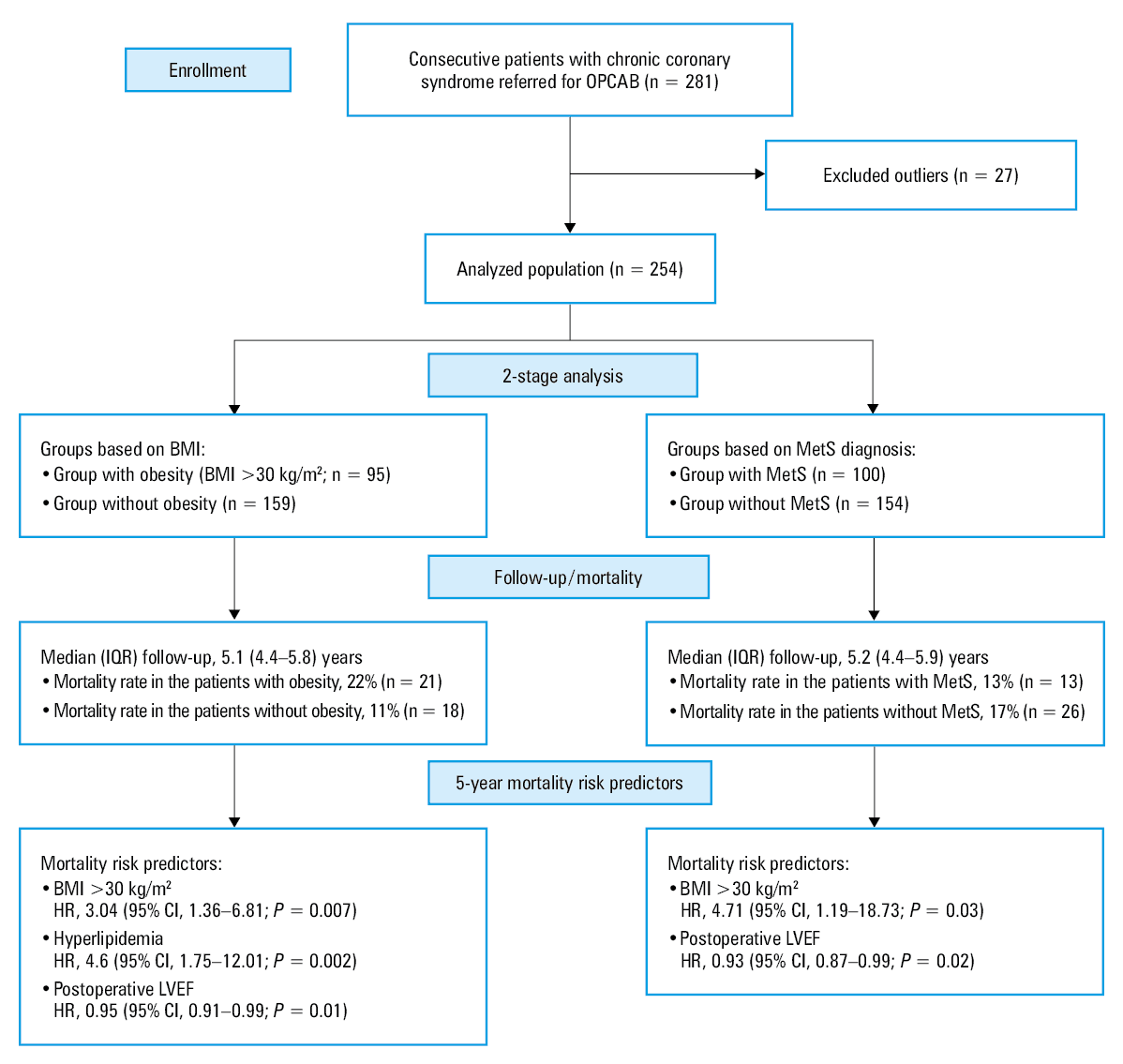
The cohort was subjected to a 2‑stage analysis based on their BMI and MetS diagnosis. First, the patients were divided into 2 groups. A total of 95 patients (37%) with obesity (BMI >30 kg/m²) were assigned to the study group and the other 159 individuals (63%), to the control group.
In the second part of the analysis, 100 patients (39%) who met the MetS diagnosis criteria were placed in the study group, and 154 individuals without MetS (61%) were assigned to the control group. MetS was defined as meeting at least 3 of the following criteria: obesity (BMI >30 kg/m²), hypertriglyceridemia, low serum levels of high‑density lipoprotein, arterial hypertension, and insulin resistance.9
A retrospective analysis of preoperative demographic and clinical characteristics and surgical data was performed.
Statistical analysis
The normality of the distribution of variables was tested with the Shapiro–Wilk test. The median (IQR) was used to describe the groups when the variables did not follow the normal distribution. When the normal distribution criteria were met, mean (SD) was applied. The t test and the Mann–Whitney test were used, where applicable, to compare the variables between the 2 groups. Multivariable regression models were created for 5‑year mortality risk prediction. We used the backward selection method. The results were presented as hazard ratios (HRs) and 95% CIs. The statistical analysis was performed using MedCalc1 statistical software version 20.010 (MedCalc Software Ltd., Ostend, Belgium). A P value below 0.05 was considered significant.
Ethics
Informed consent was obtained from all participants. The study was conducted in accordance with the Declaration of Helsinki and approved by the Institutional Review Board of Poznan University of Medical Sciences, Poznań, Poland (810/22) for human studies.
Results
Median (IQR) follow‑up was 5.1 (4.4–5.7) and 5.4 (4.6–5.8) years in the group with and without obesity, respectively (P = 0.32). The demographic and clinical characteristics were similar in both groups, as presented in Supplementary material, Table S1.
Three‑vessel disease was diagnosed in 86 patients (91%) with obesity vs 133 (84%) without obesity, whereas 9 individuals (9%) vs 26 (16%) with and without obesity, respectively, were diagnosed with 2‑vessel disease (P = 0.14). There were no intergroup differences regarding the number of performed anastomoses (2.3 [0.8] in the group with obesity vs 2.3 [0.7] in the group without obesity; P = 0.84). The rate of complete revascularization was 89% (85/95) in the group with obesity and 90% (143/159) in the group without obesity (P = 0.82). No conversion to cardiopulmonary bypass occurred in the study group. Postoperative left ventricular ejection fraction (LVEF) was assessed in an outpatient clinic during routine follow‑up and did not differ between the groups (P = 0.2), as presented in Supplementary material, Table S1.
We observed differences in 5‑year mortality between the groups with and without obesity (21 [22%] vs 18 [11%], respectively; P = 0.02), as opposed to perioperative mortality rate (2 [1%] vs 2 [1%]; P >0.99) which was similar in both groups undergoing off‑pump surgical revascularization (Supplementary material, Table S2). The long‑term risk of major adverse cardiac events was higher in the group with obesity (35 [25%]) than in the one without obesity(10 [11%]; P = 0.005).
No differences were observed in the long‑term mortality risk between the patients with complete and incomplete revascularization (P = 0.42).
The multivariable analysis of overall 5‑year mortality prediction indicated obesity (HR, 3.04; 95% CI, 1.36–6.81; P = 0.007), hyperlipidemia (HR, 4.6; 95% CI, 1.75–12.01; P = 0.002), and postoperative LVEF (HR, 0.95; 95% CI, 0.91–0.99; P = 0.01) as possible risk factors (Supplementary material, Table S3).
The second step of the study was the analysis based on MetS. The study group included 100 patients (84 men) at a median (IQR) age of 66 (60–72) years, and the control group comprised 154 participants (32 men) at a median (IQR) age of 64 (59–70), as presented in Supplementary material, Table S3. The 5‑year mortality rate did not differ between the groups with and without MS (13 [13%] vs 26 [17%]; P = 0.4).
In the multivariable analysis of 5‑year mortality prediction in the group with MetS, obesity (HR, 4.71; 95% CI, 1.19–18.73; P = 0.03) and LVEF (HR, 0.93; 95% CI, 0.87–0.99; P = 0.02) were found significant risk factors, as presented in Supplementary material, Table S4.
Discussion
The results of our analysis indicate a lower 5‑year survival rate in the group with obesity, as adipose tissue accumulation may play a primary role in long‑term outcomes. We also confirmed the results from a previous analysis,10 suggesting satisfactory perioperative mortality risk among overweight patients.
Obesity is currently considered an unsolved pathological condition, characterized by lowered quality of life, and it is accompanied by various comorbidities that can further complicate patient management. This highlights an urgent need for targeted interventions aimed at reducing obesity rates and improving overall health outcomes in affected individuals. Despite their evident benefits, the applied therapies are symptomatic and require multidisciplinary approaches.11 Obesity is related to enhanced inflammation and is a known factor of atherosclerosis progression. However, according to a recent study12, it is also associated with premature aging and increased mortality risk. Therefore, addressing obesity improves the quality of life and can significantly reduce the burden of cardiovascular diseases and other associated health issues.
We found no differences in long‑term survival rates between complete and incomplete revascularization. This can be explained by a high rate of left descending artery to left internal mammary artery grafting in the study population, which remains the cornerstone of satisfactory long‑term outcomes in surgically treated patients.13,14 According to our analysis, the possible predictors of unfavorable long‑term outcomes are obesity and atherosclerotic hyperlipidemia.
In the second stage of our analysis, MetS was found to be related to a lower 5‑year survival rate. We investigated possible differences in survival rates in the presence comorbidities, such as arterial hypertension, diabetes, and hyperlipidemia, suggesting that obesity represents the sole factor limiting the outcomes. In a previous meta‑analysis,15 MetS was found to be predictive of all‑cause mortality in patients with CCS. A study 10 on the pathophysiology of MetS indicated premature aging of the extracellular matrix in response to circulating elastin‑derived peptides and exacerbated elastolysis. In obesity, processes leading to premature aging have been demonstrated and linked to decreased nitric oxide bioavailability, increased oxidative stress, and enhanced inflammation resulting in mitochondrial dysfunction.17 The presented mechanisms may explain the results, suggesting that obesity is the primary predictor of all‑cause mortality in MetS in our group.
Our results point to the impact of visceral adipose tissue excess on outcomes in patients with obesity and MetS. In both analyses, we demonstrated a possible link between premature mortality and obesity. These results indicate the need for an immediate, postoperative multidisciplinary approach to reduce overweight in patients with multivessel disease treated with surgical revascularization. The satisfactory perioperative results should not discourage the heart team from referring patients for surgical therapy for obesity, but indicate the necessity for weight correction solutions during follow‑up.
Our analysis suggests comparable long‑term outcomes in the patients with and without MetS, which brings a new perspective on this matter. Regarding perioperative results and a 5‑year mortality risk, patients presenting with MetS should not be overlooked when considering surgical interventions. Their unique health challenges necessitate a tailored approach that would address both their cardiovascular and metabolic needs, ensuring comprehensive care and improved long‑term outcomes.
Study limitations
This was a single‑center retrospective study based on all‑cause mortality in a high‑volume OPCAB center. A large‑volume, multicenter analysis is required to confirm accuracy of the results.
Conclusions
Obesity, defined as BMI higher than 30 kg/m2, can be regarded as a possible long‑term mortality risk factor in patients with CCS treated with surgical revascularization. The OPCAB technique in patients with MetS is characterized by satisfactory perioperative results, but the 5‑year mortality risk remains higher in the analyzed group with obesity.
- Tirandi A, Montecucco F, Carbone F, et al. Role of glucagon‑like peptide‑1 receptor agonists in treating obesity, cardiovascular disease, and cerebrovascular disease. Pol Arch Intern Med. 2024; 134: 16658.
- Powell‑Wiley TM, Poirier P, Burke LE, et al. American Heart Association Council on Lifestyle and Cardiometabolic Health; Council on Cardiovascular and Stroke Nursing; Council on Clinical Cardiology; Council on Epidemiology and Prevention; and Stroke Council. Obesity and Cardiovascular Disease: a scientific statement from the American Heart Association. Circulation. 2021, 143, e984‑e1010. | Crossref
- Rajca A, Wojciechowska A, Śmigielski W, et al. Increase in the prevalence of metabolic syndrome in Poland: comparison of the results of the WOBASZ (2003‑2005) and WOBASZ II (2013‑2014) studies. Pol Arch Intern Med. 2021; 131: 520‑526. | Crossref
- Silveira Rossi JL, Barbalho SM, Reverete de Araujo R, et al. Metabolic syndrome and cardiovascular diseases: going beyond traditional risk factors. Diabetes Metab Res Rev. 2022: 38: e3502. | Crossref
- Katta N, Loethen T, Lavie CJ, et al. Obesity and coronary heart disease: epidemiology, pathology, and coronary artery imaging. Curr Probl Cardiol. 2021; 46: 100655. | Crossref
SUPPLEMENTARY MATERIAL
ARTICLE INFORMATION