

 CC BY 4.0
A 33‑year‑old patient presented to the emergency room of a department of infectious diseases with skin lesions on his feet 3 weeks after returning from Africa. Over a 4‑week period, he visited Kenya, Uganda, and Ethiopia. Throughout his journey, he diligently used insect repellents and adhered to antimalarial prophylaxis. The patient reported no insect bites or foot injuries, and mostly wore sandals during his trip. While in Africa, he resided in small villages, spent a lot of time outdoors, and tasted local food. He had been given all the required and recommended vaccinations, including tetanus booster vaccine.
The patient reported appearance of expanding dark skin lesions over the past week. These lesions were located under the skin: one on the sole of the left foot (Figure 1A) and another near the nail of the fifth toe of the right foot (Figure 1B). The lesions were centrally elevated. Initially, they were itchy but painless. The patient applied a mixture of lactic and salicylic acid to the lesion on the left foot, as he believed it to be a viral papilloma. This treatment led to pain and formation of a blister with purulent content.
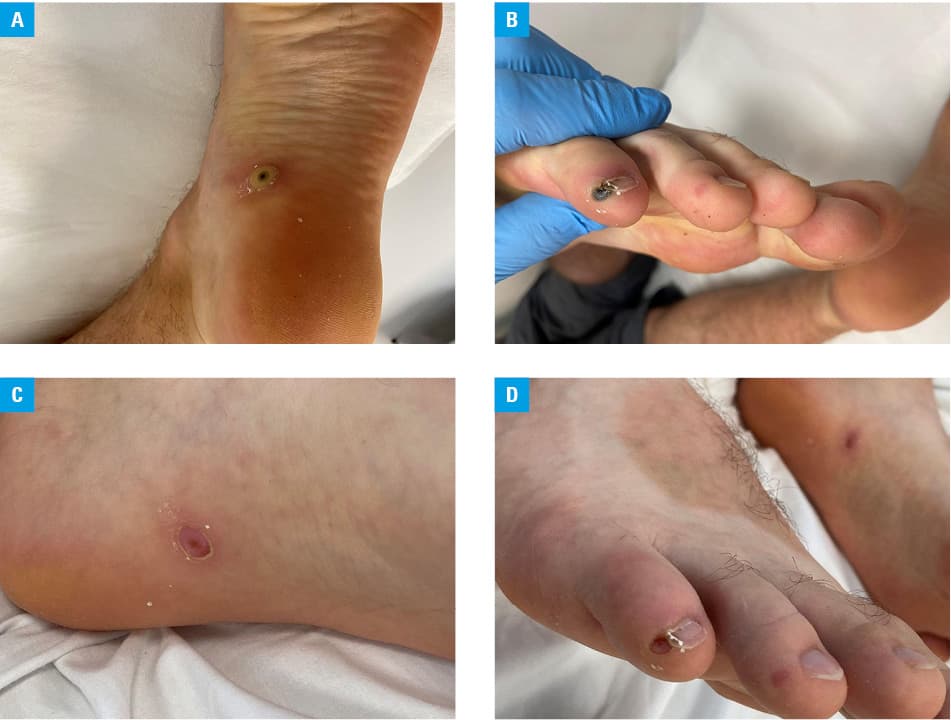
During the consultation, both skin lesions were completely removed under sterile conditions. Parasitologic examination confirmed presence of gravid female jigger flea.
The patient was discharged with an antibiotic prescription (amoxicillin with clavulanic acid) and a recommendation of proper wound care.
During a follow‑up visit 2 days later, the patient reported substantial improvement without pain on walking. The skin lesions after removal of the parasite remained clean with no signs of infection (Figure 1C and 1D).
Tungiasis is a disease caused by Tunga penetrans flea, commonly known as the jigger flea or sand flea. This tiny ectoparasitic flea is endemic to the Caribbean, South America, Sub‑Saharan Africa, and India. Tungiasis is a significant health concern, affecting an estimated 10 million people worldwide,1,2 particularly in rural regions of developing tropical countries, where up to half of the population might be infected. The condition is caused by female adult fleas that actively burrow into the skin, causing nodular swelling. Cutaneous infestation (usually on the feet) leads to pain, difficulty while walking, and reduced quality of life. It can be complicated by secondary bacterial infections, abscesses, fissures, septicemia, necrotic ulcers, fingernail loss, osteomyelitis, autoamputation of toes or fingers, and tetanus.
In literature, there are many descriptions of tungiasis among both native inhabitants of endemic regions, seriously ill due to massive infestation with life‑threatening complications,3 and tourists with a relatively mild course of the disease and clinical appearance similar to our case.4
Practical preventive recommendations for travelers include: wearing closed shoes (which additionally may be sprayed with diethyltoluamide‑containing solutions), avoiding the contact of naked skin with the ground, especially in areas with poor sanitation or inhabited by domestic animals, such as dogs, cats, or cattle, using insect repellents, living in clean accommodations, and being aware of possible symptoms of tungiasis.
- Suzuki K, Ongaya A, Okomo G, et al. Treatment‑seeking behaviours of patients with tungiasis in endemic areas of Homa Bay County, Kenya: a mixed‑methods study. Trop Med Health. 2024; 52: 73. | Crossref
- Lefebvre M, Capito C, Durant C, et al. Tungiasis: a poorly documented tropical dermatosis. Med Mal Infect. 2011; 41: 465‑468. | Crossref
- Pallangyo P, Nicholaus P. Disseminated tungiasis in a 78‑year‑old woman from Tanzania: a case report. J Med Case Rep. 2016; 10: 354. | Crossref
- Scalvenzi M, Francia MG, Costa C, et al. Tungiasis: case report of a traveller to Kenya. Case Rep Dermatol. 2009; 1: 29‑34. | Crossref
ARTICLE INFORMATION