
Successful edge-to-edge repair of iatrogenic tricuspid regurgitation related to pacemaker lead extraction

 CC BY 4.0
Successful edge-to-edge repair of iatrogenic tricuspid regurgitation related to pacemaker lead extraction
CC BY 4.0
A 75‑year‑old man with a complex cardiac history presented for pacemaker lead extraction. His history included a mechanical mitral valve replacement (Björk‑Shiley 27M, Shiley Inc., Irvine, California, United States) and a VVI pacemaker implantation in 1993 due to third‑degree atrioventricular block. He underwent a generator change in 2013 and an upgrade to a cardiac resynchronization therapy pacemaker (CRT‑P) in 2023 due to progression of heart failure to New York Heart Association (NYHA) class IV.
The patient returned for transvenous extraction of damaged right ventricular (RV) and left ventricular (LV) leads and implantation of either a CRT‑P or a left bundle branch area pacing (LBBAP) lead (he refused implantable cardioverter‑defibrillator implantation). Transthoracic echocardiography (TTE) showed severe LV dysfunction with ejection fraction of 20%. The mitral prosthesis maintained good function, and the tricuspid valve (TV) appeared morphologically normal, with only mild tricuspid regurgitation (TR) and preserved RV function.
During the procedure, we removed the LV lead using simple traction and extracted the RV lead with the Byrd system (Cook Medical Inc., Bloomington, Indiana, United States). We simultaneously implanted an LBBAP lead, achieving successful LBB pacing with a QRS duration of approximately 90 ms, eliminating the need for a new LV lead. However, the procedure was complicated with rupture of the posterior papillary muscle of the RV during RV lead extraction. This led to a flail of the TV posterior leaflet and severe TR, characterized by a vena contracta width of 9 mm, an effective regurgitant orifice area (EROA) of 0.61 cm2, a regurgitant volume of 40 ml, and a flail gap distance of 9 mm (Figure 1A and 1B). Transesophageal echocardiography showed the new lead passing through the TV at the anteroposterior commissure (Figure 1C).
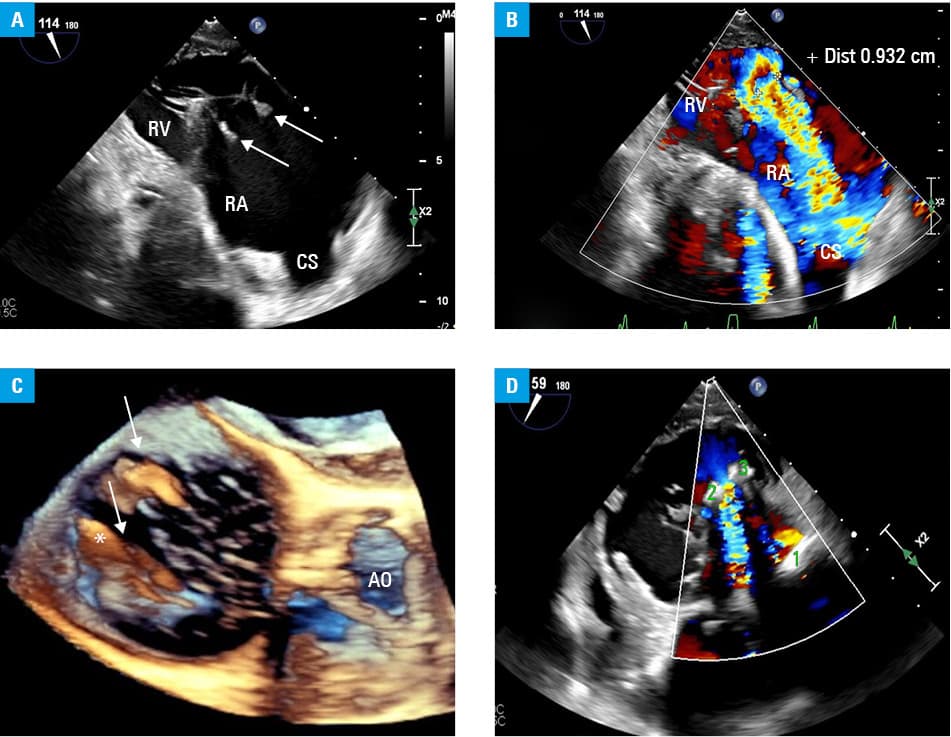
Abbreviations: AO, aortic valve; CS, coronary sinus; RA, right atrium; RV, right ventricle
Although the patient remained in a relatively stable clinical condition (NYHA class III), he was in class A2 according to the 4A classification, and required escalating doses of diuretics to manage peripheral edema.1 Given his high surgical risk (TRI‑SCORE of 14%), the heart team deemed him unsuitable for surgery.2 As transcatheter TV implantation was unavailable at this time, transcatheter edge‑to‑edge repair was undertaken as a last resort, despite challenging valve morphology according to the GLIDE scoring system (3 points).3
We implanted 3 XTW G4 MitraClip devices (Abbott Vascular, Menlo Park, California, United States) using the simultaneous grasping technique: the first between the anterior and septal leaflets to prevent annular dilation, the second between the septal and flail posterior leaflets, and the third in the posterior commissure. This intervention successfully reduced TR to a mild‑to‑moderate grade, with a vena contracta width of 4 mm, EROA of 0.2 cm2, and a regurgitant volume of 17 ml (Figure 1D).
The patient’s condition improved considerably postprocedure. His symptoms decreased to NYHA class II, with resolution of significant dyspnea and edema. His N‑terminal pro–B‑type natriuretic peptide levels dropped from 12 164 pg/ml after papillary muscle rupture to 7229 pg/ml at discharge (reference range <250 pg/ml). Follow‑up TTE at discharge and at 3 months confirmed stable clip positions with mild‑to‑moderate residual TR.
- González‑Gómez A, Fernández‑Golfín C, Hinojar R, et al. The 4A classification for patients with tricuspid regurgitation. Rev Esp Cardiol (Engl Ed). 2023; 76: 845‑851 | Crossref
- Dreyfus J, Bohbot Y, Coisne A, et al. TRI‑SCORE: a new risk score for in‑hospital mortality prediction after isolated tricuspid valve surgery. Eur Heart J. 2022; 43: 654‑662 | Crossref
- Gerçek M, Narang A, Körber, et al. GLIDE score: scoring system for prediction of procedural success in tricuspid valve transcatheter edge‑to‑edge repair. JACC Cardiovasc Imaging. 2024; 17: 729‑742
ARTICLE INFORMATION