
Diagnostic challenges in a fatal case of atypically presenting peripheral T-cell lymphoma complicated by hemophagocytic lymphohistiocytosis

 CC BY 4.0
Diagnostic challenges in a fatal case of atypically presenting peripheral T-cell lymphoma complicated by hemophagocytic lymphohistiocytosis
CC BY 4.0
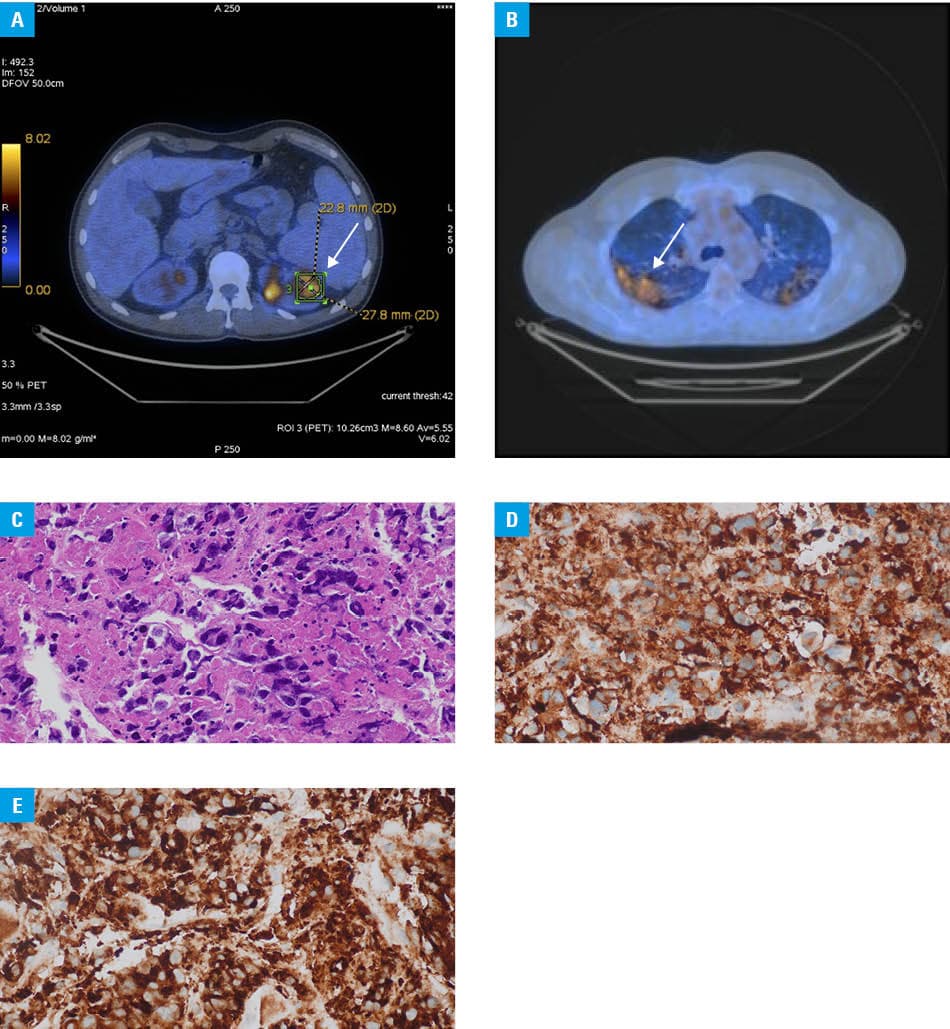
A 33‑year‑old previously healthy, physically active man was referred to a department of hematology for evaluation of pancytopenia detected on routine laboratory testing. He reported a 2‑month history of progressive malaise, reduced exercise tolerance, intermittent fevers, and excessive sweating. On admission, laboratory tests confirmed pancytopenia: white blood cell count of 2.56 × 10⁹/l (reference range [RR], 4–10 × 109/l), hemoglobin level of 9.6 g/dl (RR, 14–18 g/dl), hematocrit of 27.3% (RR, 40%–54%), and platelet count of 120 G/l (RR, 130–400 G/l). During a 2‑week hospitalization, comprehensive bone marrow evaluation was performed. Two sequential aspirates and trephine biopsy identified normocellular marrow with preserved trilineage hematopoiesis. Flow cytometry and immunohistochemistry showed no clonal lymphoid population or aberrant antigen expression. Overall, the initial diagnostic suspicions, including acute leukemia and bone marrow aplasia, were not confirmed and subsequently ruled out. Computed tomography (CT) of the chest, abdomen, and pelvis identified bilateral renal infiltrates and pulmonary ground‑glass opacities. Subsequent positron emission tomography / CT (PET/CT) demonstrated heterogeneous fluorine‑18 fluorodeoxyglucose (18F‑FDG) uptake in renal lesions (15 mm × 13 mm; maximum standardized uptake value [SUVmax], 10 in the right kidney; 29 mm × 24 mm; SUVmax, 11.9 in the left kidney; Figure 1A), focal pituitary uptake (SUVmax, 7.8), and diffuse pulmonary infiltrates (SUVmax, 4.3 in the right lobe; 3.2 in the left lobe; Figure 1B). No other metabolically active lesions were identified. Given the diagnostic uncertainty following PET/CT, which raised a suspicion of an extranodal lymphoma but did not allow for precise classification, kidney biopsy was performed, showing neoplastic infiltration by large atypical cells with crescent‑shaped nuclei and necrosis (Figure 1C). Immunohistochemistry confirmed CD3+ and MUM1+ expression, consistent with extranodal peripheral T‑cell lymphoma, not otherwise specified (PTCL‑NOS), with cytotoxic phenotype (CD2+, CD3+, CD4+, TIA‑1+, Ki67 index of 70%–80%, CD5−, CD7−, Granzyme B−, CD56−, CD25−, ALK−, CD30−, PAX5−, CD20−, SOX−, CKpan−; Figure 1D and 1E). Final diagnosis was stage IVB PTCL‑NOS. Due to increased 18F‑FDG uptake in the pituitary region, brain magnetic resonance imaging (MRI) was performed, identifying pituitary gland enlargement (10 mm × 11 mm × 22 mm) with superior convexity and a heterogeneous T2‑weighted signal in the anterior lobe, including hypointense foci up to 6 mm, suggestive of neoplastic infiltration. These findings correlated with suppressed thyroid‑stimulating hormone levels (<0.005 mIU/l; RR, 0.27–4 mIU/l), hyponatremia (sodium concentration of 124 mmol/l; RR, 136–145 mmol/l), and reduced adrenocorticotropic hormone secretion (3.39 pg/ml; RR, 3.6–60.5 pg/ml), consistent with central hypothyroidism and secondary adrenal insufficiency. Cyclophosphamide, doxorubicin, vincristine, prednisone (CHOP) chemotherapy was initiated. Prior to the second cycle, the patient developed marked polyuria (urine output of 6 l/day), which responded to desmopressin, indicating central diabetes insipidus. Follow‑up brain MRI demonstrated progression of pituitary involvement with loss of distinction between the anterior and posterior lobes. Consequently, the second chemotherapy cycle was administered (methotrexate‑CHOP), incorporating high‑dose intravenous methotrexate (3 g/m2). The third cycle was delayed due to multiorgan dysfunction, including hepatotoxicity (aspartate transaminase, 729 U/l; RR, 0–40 U/l; alanine transaminase, 201 U/l; RR, 0–41 U/l), cardiotoxicity (N‑terminal pro–B‑type natriuretic peptide, 10 233 pg/ml; RR, 0–125 pg/ml), and metabolic derangements with elevated levels of lactate dehydrogenase (4824 U/l; RR, 135–225 U/l) and D‑dimer (11 130 ng/dl; RR, 0–500 ng/dl). Follow‑up abdominal CT showed progression of renal infiltration (up to 4.7 cm), new para‑aortic lymphadenopathy (up to 1.7 cm), and worsening hepatosplenomegaly: liver, 23 cm and spleen, 18.5 cm (previously 16.6 cm)—indicative of refractory disease. Treatment was modified to include alemtuzumab (anti‑CD52 monoclonal antibody) at a dose of 3 mg daily, which was selected as a salvage therapy in line with current guidelines1 for refractory PTCL, as second‑line intensive chemotherapy was not feasible given the patient’s Eastern Cooperative Oncology Group 3 status and transfusion‑dependent marrow failure. Therefore, other recommended agents were either inapplicable or unavailable. Concurrently, the patient developed clinical and laboratory features of secondary hemophagocytic lymphohistiocytosis (HLH), including hyperferritinemia (ferritin >100 000 ng/ml), progressive cytopenias, splenomegaly, fever (38.2 °C), and hypertriglyceridemia (triglycerides, 676 mg/dl; RR, 0–150 mg/dl). HLH‑directed therapy with etoposide (150 mg/m2) and dexamethasone (10 mg/m2) was initiated concurrently with alemtuzumab. Shortly after, the patient developed tumor lysis syndrome. Despite treatment, his clinical status continued to deteriorate, with progressive respiratory failure and metabolic acidosis, necessitating transfer to an intensive care unit. The patient died 2 days later.
Our case illustrates the diagnostic complexity of PTCL‑NOS presenting with HLH. Similar clinical scenarios with prolonged fever, cytopenias, and initial diagnostic uncertainty have been reported in the literature.2 In contrast to the majority of cases described by Weisenburger et al,2,3 where bone marrow involvement was frequent, our patient showed persistent pancytopenia without confirmed marrow infiltration. HLH as a first manifestation of PTCL remains rare but highly aggressive, as seen in the case reported by Said et al4 and supported by Knauft et al.5 In HLH‑associated PTCL, nonspecific clinical presentation may delay diagnosis and initiation of treatment, while the disease course is often fulminant, and prognosis, dismal. Despite guideline‑concordant management, outcomes remain poor, underscoring the need for earlier recognition and more effective therapeutic strategies.
- McKay C, Hong LT, Uddin AKMN. Peripheral T‑cell lymphoma presenting as fever of unknown origin in a man with deranged liver function tests and pancytopenia. BMJ Case Rep. 2021; 14: e237 806. | Crossref
- Weisenburger DD, Savage KJ, Harris NL, et al. Peripheral T‑cell lymphoma, not otherwise specified: a report of 340 cases from the International Peripheral T‑cell Lymphoma Project. Blood. 2011; 117: 3402‑3408. | Crossref
- Said C, Bitar K, Elias F. Aggressive T‑cell lymphoma smoldering as hemophagocytic lymphohistiocytosis: a diagnostic and medical challenge. Cureus. 2025; 17: e76 757. | Crossref
- Knauft J, Schenk T, Ernst T, et al. Lymphoma‑associated hemophagocytic lymphohistiocytosis (LA‑HLH): a scoping review unveils clinical and diagnostic patterns of a lymphoma subgroup with poor prognosis. Leukemia. 2024; 38: 235‑249. | Crossref
- Moskowitz AJ, Stuver RN, Horwitz SM. Current and upcoming treatment approaches to common subtypes of PTCL (PTCL, NOS; ALCL; and TFHs). Blood. 2024; 144: 1887‑1889. | Crossref
ARTICLE INFORMATION