
Cyclic Cushing syndrome associated with cadherin-23 and multiple endocrine neoplasia type 1 gene mutations accompanied by bilateral primary papillary thyroid carcinoma

 CC BY 4.0
Cyclic Cushing syndrome associated with cadherin-23 and multiple endocrine neoplasia type 1 gene mutations accompanied by bilateral primary papillary thyroid carcinoma
CC BY 4.0
A 43‑year‑old woman presented to our hospital in February 2022 due to back pain. Magnetic resonance imaging (MRI) of the thoracic spine showed compressive fractures at T7, T8, and T12 vertebral bodies. Dual‑energy X‑ray absorptiometry indicated osteoporosis (L1–L4 bone mineral density, 0.754 g/cm2; Z‑score, –3). Laboratory tests yielded the following results: serum potassium, 2.08 mmol/l (reference range [RR], 3.5–5.3 mmol/l); calcium, 2.03 mmol/l (RR, 2.09–2.54 mmol/l); and parathyroid hormone, 65.16 pg/ml (RR, 15–65 pg/ml). She was considered to have severe osteoporosis at an early premenopausal age, with possible secondary causes of osteoporosis. The patient had a history of severe hypertension, poorly controlled diabetes mellitus, bipolar disorder, and physical changes following childbirth in 2013 (central obesity, abdominal striae, and oligomenorrhea). Considering the clinical manifestations mentioned above, we suspected Cushing syndrome (CS) and conducted further auxiliary examinations, which showed significantly elevated cortisol and adrenocorticotropic hormone (ACTH) levels and loss of normal circadian rhythm. Both low‑dose and high‑dose overnight dexamethasone suppression tests failed to suppress cortisol secretion. Contrast‑enhanced MRI of the pituitary and adrenal glands showed a possible pituitary microadenoma, bilateral adrenal hyperplasia, and a left adrenal nodule. Due to small size of the pituitary lesion and a lack of suppression on the high‑dose test, ectopic ACTH production was considered. No abnormalities were found on chest and abdominal computed tomography. Thyroid ultrasound showed nodules in the middle left lobe and the lower right lobe, which were categorized as 4c according to the Thyroid Imaging Reporting and Data System. Biopsy confirmed papillary thyroid carcinoma (PTC). Octreotide scintigraphy was unremarkable. Without treatment, the patient’s blood pressure and blood glucose levels markedly decreased. Multiple tests for serum cortisol at 8:00 AM and 24‑hour urinary free cortisol were performed, all showing low levels. Upon further inquiry into the patient’s medical history, it was found that since 2014, she has been experiencing episodes of edema, hyperglycemia, and hypertension every 4–5 months, with each episode lasting from 1 week to 1 month. The symptoms spontaneously resolved without treatment, suggesting cyclic CS (CCS), with the patient currently in the trough phase. In June 2022, the patient presented to a hospital with recurrent facial edema, elevated blood pressure, and increased blood glucose levels. Laboratory tests showed serum cortisol concentration of 63.5 μg/dl (RR, 4–22.3 μg/dl), and ACTH concentration of 189.56 pg/ml (RR, 7.2‑63.3 pg/ml). At this time, the patient was in the peak period of cortisol secretion. Bilateral inferior petrosal sinus sampling and a desmopressin stimulation test were performed. The results demonstrated a central‑to‑peripheral ACTH ratio greater than 3, both at baseline and following desmopressin stimulation, confirming a CCS diagnosis. After contraindications for surgery were ruled out, the patient underwent transsphenoidal endoscopic resection of the pituitary ACTH microadenoma with sellar floor reconstruction. Pathologic examination of the right‑sided tumor confirmed pituitary microadenoma, with positive immunohistochemical staining for ACTH, growth hormone (focal), and prolactin (focal; Figure 1A and 1B). Postoperatively, after repeated assessments, blood ACTH, cortisol, and potassium levels returned to normal. The patient was able to discontinue all antihypertensive and antidiabetic medications, and the features of CS gradually improved.
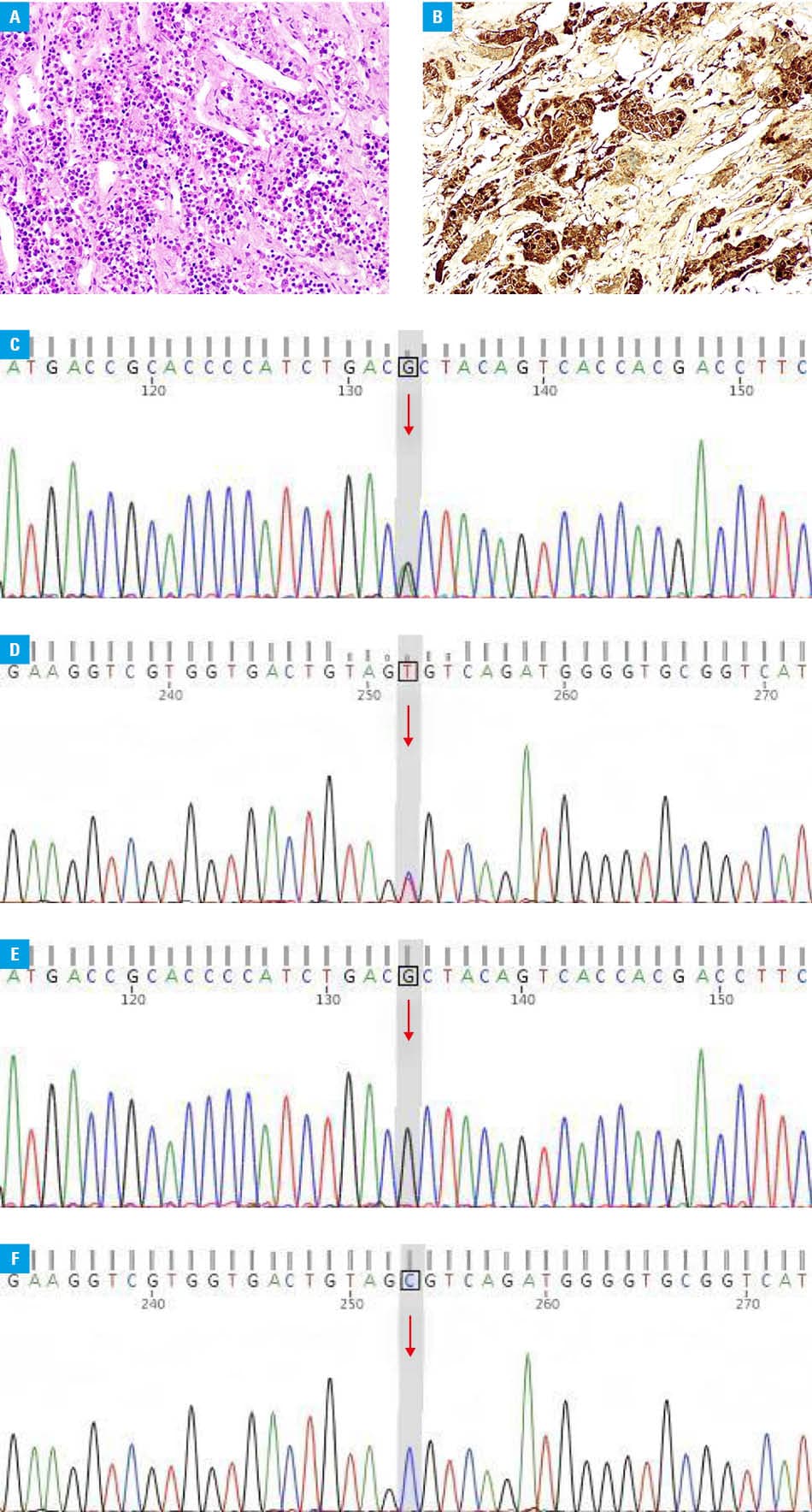
In October 2022, the patient underwent total thyroidectomy. Postoperative pathology confirmed PTC in the left lobe (BRAF-negative) and micropapillary thyroid carcinoma in the right lobe (BRAF-positive). We performed whole‑exome sequencing on the patient, which showed mutations in the cadherin‑23 (CDH23) gene (c.982G>A) and the multiple endocrine neoplasia type 1 (MEN1) gene (c.1508G>A; Figure 1C–1F).
CDH23-encoded cadherin plays a significant role in tumor invasion and metastasis. Variants in this gene constitute established risk factors for both familial and sporadic pituitary adenomas, with documented CDH23 mutations in patients with CS. Notably, these mutations demonstrate positive correlations with pituitary adenoma invasiveness and maximal tumor diameter. Currently, no clinical evidence links CDH23 to PTC. Intriguingly, thyroid tumor co‑occurrence is observed in a minority of MEN1 cases, with literature reporting PTC in 4.7% of individuals with MEN1 mutations.1 These concurrent genetic alterations may represent plausible pathogenic mechanisms underlying the co‑manifestation of CCS and synchronous primary PTC in our patient, though the precise molecular interplay warrants further mechanistic investigation.
Diagnosing CCS is challenging because of periodic fluctuations in cortisol levels,2 and abnormal results of dexamethasone suppression tests may lead to misdiagnosis.3 This case underscores the challenges in diagnosing and treating CCS. It is crucial for clinicians to carefully screen and, when necessary, repeat tests to ensure an accurate diagnosis. Given the high recurrence rate of CCS and the need for further exploration of the pathogenicity of CDH23 and MEN1 mutations,4,5 we plan to conduct long‑term follow‑up of this patient.
- Yoshimoto K, Saito S. Clinical characteristics in multiple endocrine neoplasia type 1 in Japan: a review of 106 patients [in Japanese]. Nihon Naibunpi Gakkai Zasshi. 1991; 67: 764‑774. | Crossref
- Nowak E, Vogel F, Albani A, et al. Diagnostic challenges in cyclic Cushing’s syndrome: a systematic review. Lancet Diabetes Endocrinol. 2023; 11: 593‑606. | Crossref
- Jahandideh D, Swearingen B, Nachtigall LB, et al. Characterization of cyclic Cushing’s disease using late night salivary cortisol testing. Clin Endocrinol (Oxf). 2018; 89: 336‑345. | Crossref
- Chakrabarti J, Pandey R, Churko JM, et al. Development of human pituitary neuroendocrine tumor organoids to facilitate effective targeted treatments of Cushing’s disease. Cells. 2022; 11: 3344. | Crossref
- Zhang Q, Peng C, Song J, et al. Germline mutations in CDH23, encoding cadherin‑related 23, are associated with both familial and sporadic pituitary adenomas. Am J Hum Genet. 2017; 100: 817‑823. | Crossref
ARTICLE INFORMATION