

 CC BY 4.0
A 29‑year‑old woman presented with severe chest pain accompanied by facial droop and dysarthria. She was an active smoker with a history of arterial hypertension. She denied drug abuse and had not given birth within the past year. Upon admission, she required nitroglycerin infusion for blood pressure control and intravenous loop diuretics for pulmonary congestion. Electrocardiography showed sinus tachycardia. Transthoracic echocardiography (TTE) demonstrated markedly decreased (by 20%) left ventricular ejection fraction (LVEF) with 2 thrombi in the LV (Figure 1A). Laboratory findings included leukocytosis, moderate anemia (hemoglobin, 9.2 g/dl; reference range [RR], 12–16 g/dl), elevated N‑terminal pro–B‑type natriuretic peptide (18 538 pg/ml; RR <125 pg/ml), and increased high‑sensitivity cardiac cardiac troponin T levels (852 ng/l; RR <14 ng/l). Inflammatory markers were negative. Coronary computed tomography (CT) angiography showed normal vascular anatomy. Cardiac magnetic resonance (CMR) imaging confirmed the presence of LV thrombi and reduced LVEF (Figure 1B). Additionally, CMR detected new ischemic injury in the apex and adjacent segments, along with global myocardial fibrosis of the LV (Figure 1C–1F). Brain MR imaging identified multiple acute and subacute ischemic lesions distributed across various vascular territories (Figure 1G). Following clinical stabilization, the patient developed abdominal pain. Abdominal CT showed multiple splenic and right kidney infarctions (Figure 1H). A thromboembolic etiology for these numerous complications was suspected, particularly as subsequent TTE demonstrated only 1 remaining LV thrombus. Given the multiple thrombotic events, therapeutic‑dose low‑molecular‑weight heparin was initiated alongside guideline‑directed heart failure (HF) therapy. Follow‑up CMR after 3 weeks of hospitalization showed resolution of LV thrombi and a notable improvement in LVEF at 35%. Anticoagulation was changed to apixaban (5 mg twice daily). The patient was discharged in a stable condition. During ambulatory follow‑up, coagulation and autoimmune disorders were excluded. Genetic testing showed no known cardiomyopathy variants. Follow‑up TTE after 3 months indicated significant improvement of LVEF up to 50%.
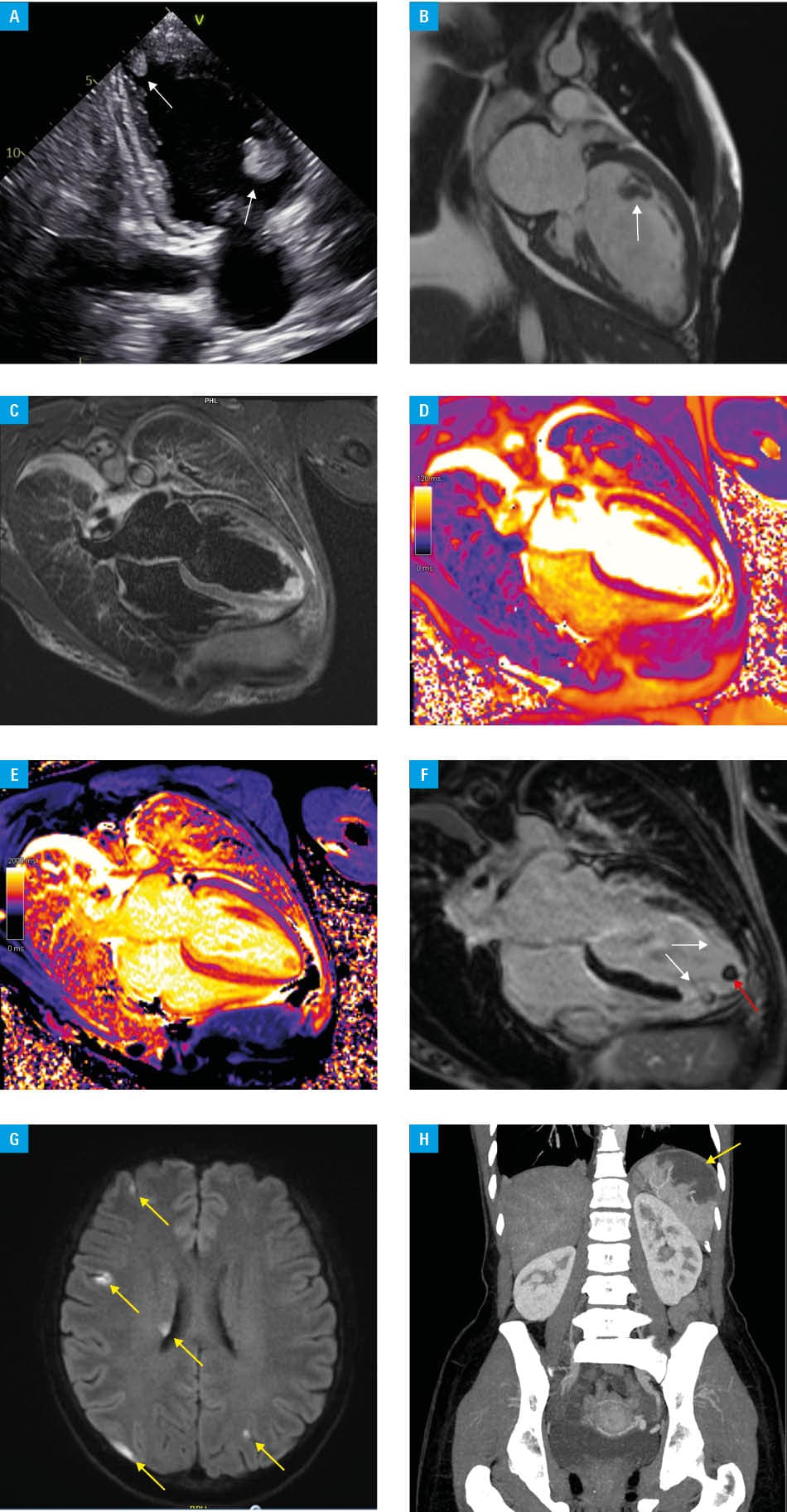
HF is a clinical syndrome resulting from structural or functional cardiac disorders.1 Although typically associated with older adults, young patients can develop HF due to various etiologies. Common causes include congenital heart defects, cardiomyopathies (including peripartum cardiomyopathy), and myocarditis.2 Additional factors involve lifestyle choices, substance abuse, and Takotsubo syndrome.2 Patients with HF with reduced EF (HFrEF) face an increased thromboembolic risk, as demonstrated in numerous studies.3 LV thrombus represents a serious complication of HFrEF. Predisposing factors include severe systolic dysfunction, ischemic HF etiology, and akinesis of the apex and anterior walls.4 Patients with LV thrombus have a higher risk of thromboembolism and long‑term mortality, making anticoagulation with heparin or vitamin K antagonists the standard of care.4 While all patients with HFrEF require guideline‑directed medical therapy, identifying the underlying cause is crucial for initiating targeted treatment and optimizing cardiac function recovery.1,5 In this case, the most probable cause appears to be previous myocarditis presenting without overt edema but with residual myocardial fibrosis.
- Kamsani S, Sanders P. The fraction we know: heart failure phenotypes and their clinical outcomes. Pol Arch Intern Med. 2023; 133: 16 630. | Crossref
- Domengé O, Fayol A, Ladouceur M, et al. Trends in prevalence of major etiologies leading to heart failure in young patients: an integrative review. Trends Cardiovasc Med. 2024; 34: 80‑88. | Crossref
- Shantsila E, Lip GY. Thrombotic complications in heart failure: an underappreciated challenge. Circulation. 2014; 5: 387‑389. | Crossref
- Weinsaft JW, Kim HW, Shah DJ, et al. Detection of left ventricular thrombus by delayed‑enhancement cardiovascular magnetic resonance prevalence and markers in patients with systolic dysfunction. J Am Coll Cardiol. 2008; 52: 148‑157. | Crossref
- Mizia‑Stec K, Burchardt P, Mazurkiewicz Ł, et al. Position statement of Polish Cardiac Society experts on cardiomyopathy. Kardiol Pol. 2024; 82: 1040‑1053. | Crossref
ARTICLE INFORMATION