
Paramedic-performed multiorgan ultrasound suggestive of acute pulmonary embolism in the prehospital setting


 CC BY-NC-SA 4.0
Paramedic-performed multiorgan ultrasound suggestive of acute pulmonary embolism in the prehospital setting
CC BY-NC-SA 4.0
In the prehospital setting, managing hemodynamic instability requires rapid assessment, immediate targeted interventions, and timely transport to definitive care.1,2 Since ultrasound technology became widely available, specific, goal‑directed ultrasound examinations in the initial evaluation of critically ill patients have been shown to facilitate rapid diagnosis of nontraumatic causes of hypotension.3-5 Point‑of‑care ultrasound (POCUS) allows paramedics to quickly diagnose patients, implement targeted treatment, and allocate resources appropriately.
A 2‑person emergency medical team was urgently dispatched to assist a 75‑year‑old man experiencing severe shortness of breath. His main complaints were severe dyspnea and swelling of the lower extremities. The patient had reported symptoms of infection, including cough and fever, for 4 days, and was prescribed empirical antibiotic therapy. He had a history of arterial hypertension, chronic heart failure, deep vein thrombosis, and implantation of an artificial mitral valve (with chronic anticoagulant therapy) and a cardiostimulator.
Upon physical examination, the patient’s respiratory rate was 35 breaths per minute, with an oxygen saturation of 67% and markedly increased respiratory effort. Auscultation showed symmetrical wheezes and rales over the lungs. His heart rate was 120 bpm and the blood pressure was 70/30 mm Hg. His skin was pale and damp. The Glasgow Coma Scale score was 15. Electrocardiography showed sinus tachycardia at 120 bpm and incomplete right bundle branch block.
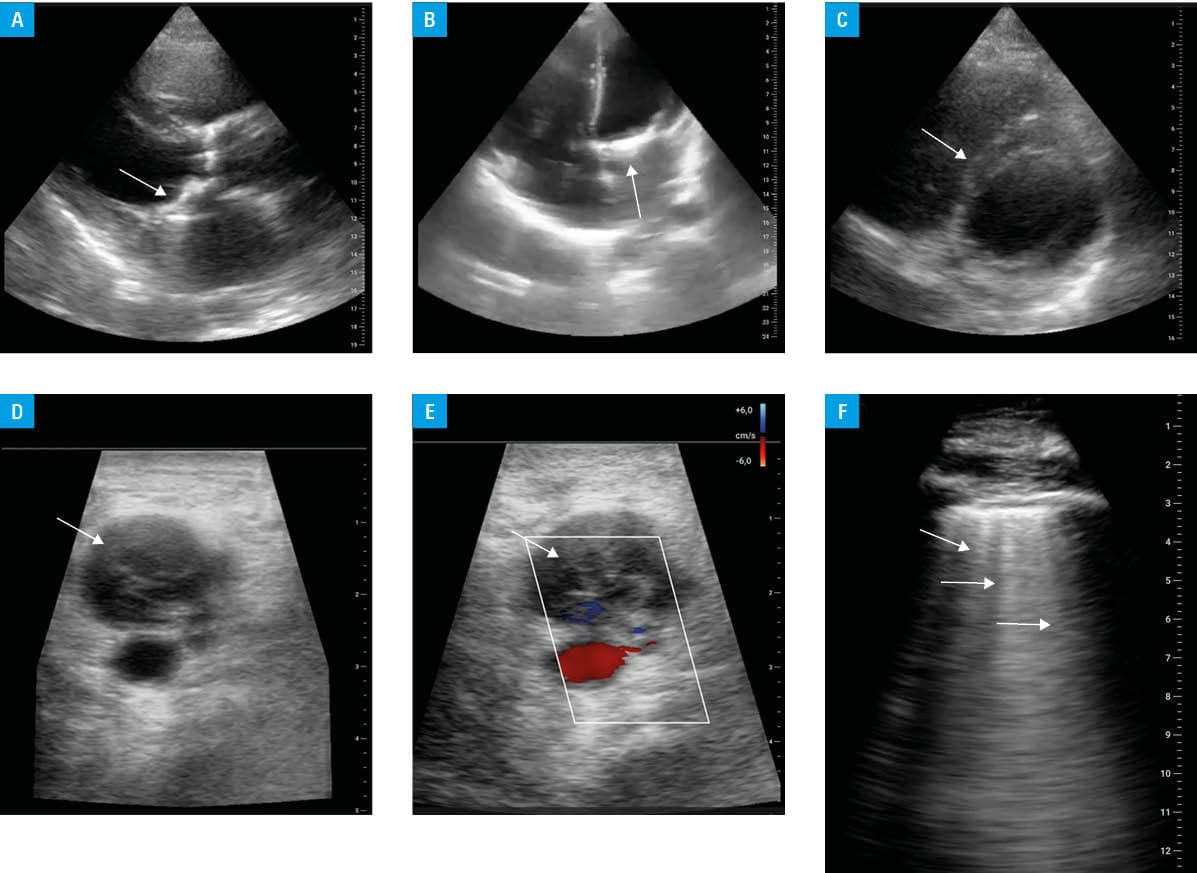
The ambulance was equipped with a portable handheld US machine.Preliminary US examination was performed by the paramedics. The POCUS examination included echocardiographic assessment, 3‑point venous compression US test, and 6‑point lung US. Echocardiography identified a mechanical artificial valve in the mitral position (Figure 1A and 1B), right ventricular dilatation (Figure 1B), and features indicative of right‑sided heart overload, including the D‑sign (Figure 1C) and vena cava plethora. Deep vein US showed an immobile, hyperechoic structure within the lumen of the right popliteal vein (Figure 1D). Color Doppler examination of the area showed no blood flow (Figure 1E). Lung US demonstrated symmetrical pleural sliding, numerous B‑lines in the basal lung regions (Figure 1F), and several small subpleural consolidations on the left. Based on the POCUS imaging, the paramedics suggested acute pulmonary embolism, secondary to right popliteal vein thrombosis.
The prehospital therapeutic management included anticoagulation with unfractionated heparin and administration of noradrenaline. The patient was then transferred to the nearest hospital emergency department. Thirty minutes after admission, he experienced sudden cardiac arrest in the form of pulseless electrical activity and died despite the implementation of advanced resuscitation procedures and the use of fibrinolytic therapy. The autopsy confirmed the diagnosis of massive pulmonary embolism.
Due to its speed, portability, and safety, POCUS appears to be an ideal imaging technique for the initial evaluation of patients with severe dyspnea.5 This case illustrates how a multiorgan POCUS in the hands of paramedics may improve diagnostic accuracy and prehospital triage in critically ill patients.
- Quach JL, Downey AW, Haase M, et al. Characteristics and outcomes of patients receiving a medical emergency team review for respiratory distress or hypotension. J Crit Care. 2008; 23: 325‑331. | Crossref
- Holler JG, Bech CN, Henriksen DP, et al. Nontraumatic hypotension and shock in the emergency department and the prehospital setting, prevalence, etiology, and mortality: a systematic review. PLoS One. 2015; 10: e0119 331. | Crossref
- Lichtenstein D, Karakitsos D. Integrating lung ultrasound in the hemodynamic evaluation of acute circulatory failure (the fluid administration limited by lung sonography protocol). J Crit Care. 2012; 27: 533.e11‑533.e5.33E19. | Crossref
- Volpicelli G, Mussa A, Frascisco MF. Sonographic diagnosis of pulmonary embolism with cardiac arrest without major dilation of the right ventricle or direct sign of lower limb venous thrombosis. J Clin Ultrasound. 2012; 40: 529‑533. | Crossref
- Volpicelli G, Lamorte A, Tullio M, et al. Point‑of‑care multiorgan ultrasonography for the evaluation of undifferentiated hypotension in the emergency department. Intensive Care Med. 2013; 39: 1290‑1298. | Crossref
ARTICLE INFORMATION