


 CC BY-NC-SA 4.0
A 33‑year‑old white non‑smoking man with a history of seasonal rhinitis and nephrolithiasis presented to a district hospital with symptoms of upper respiratory tract infection, including fever, cough, syncope, and vomiting. Before admission, on an outpatient basis, he received an antibiotic, after which his symptoms worsened. Following the detection of elevated inflammatory markers and computed tomography (CT) imaging findings, the diagnosis of pneumonia was made. Second antibiotic therapy led to clinical improvement. After treatment, persistent dry cough remained. Additionally, CT showed nodules with perilymphatic distribution, lymphadenopathy of the mediastinum, hila, axillae, and epigastrium, as well as macular osteosclerotic lesions in the spine and sternum.
Subsequently, the patient was referred to a department of pulmonary diseases. On admission, he reported chronic dry cough only. No significant abnormalities were found on physical examination. In an in‑depth interview, the patient reported that a few years back, he observed an episode of erythema of the lower extremities, which resolved spontaneously. The symptoms could have corresponded to erythema nodosum.
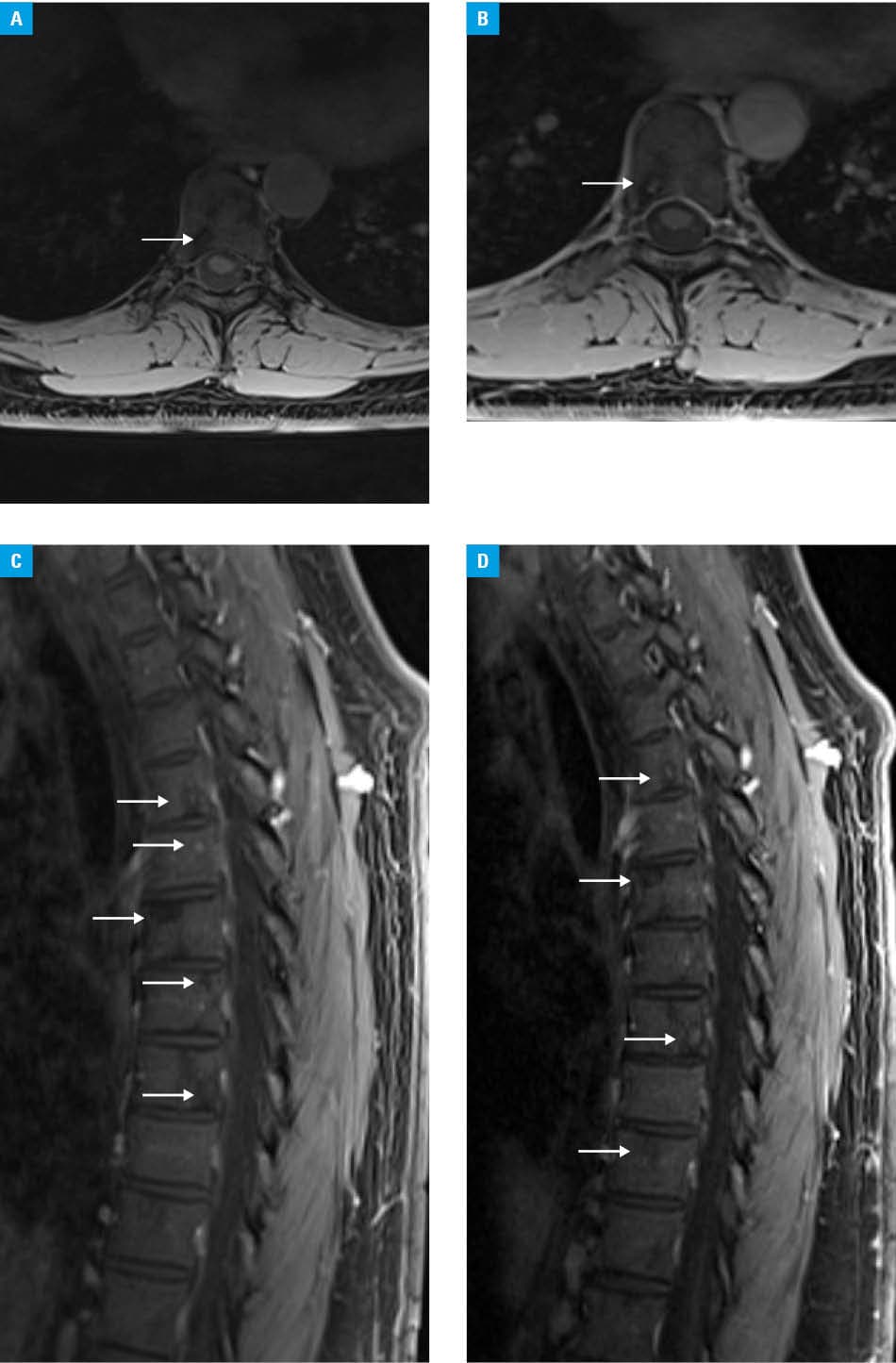
Laboratory test results showed no abnormalities. Control chest CT (after 1 month) identified partial regression of disseminated pulmonary lesions. Similarly to the previous examination, no enlarged mediastinal or hilar lymph nodes were found, axillary lymph nodes were equally enlarged (13–15 mm), and no suspicious lesions were observed in the bones. Magnetic resonance imaging showed thoracic vertebral bodies (Th5–Th11) with areas of heterogeneous marrow fat conversion, the largest in the Th5 body, and 2 small foci of weak contrast enhancement in the Th4 body (Figure 1A–1D). Due to the need to differentiate bone lesions from cancer metastases, testicular examination, abdominal ultrasound, proteinogram, and tumor marker assessment were performed, showing no abnormalities. No evidence of ventilatory impairment was detected in pulmonary function tests, and the lung transfer factor for carbon monoxide was within normal limits. In the 6‑minute walk test, the patient covered the required distance without desaturation. Bronchoscopy showed moderately intense inflammatory lesions (no pathogenic flora was cultured and tuberculosis test results were negative), and transbronchial lung biopsy was performed. The histopathologic examination showed fragments of the mucosa and stroma with noncaseating granulomas composed of epithelioid and giant cells. A diagnosis of stage III sarcoidosis with the involvement of the spine and sternum was made. Due to the spontaneous regression of the bone lesions and no other indications, treatment was not initiated. The patient was followed in an aoutpatient clinic.
Sarcoidosis of the bones is a rare manifestation of the systemic disease, usually associated with multiorgan involvement.1 Skeletal involvement occurs in about 3%–13% of sarcoidosis cases.2 The exact prevalence remains uncertain due to underreporting and a frequently asymptomatic course. Osseus sarcoidosis typically affects the hands, feet, long bones, and, less commonly, the axial skeleton.3 Symptoms vary widely, from localized pain to pathologic fractures. In unclear cases, positron emission tomography may be utilized, and in the cases requiring differentiation from a neoplastic etiology, bone biopsy may be necessary. The treatment of bone sarcoidosis is not definitively established, as in most cases it is part of a systemic disease that requires treatment due to involvement of other organs. Regression of lesions in the vertebrae, as in our case, is an extremely rare phenomenon.4 Long‑term monitoring is crucial due to potential complications, such as bone fragility.5
- Sparks JA, McSparron JI, Shah N, et al. Osseous sarcoidosis: clinical characteristics, treatment, and outcomes‑experience from a large, academic hospital. Semin Arthritis Rheum. 2014; 44: 371‑379. | Crossref
- Wilcox A, Bharadwaj P, Sharma OP. Bone sarcoidosis. Curr Opin Rheumatol. 2000; 12: 321‑330. | Crossref
- Błasińska K, Jędrych ME, Opoka L, et al. Imaging plays a key role in the diagnosis and control of the treatment of bone sarcoidosis. Biomedicines. 2023; 11: 1866. | Crossref
- Rahmouni S, Maatallah K, Ferjani H, et al. Spontaneous improvement of sarcoidosis mimicking a vertebral metastatic lesion: it’s indeed possible! Clin Case Rep. 2020; 8: 2423‑2428. | Crossref
- Caffarelli C, Cameli P, Al Refaie A, et al. Bone fragility and sarcoidosis: an underestimated relationship. Front Med.2022; 9: 1026028. | Crossref
ARTICLE INFORMATION