
Watermelon stomach and recurrent anemia in a patient with heart failure and permanent atrial fibrillation

 CC BY 4.0
Watermelon stomach and recurrent anemia in a patient with heart failure and permanent atrial fibrillation
CC BY 4.0
A 63‑year‑old woman with a 3‑year history of heart failure (HF) with mildly reduced ejection fraction was admitted to a hospital due to HF decompensation. Her medical history included permanent atrial fibrillation (AF), single‑chamber cardioverter‑defibrillator implantation for secondary prevention of sudden cardiac death, transient ischemic attack, arterial hypertension, and osteoarthritis. For AF, she was taking rivaroxaban 20 mg once daily.
On admission, laboratory tests showed elevated levels of N‑terminal pro–B‑type natriuretic peptide (368 pg/ml; reference range [RR], 0–125 pg/ml), as well as low levels of hemoglobin (4.7 mmol/l; RR, 7.75–10 mmol/l) and hematocrit (25%; RR, 36%–47%). Further testing indicated iron deficiency with total iron binding capacity of 61.9 µmol/l (RR, 40–80 µmol/l) and transferrin saturation of 3.2% (RR, 20%–55%). She required red blood cell (RBC) transfusion. Echocardiography demonstrated severe mitral and tricuspid regurgitation and left ventricular ejection fraction (LVEF) of 55% (Figure 1A). Coronary angiography ruled out obstructive coronary artery disease (Figure 1B and 1C), and cardiac magnetic resonance imaging showed late gadolinium enhancements of nonischemic type located intramurally in the inferior wall, focally at the junction of both ventricles, and linearly in the inferoseptal segment with LVEF of 43%.
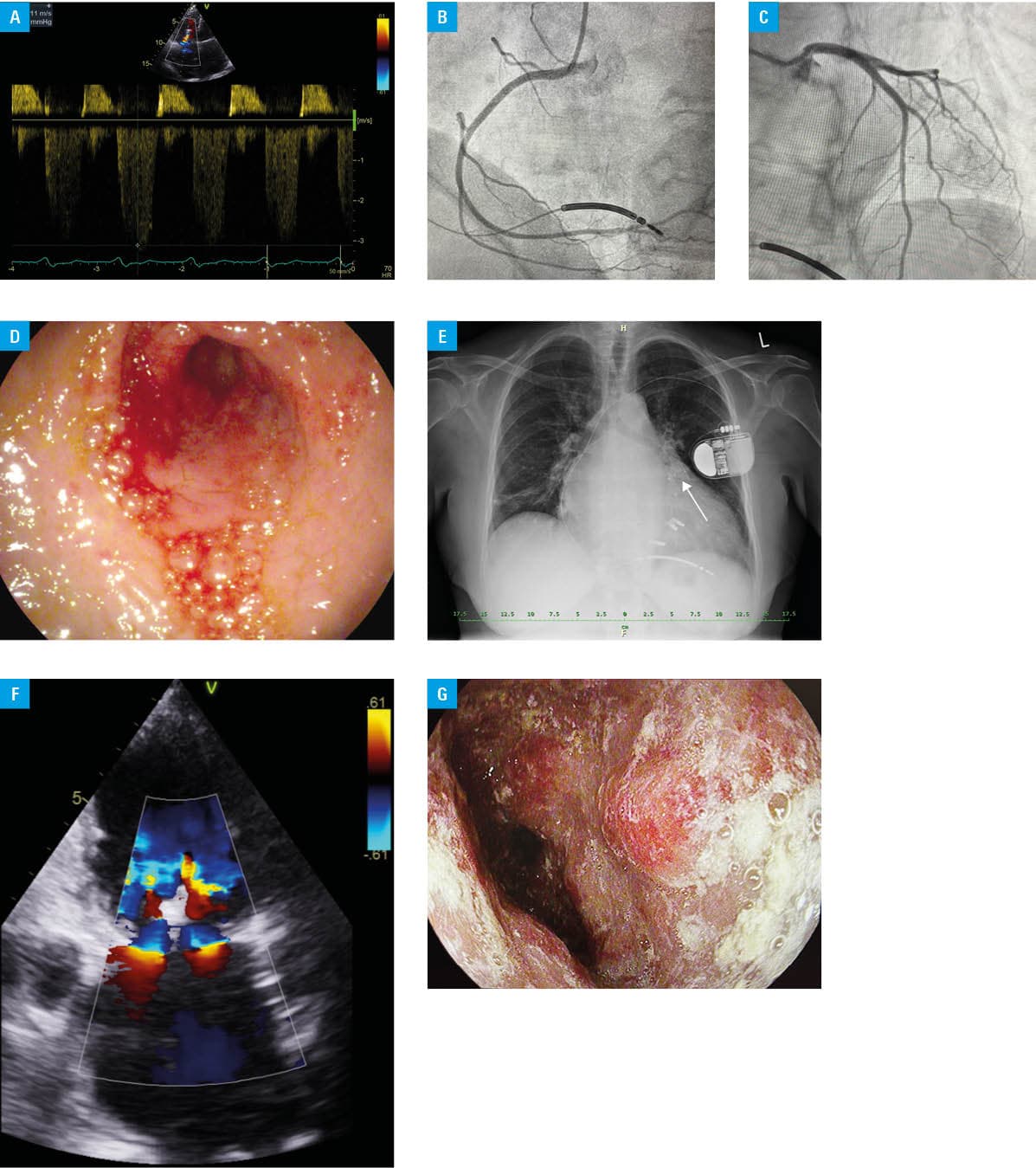
To extend the diagnosis of anemia, gastroscopy was performed showing gastric antral vascular ectasia (GAVE; Figure 1D). Given the decreasing hemoglobin level during hospitalization, massive blood transfusion (8 units of packed RBCs) and 2 procedures of endoscopic argon plasma coagulation (APC) were performed. Rivaroxaban was changed to acenocoumarol.
Three months later, due to recurrent bleeding during the necessary continuous anticoagulation, left atrial appendage closure (LAAC) was performed, allowing for the implementation of dual antiplatelet therapy with clopidogrel 75 mg and acetylsalicylic acid (ASA) 75 mg once daily in place of acenocumarol.
Due to severe mitral regurgitation and persistent symptoms of HF despite correcting the anemia, the patient underwent MitraClip (Abbott Vascular, Santa Clara, California, United States) implantation (Figure 1E and 1F). In the course of hospitalization, progressive anemia and tarry stools were observed, hence, after a gastroenterologic consultation, clopidogrel was discontinued and ASA 75 mg was maintained in monotherapy. Six months later, follow‑up gastroscopy identified diffuse submucosal hemorrhages. Due to this finding and reoccurring gastrointestinal bleedings, ASA was changed to clopidogrel 75 mg once daily (monotherapy). One year later, the patient reported again with a low hemoglobin level (5.6 mmol/l) without apparent gastrointestinal bleeding. During gastroscopy, 4 bands were placed in the antrum, encompassing the mucosa along with vascular malformations (Figure 1G).
In the following months, the patient was hospitalized repeatedly in gastroenterology and cardiology departments. She required further RBC transfusions and intensification of loop diuretic therapy due to HF exacerbations. Collectively, 5 APCs and 4 endoscopic bandings were performed.
GAVE syndrome, also known as watermelon stomach, is a rare but significant cause of recurring gastrointestinal bleedings in the elderly.1,2 Potential underlying causes of GAVE in the presented patient may have been chronic HF‑related vascular congestion, long‑term anticoagulation, and comorbidities, such as hypertension and age‑related vascular fragility, all of which could contribute to mucosal vulnerability and recurrent bleeding. Treatment involves the APC procedure, which often needs to be repeated.3 GAVE may be asymptomatic and is often associated with other conditions, therefore requiring a multidisciplinary approach.4 To our knowledge, this is the first case demonstrating the use of multiple interventional techniques, including LAAC, as a mean to avoid long‑term anticoagulation in a patient at a high risk of recurrent gastrointestinal bleeding due to GAVE.
- Selinger CP, Ang YS. Gastric antral vascular ectasia (GAVE): an update on clinical presentation, pathophysiology and treatment. Digestion. 2008; 77: 131‑137. | Crossref
- Fuccio L. Diagnosis and management of gastric antral vascular ectasia. WJGE. 2013; 5: 6. | Crossref
- Boltin D, Gingold‑Belfer R, Lichtenstein L, et al. Long‑term treatment outcome of patients with gastric vascular ectasia treated with argon plasma coagulation. Eur J Gastroenterol Hepatol. 2014; 26: 588‑593. | Crossref
- Ito Y. Gastric antral vascular ectasia manifesting as refractory anemia. J Gen Fam Med. 2024; 26: 171‑172. | Crossref
ARTICLE INFORMATION