
Refractory ascites and multinodular systemic involvement led to the discovery of an exceptional multivisceral form of vascular epithelioid tumor associated with the EWSR1::NFATC2 rearrangement


 CC BY-NC-SA 4.0
Refractory ascites and multinodular systemic involvement led to the discovery of an exceptional multivisceral form of vascular epithelioid tumor associated with the EWSR1::NFATC2 rearrangement
CC BY-NC-SA 4.0
Internists frequently face complex diagnostic challenges that demand interdisciplinary collaboration. Interactions with pathologists and laboratory specialists often yield essential insights. While initial investigations typically begin locally, particularly rare or atypical cases may require referral to national expert networks. We present a case of a multivisceral epithelioid vascular tumor associated with an EWSR1::NFATC2 gene fusion, illustrating the critical role of broad collaborative efforts in reaching a definitive diagnosis.
A 39‑year‑old woman was evaluated at a gastroenterology clinic for elective cholecystectomy. Her medical history included childhood allergic asthma managed with antihistamines, inhaled corticosteroids, bronchodilators, and leukotriene receptor antagonists. Hepatic focal nodular hyperplasia (FNH) had been incidentally discovered 5 years earlier. The family history was notable for metastatic testicular cancer in her brother and uterine cancer in several maternal relatives. She was a single mother of 3, employed in retail, and a former smoker (21 pack‑years), with no other substance use reported.
During laparoscopy, a surgeon noted multiple millimetric retractive nodules on the parietal peritoneum and several hepatic retractions. The procedure was converted to laparotomy, during which cholecystectomy, along with liver and peritoneal biopsies, was performed. Liver histology showed preserved architecture with numerous small vascular cavities, mild fibrosis, and lymphoid aggregates with regular endothelial lining, and no evidence of proliferation, consistent with FNH. Peritoneal histology identified small areas of fibrous thickening, richly vascularized and associated with lymphoid aggregates, interpreted as nonspecific fibrocongestive nodules. Hepatic magnetic resonance imaging confirmed FNH involution, but identified multiple pseudonodular infiltrative hepatic lesions. Thoracoabdominal computed tomography (CT) showed diffuse hepatic parenchymal changes and extensive osteosclerotic lesions in the spine, scapulae, pelvis, and femurs. Positron emission tomography (PET)-CT demonstrated low metabolic activity in most lesions, with mild hypermetabolism in the ninth thoracic vertebra and pelvis, along with focal hepatic uptake. Routine blood test, tumor markers, and viral serologies were unremarkable. The mammogram was normal. The patient, asymptomatic, was lost to follow‑up before undergoing planned CT‑guided bone biopsy.
Two years later, the patient presented to an emergency department with progressive abdominal distension, showing abundant ascites. Her general condition remained good, and she reported no additional symptoms. No signs of decompensated cirrhosis were found on physical examination. Paracentesis yielded hemorrhagic, sterile ascitic fluid without cytological abnormalities. Updated imaging, including thoracoabdominal CT and PET‑CT scans, identified the same previously described nodular lesions, which remained minimally hypermetabolic and exhibited little progression in size or number (Figure 1A–1D).
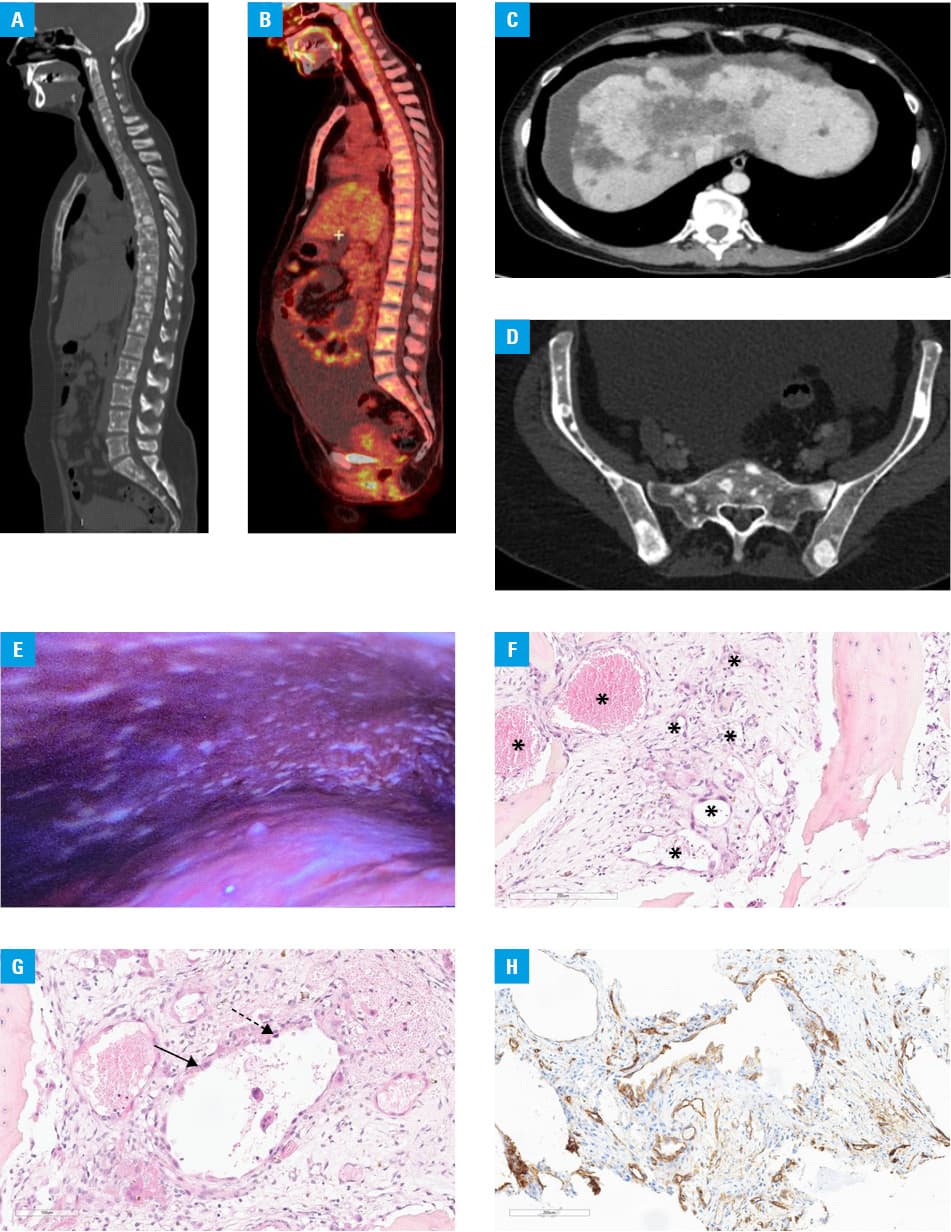
Transjugular liver biopsy showed normal architecture, devoid of neoplasms or granulomas, with centrilobular sinusoidal dilation. Simultaneous hepatic catheterization confirmed portal hypertension. Multidisciplinary assessment concluded a diagnosis of noncirrhotic portal hypertension, likely due to the pseudo‑Budd–Chiari syndrome from extrinsic hepatic vein compression by nodules and peritoneal involvement. Extensive laboratory evaluation remained inconclusive.
Exploratory laparoscopy showed inflammatory peritoneal nodularity (Figure 1E). Peritoneal biopsies identified fibrous remodeling with minimal inflammation and associated capillary hyperplasia, interpreted as reactive changes following a consultation with a national expert. Multiple CT‑guided bone biopsies were nondiagnostic due to crush artifacts. Concurrently, recurrent ascites was managed with high‑dose diuretics, which proved ineffective, leading to the placement of a transjugular intrahepatic portosystemic shunt that also failed to alleviate the condition, ultimately necessitating iterative large‑volume paracenteses.
Following a multidisciplinary imaging review, third transjugular liver biopsy under ultrasound guidance showed extramedullary hematopoiesis, in addition to previously noted lesions. This prompted blind posterior iliac bone marrow biopsy, demonstrating numerous vessels between bone trabeculae, often lined with epithelioid endothelial cells with abundant eosinophilic cytoplasm, sometimes with nuclear atypia as hyperchromatic nucleus, and endothelial markers, such as cluster of differentiation 31 on immunohistochemical staining of vessels (Figure 1F–1H).
After further discussion with the pathology team, the case was presented at a national rare bone tumor multidisciplinary board. Although angiosarcoma was considered, clinical and imaging findings were inconsistent with that diagnosis. Ultimately, a peritoneal tissue sample was sent to the molecular pathology laboratory at Léon Bérard Cancer Center, where a novel next‑generation sequencing on formalin‑fixed tissue identified an EWSR1::NFATC2 gene fusion, confirming an exceptional multivisceral form of epithelioid vascular tumor.
The patient exhibited extensive yet indolent hepatic, peritoneal, and osseous involvement that remained elusive despite multiple investigations, including repeated biopsies. Collaborative discussions with hepatologists, radiologists, orthopedists, and pathologists ultimately redirected diagnostic efforts toward vascular etiology. Involvement of a national expert network and a specialized molecular pathology laboratory enabled the final diagnosis through the identification of a rare gene fusion.
Epithelioid vascular tumors are exceedingly rare and diagnostically challenging due to nonspecific histopathological features, particularly in indolent forms. The advent of next‑generation sequencing has redefined the nosology of these tumors by uncovering recurrent genetic alterations. The most recent World Health Organization classification1 of bone and soft tissue tumors incorporates molecular signatures into diagnostic criteria, underscoring the role of genomics in characterizing ambiguous proliferative lesions.
Tumors harboring EWSR1::NFATC2 fusions exhibit a wide spectrum of morphologies and behaviors, from vascular malformations and hemangiomas to epithelioid vascular tumors, bone cysts, and round‑cell sarcomas.2-4 Due to the rarity of this condition, therapeutic options are based on limited evidence and guided by disease extent and aggressiveness, ranging from surveillance to surgery, radiotherapy, chemotherapy, or targeted therapy.5
Molecular analyses have revolutionized both the classification and diagnostic approach to atypical cellular proliferations in internal medicine, such as histiocytosis. In diagnostically challenging cases, high‑throughput sequencing enhances diagnostic accuracy and may facilitate recognition of novel disease entities, as exemplified by the discovery of VEXAS syndrome.
This case underscores the critical importance of multidisciplinary collaboration, particularly with pathologists and molecular biology experts, in resolving complex diagnostic challenges.
Neoplasms with EWSR1::NFATC2 fusions encompass a heterogeneous group, including epithelioid vascular tumors that may follow an indolent clinical course. Molecular diagnostics plays a pivotal role in their identification and classification.
- International Agency for Research on Cancer. Soft tissue and bone tumors. In: WHO Classification of Tumours. 5th ed. Lyon, France; 2020: 321‑336.
- Brcic I, Scheipl S, Bergovec M, et al. Implementation of copy number variations‑based diagnostics in morphologically challenging EWSR1/FUS::NFATC2 neoplasms of the bone and soft tissue. Int J Mol Sci. 2022; 23: 16196. | Crossref
- Dashti NK, Dickson BC, Zhang L, et al. A unique epithelioid vascular neoplasm of bone characterized by EWSR1 FUS‐NFATC1/2 fusions. Genes Chromosomes Cancer. 2021; 60: 762‑771. | Crossref
- Ong SLM, Lam SW, Van Den Akker BEWM, et al. Expanding the spectrum of EWSR1‑NFATC2‑rearranged benign tumors: a common genomic abnormality in vascular malformation / hemangioma and simple bone cyst. Am J Surg Pathol. 2021; 45: 1669‑1681. | Crossref
- Tortorelli I, Bellan E, Chiusole B, et al. Primary vascular tumors of bone: a comprehensive literature review on classification, diagnosis and treatment. Crit Rev Oncol Hematol. 2024; 195: 104268. | Crossref
ARTICLE INFORMATION