


 CC BY-NC-SA 4.0
Fever of unknown origin (FUO) is defined as a body core temperature above 38.3 °C for at least 3 weeks during 3 outpatient evaluations, 1 week of intensive outpatient investigation, or 3 days of inpatient workup.1 Three etiologies need to be explored, including infections, malignancies, and autoimmune conditions. Giant cell arteritis (GCA) is a type of vasculitis affecting medium and large vessels, primarily observed in patients above the age of 50 years. It most commonly affects carotid artery branches, specifically the temporal artery. Extracranial GCA needs a higher level of suspicion due to the absence of the well‑known symptoms of cranial GCA.2 We present a challenging case of diagnosing FUO in a 64‑year‑old woman.
A 64‑year‑old black woman presented with fever, nausea, reduced oral intake, and abdominal pain, symptoms she had been experiencing for a week. Her past medical history included irritable bowel syndrome. Upon admission, she was frail, tachycardic (105 bpm), and febrile (38.5 °C). Physical examination was unremarkable, except for generalized abdominal tenderness without rigidity or rebound tenderness.
Initial laboratory tests showed leukocytosis (white blood cell count, 12.8 × 10⁹/l; reference range [RR], 4–11 × 109/l), thrombocytosis (platelet count, 461 × 109/l; RR, 140–400 × 109/l), anemia (hemoglobin, 9.2 g/l; RR, 12.1–15.1 g/l), and a C‑reactive protein (CRP) level of 273 mg/l (RR <3 mg/l) with transaminitis. Urgent contrast‑enhanced computed tomography (CT) of the abdomen and pelvis was performed, identifying mild sigmoid colon wall edema along with fat stranding and minimal free fluid. The patient was admitted as a case of infectious colitis. Stool workup eventually came back negative. Sigmoidoscopy was normal. Sigmoid biopsy came back unremarkable.
One week after admission, there was no improvement in the clinical status or inflammatory markers, even though the patient had been receiving antibiotics for 5 days. Transthoracic echocardiogram showed no vegetations. Possible autoimmune etiology was investigated. Erythrocyte sedimentation rate (ESR) was elevated at 115 mm/hour (RR, 0–20 mm/h), but her autoimmune panel was negative, ruling out most of microvasculitis pathologies (Supplementary material, Table S1). Extensive infectious workup was unremarkable.
Contrast‑enhanced CT of the thorax and neck was performed, but did not identify any lymphadenopathies. Myeloma workup was negative (Supplementary material, Table S1). Bone marrow biopsy, flow cytometry, and culture were unremarkable.
Upon further review of the CT images of the abdomen and pelvis (Figure 1A) and a discussion with an expert vascular radiologist, a mild circumferential thickening of the wall of the abdominal aorta extending to the root of the celiac and mesenteric arteries was noted. The image was not typical of atheromatous lesions and raised a suspicion of large vessel vasculitis. Magnetic resonance angiography (MRA) of the aorta was advised. Infectious causes of aortitis, including syphilis, tuberculosis, and salmonella, had already been ruled out (Supplementary material, Table S1).
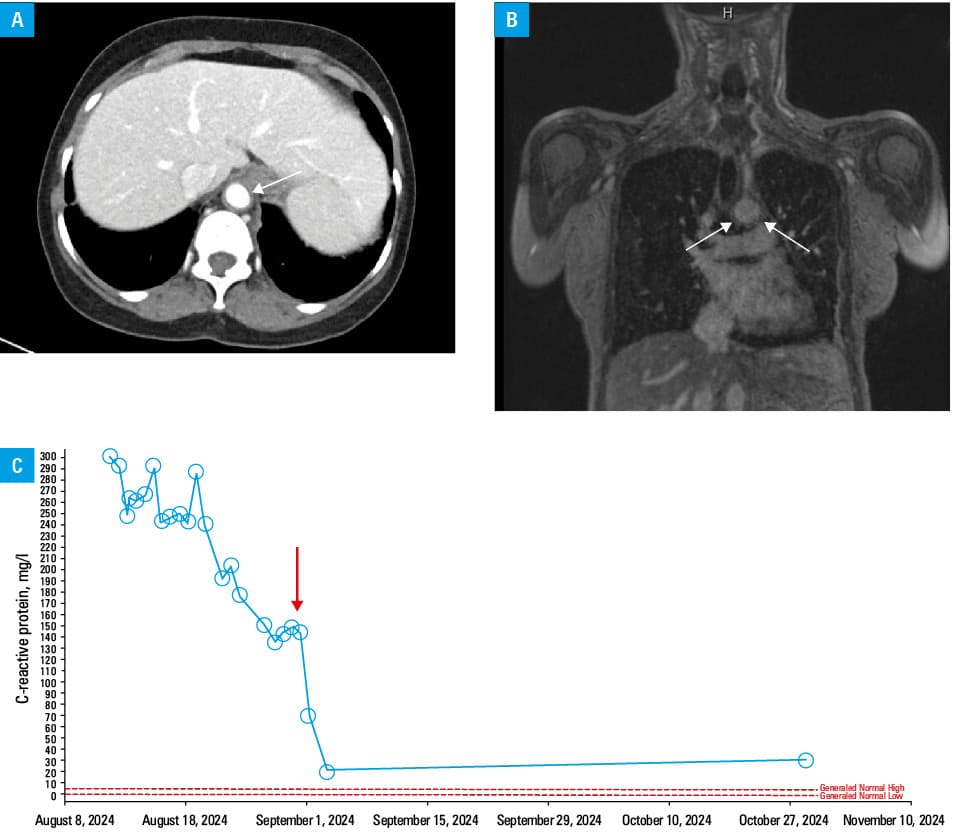
MRA identified uniform mural thickening of the aortic arch and the thoracic aorta, with extension into the root of the arch vessels (Figure 1B). A diagnosis of extracranial GCA was established. Temporal artery ultrasound (TA‑US) showed normal diameters. No obvious halo was noted bilaterally.
The patient was commenced on pulse steroids (1 gram of methylprednisolone). Within 3 days, a marked improvement, supported by laboratory test results, was observed clinically (Figure 1C). Her fever finally resolved after 3 weeks. The patient was discharged on a tapering dose of prednisolone. She was followed‑up in a rheumatology clinic 2 months later. She was asymptomatic and her laboratory test results were normal.
FUO is challenging and exhausting to patients, direct care physicians, and health care resources, requiring extensive workup and ultimately 18F‑fluorodeoxyglucose positron emission tomography (18F‑FDG‑PET) if diagnosis is not established. Financial burden on the patient and the health care system is another aspect which highlights the importance of appropriate patient workup and timely diagnosis.3
Historically, GCA was thought to only be confined to cranial arteries; however, it may also affect large arteries. Large vessel arteritis, also known as extracranial GCA, usually presents differently from cranial GCA.4
The 2022 American Congress of Rheumatolofy / European League Against Rheumatism (ACR/ EULAR) GCA classification criteria are the most updated diagnostic criteria for GCA. Patients need to be above the age of 50 years and score 6 points or more for diagnosis.5 Our patient only scored 3 points on account of elevated ESR (115 mm/h) and CRP level (273 mg/l). Although the sensitivity of the ACR/EULAR GCA classification for isolated cranial GCA is as high as 96.4%, for isolated extracranial GCA, it is only 62.2%. This is important to note, as a large subset of patients presenting with isolated extracranial GCA, as in our case, may be incorrectly diagnosed due to low scores.
Temporal artery biopsy (TAB) showing mononuclear cell infiltrates or granulomas is the gold standard for diagnosing GCA. While it is highly specific, its sensitivity has reduced over the years. TA‑US showing homogenous, hypoechoic wall thickening of the temporal artery, referred to as the “halo sign” is a diagnostic modality equivalent to Tab. In our case, the patient did not have it.4 Our patient did not demonstrate any clinical signs of temporal artery involvement and preferred to avoid any invasive procedures. Hence, the decision against TAB was made after extensive discussion with the patient and her family. MRA showing extension into the aortic arch and its roots without involvement of the carotid artery branches was helpful, and the patient was discharged without performing Tab.
Large vessel angiography has become an increasingly common diagnostic tool, especially useful in diagnosing extracranial GCA. Angiography can be helpful in up to 67% of patients with or without a positive TAB, while 18F‑FDG‑PET is positive in up to 83% of patients.4 Our patient had remarkable findings on contrast‑enhanced CT and MRA. Her good response to steroids, (cessation of the fever and a marked reduction of the CRP level 2 months after discharge) provided further proof that her diagnosis was accurate.
Patients with isolated extracranial GCA presenting with nonspecific constitutional symptoms may not be appropriately diagnosed and consequently fail to receive adequate treatment. This emphasizes the need to have a high clinical suspicion index, utilizing multidisciplinary approach and sophisticated imaging modalities to improve patient care in complex cases of FUO.
- Wright WF, Mulders‑Manders CM, Auwaerter PG, et al. Fever of unknown origin (FUO) ‑ a call for new research standards and updated clinical management. Am Med. 2021; 135: 173‑178. | Crossref
- Wurmann P, Karsulovic C, Sabugo F, et al. Cranial versus extracranial involvement in giant cell arteritis: 15 years retrospective cohort analysis. Open Access Rheumatol. 2022; 14: 97‑101. | Crossref
- Nakayo EB, Vicente AG, Castrejónn AS, et al. Analysis of cost‑effectiveness in the diagnosis of fever of unknown origin and the role of 18F‑FDG PET‑CT: a proposal of diagnostic algorithm. Rev Esp Med Nucl Imagen Mol. 2012; 31: 178‑186. | Crossref
- Gribbons KB, Ponte C, Craven A, et al. Diagnostic assessment strategies and disease subsets in giant cell arteritis: data from an international observational cohort. Arthritis Rheumatol. 2020; 72: 667‑676. | Crossref
- Molina‑Collada J, Castrejón I, Monjo I, et al. Performance of the 2022 ACR/EULAR giant cell arteritis classification criteria for diagnosis in patients with suspected giant cell arteritis in routine clinical care. RMD Open. 2023; 9: e002970. | Crossref
SUPPLEMENTARY MATERIAL
ARTICLE INFORMATION