

 CC BY 4.0
Immune thrombocytopenia (ITP) is a hematological disorder caused by immune system dysfunction, resulting in low platelet (PLT) count and bleeding into the skin and mucous membranes. Approximately 20%–30% of ITP cases are secondary, associated with various conditions, such as systemic connective tissue diseases, lymphomas, infections, drugs, or genetic factors. Notably, infections with viruses, such as hepatitis C virus (HCV), HIV, Epstein–Barr virus, or cytomegalovirus, are its known triggers.1 Clinicians should also consider rare bacterial causes of secondary ITP, as treatment of secondary ITP differs from that of primary ITP, and accurate diagnosis is crucial to prevent complications.2
We present a case of a 65‑year‑old woman with schizophrenia, admitted to a department of infectious diseases after 10 days of fever up to 39 °C and persistent headache. She denied recent travel or contact with sick individuals. Laboratory tests showed leukocytosis with neutrophilia, elevated C‑reactive protein (112 mg/l; reference range [RR], 0–5 mg/l), and increased alanine transaminase (119 U/l; RR, 10–35 U/l). Chest X‑ray and urine tests were normal. SARS‑CoV‑2, influenza, and RSV swabs were negative.
On admission, the patient was stable, conscious, and oriented, without meningeal or skin signs. She reported dull headache (4/10 on the Numerical Rating Scale). Computed tomography of the head, chest, abdomen, and pelvis identified only nonspecific changes (fibronodular lesions in lung apices and cerebrovascular lesions). Lumbar puncture showed lymphocytic meningitis: cerebrospinal fluid white blood cell count of 72/µl (90% lymphocytes) and total protein level of 99.8 mg/dl (RR, 20–40 mg/dl). Extensive microbiological test results were negative, including neurotropic virus panel, anti–tick‑borne encephalitis and Borrelia antibodies, HIV, HCV, HBV, syphilis, Legionella and Streptococcus antigen tests, and urine culture. Empirical antibiotic therapy with ceftriaxone was initiated in addition to symptomatic treatment, resulting in gradual pain relief and fever resolution.
On day 7, the patient developed epistaxis and extensive hemorrhagic lesions on the skin and mucosa (Figure 1). Her condition deteriorated, and she developed hypotension (blood pressure, 70/40 mm Hg) and tachycardia (heart rate, 140 bpm). The PLT count dropped below 1000/µl, and anemia developed (hemoglobin [Hb], 6.4 g/dl; RR, 12–16 g/dl). International normalized ratio, activated partial thromboplastin time, fibrinogen, lactate dehydrogenase, bilirubin, bladder tumor antigen, and creatinine levels were normal, whereas the D‑dimer level was elevated (1.75 mg/l; RR <0.5 mg/l). Hematology and intensive care unit consultations were initiated. Thrombotic thrombocytopenic purpura was suspected, but was ruled due to normal disintegrin and metalloproteinase with a thrombospondin type‑1 motif, member 13 activity and absence of hemolysis. After excluding other causes of thrombocytopenia, a diagnosis of autoimmune thrombocytopenia was established.
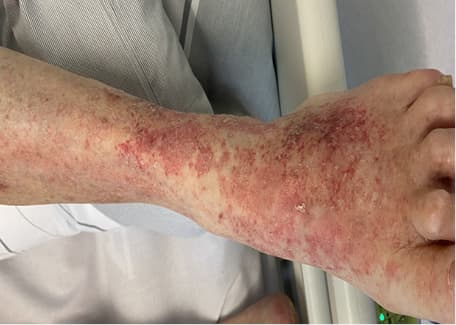
On day 8, the patient developed gastrointestinal bleeding. Oral feeding was stopped, and a proton pump inhibitor infusion was started. The Hb level dropped to 4.6 g/dl despite transfusions. The treatment included intravenous immunoglobulin, corticosteroids, tranexamic acid, etamsylate, and transfusions (13 red blood cell units, 7 fresh frozen plasma units, and 7 PLT units). The PLT count remained low (32 × 10³/µl). Romiplostim (a thrombopoietin receptor agonist) was added after a hematology consultation.
As the etiology of both autoimmune thrombocytopenia and aseptic meningitis remained unclear, further diagnostic investigations were conducted. Once again, we collected the medical history from the patient and her family. The patient’s daughter reported that a few days before falling ill, her mother was bitten by an unknown insect on the leg. At the site of the bite, there was a redness up to 1 cm in diameter that disappeared spontaneously. As we could not exclude a tick bite, polymerase chain reaction test for anaplasmosis was carried out, and the result was positive. The results for immunoglobulin M and immunoglobulin G antibodies against anaplasmosis were also positive. Intravenous doxycycline treatment was started. The patient condition and laboratory values improved rapidly after initiating targeted therapy (PLT count increased to 118 × 10³/µl). The results are presented in Supplementary material, Table S1. The patient was rehabilitated and feeding was resumed. No further bleeding occurred. She was discharged in a good general condition with follow‑up in a hematology outpatient clinic.
Anaplasma phagocytophilum is an obligate gram‑negative intracellular bacterium causing human granulocytic anaplasmosis (HGA) transmitted mainly by ticks.3 It is found in the United States, Asia, and Europe, particularly Slovenia, with seroprevalence up to 17%.4 HGA symptoms are often mild and nonspecific, leading to underdiagnosis. Laboratory findings typically include leukopenia, thrombocytopenia, and liver enzyme abnormalities.5 Mortality is higher in immunocompromised patients, and when doxycycline treatment is delayed.5
The increasing numbers of country‑based surveillance reports on A. phagocytophilum in humans, animal reservoir, and tick vectors in several parts of the world suggest that the pathogen is a growing public health concern,5 so HGA should be considered a rare causative infective factor associated with fever of unknown origin, meningitis, encephalitis, disseminated intravascular coagulation, and autoimmune thrombocytopenia by health care professionals, even when patients do not report a tick bite.
- Korzeniowska K, Cieślewicz A, Wietlicka I, Jabłecka A. Secondary immune thrombocytopenia after Streptococcus infection. Hematol Clin Pract. 2021; 12: 29‑32. | Crossref
- Cines DB, Liebman H, Stasi R. Pathobiology of secondary immune thrombocytopenia. Semin Hematol. 2009; 46: S2‑S14. | Crossref
- Karshima SN, Ahmed MI, Mohammed KM, et al. Worldwide meta‑analysis on Anaplasma phagocytophilum infections in animal reservoirs: prevalence, distribution and reservoir diversity. Vet Parasitol Reg Stud Reports. 2023; 38: 100830. | Crossref
- Dumic I, Jevtic D, Veselinovic M, et al. Human granulocytic anaplasmosis—a systematic review of published cases. Microorganisms. 2022; 10: 1433. | Crossref
- Cosiquien RJS, Stojiljkovic N, Nordstrom CW, et al. Anaplasma phagocytophilum encephalitis: a case report and literature review of neurologic manifestations of anaplasmosis. Infect Dis Rep. 2023; 15: 354‑359. | Crossref
SUPPLEMENTARY MATERIAL
ARTICLE INFORMATION