
Decreased citrulline and propionic acid levels in metabolic depression: a cross-sectional study

 CC BY 4.0
Decreased citrulline and propionic acid levels in metabolic depression: a cross-sectional study
CC BY 4.0
Introduction
Immunometabolic depression is associated with chronic inflammation and metabolic disorders that are intimately linked to depression. These include obesity and its associated conditions, such as hyperglycemia, dyslipidemia, insulin resistance, and metabolic syndrome (MetS). According to literature data, a lifetime risk of developing MetS is by 48% higher in depressed individuals than in those without depression.1 The links between these disorders are a growing research area; one of the topics investigated is the influence of chronic low‑grade inflammation (CLGI) and the microbiota–gut–brain axis (MGBA) on metabolic depression.2
MGBA refers to the 2‑way communication that occurs between the brain and the gut microbiota, an ecosystem composed of billions of microorganisms that live in the human gut. One of the factors associated with impaired functioning of MGBA is disturbance in the composition and function of the microbiota, called dysbiosis.3 It may lead to “leaky gut” syndrome, a pathological condition characterized by increased intestinal permeability due to a breakdown in intestinal barrier function causing the translocation of inflammatory agents, toxic metabolites, and bacterial components.4 Both dysbiosis and its after‑effects, including leaky gut and systemic inflammation, were reported to occur in depressed patients, and may be connected to the use of antidepressant medications.2,3 Several biomarkers, such as intestinal fatty acid–binding protein (I‑FABP), have been used to evaluate intestinal barrier function and permeability.3 One of the markers that has gained attention recently is citrulline (CIT), a nonessential and nonprotein amino acid that is mostly generated in enterocytes of the small bowel. It is believed to be a suitable biomarker for evaluation of intestinal barrier function, regardless of the cause of its impairment or associated diseases.5 In addition, together with I‑FABP, CIT can serve as a marker of both gut function and metabolic health, as the I‑FABP/CIT ratio was shown to positively correlate with weight as well as glucose, insulin, and C‑peptide levels.6
CIT is a precursor to arginine in the urea cycle, and it is additionally believed to have vasodilatory and antioxidant properties due to its crucial role in the production of nitric oxide (NO).7 Inducible NO synthase (iNOS) catalyzes the oxidation of arginine to NO and CIT during inflammatory responses activated by bacterial toxins or cytokines. This process occurs in various cell types, including macrophages, neutrophils, and endothelial cells, and it may contribute to the development of CLGI. Plasma CIT levels were shown to correlate negatively with C‑reactive protein (CRP) levels.5 They were also found to be lower in both overweight and obese adults and children, as compared with nonobese populations.6
Proper secretion and function of CIT in the body are linked to the protective role of short‑chain fatty acids (SCFAs) produced by the microbiota during intestinal fermentation. One of the frequently identified SCFAs is propionic acid (PA), produced by commensal gut microbiota, such as Akkermansia municiphila. At physiological plasma concentrations, PA exerts a protective effect on the blood–brain barrier by reducing harmful inflammatory and oxidative stimuli.8 However, serum PA levels are decreased in the case of altered microbiota composition.
Considering current data on circulating CIT and PA levels in patients with depression and immunometabolic abnormalities, we aimed to assess the levels of these biomarkers in a clinical population with depressive disorders, depending on: 1) MetS presence, 2) CLGI status, and 3) depression severity. We hypothesized that the coexistence of depression with MetS and CLGI (ie, immunometabolic depression) would be characterized by intestinal and endothelial dysfunction reflected by decreased peripheral CIT levels, lowered serum PA levels, and an elevated I‑FABP/CIT ratio. Dietary habits, medications used (including antidepressants), and smoking status were assumed to be the potential contributing factors.
Patients and methods
This study is based on the entry population (n = 115) of the PRO‑DEMET study (The Influence of Probiotic Supplementation on Depressive Symptoms, Inflammation and Oxidative Stress Parameters and Faecal Microbiota in Patients With Depression Depending on Metabolic Syndrome Comorbidity; ClinicalTrials.gov identifier, NCT04756544).2 The inclusion criteria and sample size calculations are presented in Supplementary material.
The levels of CIT and PA were considered the primary outcome measures. The secondary outcome measures included the presence of MetS, CLGI, depression severity, and the I‑FABP/CIT ratio.
MetS was diagnosed according to the International Diabetes Federation definition and criteria. CLGI was defined as a serum CRP level between 3 and 10 mg/l. Depression severity was assessed with the Depression subscale of the self‑report Depression, Anxiety, and Stress Scale, and classified as at least severe (>20 points) and at most moderate (≤20 points).
The validated Polish version of the Food Frequency Questionnaire was applied to investigate dietary habits, and the International Physical Activity Questionnaire was used to assess the physical activity level. All definitions and instruments, along with references, are detailed in Supplementary material.
Blood tests were performed at the Department of Laboratory Diagnostics, Central Teaching Hospital, Medical University of Lodz, Poland. The samples were used for the measurements of CIT and PA levels, carried out at the Institute of Food Technology and Analysis, Lodz University of Technology, Poland. Measurements of serum tumor necrosis factor α (TNF-α), I‑FABP, and SCFA levels were performed at the Department of Biomedicine and Genetics, Medical University of Lodz. Fecal SCFA levels were measured at the Department of Biochemical Sciences, Pomeranian Medical University, Poland. Details regarding the measurement methods are provided in Supplementary material.
All patients gave their informed consent to participate. The study was conducted in accordance with the Declaration of Helsinki, and the protocol of the parent study was approved by the Bioethical Commission of the Medical University of Lodz, Poland (RNN/228/20/KE).
Statistical analysis
Statistical procedures were performed with STATISTICA 13.1 (TIBCO Software Inc., Palo Alto, California, United States) and JASP 0.18.1.0 packages (University of Amsterdam, Amsterdam, Netherlands). Descriptive statistics, including median and interquartile range (IQR), were generated for continuous variables. For discrete variables, the number of patients and percentages were given. Normality of distribution was tested with the Shapiro–Wilk test. The Mann–Whitney and Kruskal–Wallis tests were used to evaluate intergroup differences. Effect sizes were shown as the rank‑biserial correlation coefficient (rrb) or eta‑squared (η2) values. Associations were tested with the Spearman correlation coefficient (R). Multiple linear regression was used to identify the set of variables that provided the most accurate explanation of the CIT levels (standardized regression coefficients were provided for significant predictors). Apart from physical activity level, none of the other variables had any missing data points. For primary analyses (comparisons of CIT and PA levels between subgroups stratified by MetS, CLGI presence, and depression severity), correction for multiple testing was included (Benjamini–Hochberg correction; false discovery rate set at 10%). The significance level for all analyses was set at a P value below 0.05.
Results
Characteristics of the study group are shown in Supplementary material, Tables S1 and S2. The median (IQR) CIT level was 45.87 (33.63–55.51) µmol/l (reference range [RR], 13.7–63.2 µmol/l), and the median (IQR) level of PA was 49.5 (32.29–85.5) µg/l (RR, 0–374 µg/l).
The levels of both CIT and PA were lower in the individuals with comorbid MetS than in the metabolically healthy participants. The effect size of the differences was moderate (median [IQR] CIT, 35.28 [17.37–49.55] vs 47.78 [35.95–57.1] µmol/l, respectively; P <0.001; |rrb| = 0.42; median [IQR] PA, 35.22 [21.44–63.99] vs 56.24 [37.89–79.93] µg/l, respectively; P = 0.004; |rrb| = 0.37). The CLGI status had no influence on the CIT (P = 0.93; |rrb| = 0.129) or PA levels (P = 0.66; |rrb| = 0.05). The patients with at least severe self‑assessed depression had lower levels of PA those with at most moderate depression, although with a small effect (median [IQR], 42.69 [30.35–68.23] vs 65.86 [36.74–96.8] µg/l, respectively; P = 0.03; |rrb| = 0.25). Depression severity had no influence on the CIT levels (P = 0.42; |rrb| = 0.09). Additionally, the type of diagnosis (depressive episode vs recurrent depression vs mixed depressive and anxiety disorder) had no impact on the levels of CIT (P = 0.46) or PA (P = 0.94).
The main results of the analyses of CIT and PA levels in the subgroups stratified by particular MetS criteria are shown in Supplementary material, Table S3.
Dietary supplement use had no influence on the CIT levels (P = 0.19; |rrb| = 0.14). However, PA levels were lower in the patients taking than in those not taking dietary supplements, although with a small effect (median [IQR], 42.48 [24.38–71.9] vs 63.4 [41.77–90.73] µg/l, respectively; P = 0.01; |rrb| = 0.27). The analysis of the subgroups stratified by the type of dietary supplement showed differences in PA levels (P = 0.03). PA concentration was shown to be lower in the patients taking supplements with vitamin D3 than those not taking any dietary supplements (median [IQR], 38.59 [22.85–63.99] vs 63.64 [41.77–90.73] µg/l, respectively; P = 0.03; η² = 0.01).
The I‑FABP/CIT ratio was found to be higher in the patients treated with antidepressants than in those not taking such medications (median [IQR], 44.98 [25.3–73] vs 28.85 [17.51–47.54], respectively; P = 0.02, |rrb| = 0.28). It was also higher in the participants taking dietary supplements, as compared with those not taking such supplements (median [IQR], 48.81 [25.3–84.79] vs 37.52 [19.59–48.04], respectively; P = 0.02, |rrb| = 0.25).
Correlation analyses for CIT and PA levels and the chosen continuous variables arising from the study rationale (including immuno‑metabolic depression parameters: psychometric, metabolic, inflammatory, dietary, and microbiota‑related) are presented in Supplementary material, Figure S1.
In order to test the research hypothesis, a multiple regression analysis was conducted, with levels of CIT as the dependent variable. The results showed that the model was significant, (F[11,94] = 3.7; R2 = 0.3; P <0.001). Valid predictors explained 30% of the variance in the CIT levels. TNF-α and SCFAs were significant positive predictors of the CIT level (β = 0.27; t = 2.93; P = 0.004 and β = 0.28; t = 3.09; P = 0.003, respectively; Figure 1).
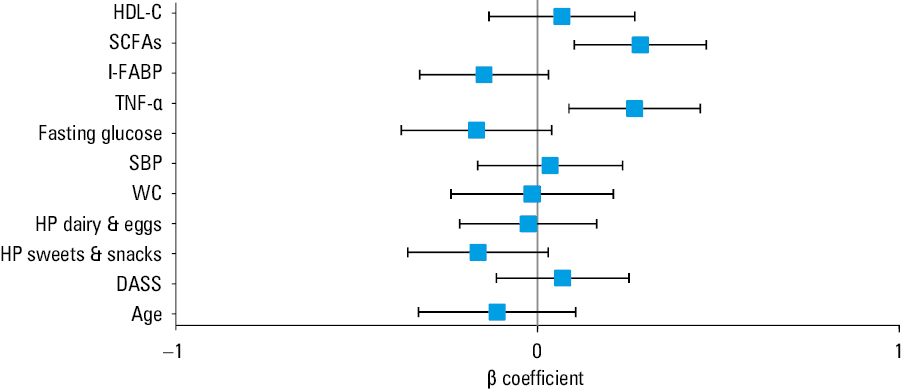
Abbreviations: DASS, Depression, Anxiety, Stress Scale; HDL‑C, high‑density lipoprotein cholesterol; HP, highly processed; I‑FABP, intestinal fatty acid–binding protein; SBP, systolic blood pressure; SCFAs, short‑chain fatty acids; TNF, tumor necrosis factor; WC, waist circumference
Discussion
A recent paper identified clinical and immune‑metabolic markers strata to deliver better‑adjusted treatment options for patients with depression.1 We found decreased levels of CIT and PA in the patients with depression and co‑existing MetS, as compared with those without metabolic disorders. In line with our results, several studies reported lower circulating CIT levels in individuals with obesity or those with other indicators of an increased cardiovascular risk.6 Additionally, CIT, as an NO donor, was found to improve energy expenditure, or insulin sensitivity, in a mouse model of obesity and Alzheimer disease.7 Thus, it appears that CIT derived from the small intestine and endothelium is essential for whole‑body metabolic processes. Additionally, in congruence with our study findings, a significant negative correlation between PA levels and body mass index, waist circumference, or fat percentage was found in humans.9 This might be due to the fact that PA reduces circulating fatty acid levels and inhibits food intake via the induction of leptin production. Dietary fiber intake, as a substrate for the production of SCFAs (including PA), may be the reason for both higher PA levels and healthier metabolic profiles.10
Moreover, in our study population, the levels of PA, but not of CIT, were shown to be decreased in the patients with more severe depressive symptoms. Accordingly, circulating SCFA (including PA) levels were reported to be related to depression in a recent systematic review.10 This may be due to several properties of PA, including those promoting immunomodulation, protection of the blood–brain barrier, and neuroprotection, or cognition, as these mechanisms are also involved in depression pathology, especially of the immunometabolic phenotype.8 PA was also shown to improve neuroregeneration, mediated by free fatty acid receptor signaling and inhibition of histone deacetylase class I/II activity. However, in the case of supplementation, the effect of PA on the central nervous system may be dependent on the dose. Low‑dose propionate (2 mg/kg body weight/day) induced antidepressant effects in rats, while high‑dose propionate (200 mg/kg body weight/day) exerted prodepressant effects.11
The CLGI status, as assessed by CRP levels, was not found to be associated with altered CIT or PA levels. In contrast, Lee et al5 reported that CIT levels were inversely associated with the CRP concentration in children with serious somatic diseases.5 The divergent results are probably due to severe intestinal involvement observed in the patients included in the abovementioned study, whereas our participants were free of decompensated somatic diseases, as assessed by the eligibility criteria. Nonetheless, we found that the TNF-α level correlated positively with both CIT and PA concentrations. The correlation strength for CIT might be explained by the fact that iNOS is triggered during inflammation, for example, by microbial toxins in macrophages responsible for the production of TNF.12 In congruence with our findings, Burton et al13 showed temporal PA and TNF-α level fluctuations to be parallel in patients with depression comorbid with obesity. This may be related to the fact that PA, similarly to CIT, was found to be an adaptive mechanism to LPS‑induced TNF-α production.14
In light of these findings, it seems probable that the correlation strength between CIT and PA levels is not only a marker of intestinal microbiota function, but also an indicator of cardiovascular risk, especially the risk factors related to metabolic health abnormalities. The interplaying factors might be glucose regulation and insulin sensitivity, or body fat storage.9 Other shared factors may include I‑FABP levels, processed sweet intake, and dietary supplement use, as shown in our exploratory analyses.
Dietary habits, specifically processed sweet or dairy consumption, were shown to be associated with lower CIT levels. This is in line with the findings that processed food products containing artificial sweeteners may be linked to endothelial dysfunction and cerebrovascular accidents.15 Moreover, long‑term intake of processed foods contributes to the occurrence of leaky gut syndrome and an increased risk of microvascular damage, driving not only intestinal dysfunction, but also chronic inflammatory diseases.4 Additionally, dietary habits (eg, high intake of ultraprocessed food or low fiber consumption) were shown to have a significant impact on the composition of gut microbiota and intestinal health.16
Consequently, both CIT and PA were found to negatively correlate with I‑FABP levels. As I‑FABP is an indicator of intestinal microdamage and a proxy biomarker of increased intestinal permeability and microbiota dysfunction, its direct connections with CIT or gut microbiota metabolites are not a surprise.3 Importantly, it was shown to be incorporated in the interplay of diet, microbiota, and gut inflammation.
Regarding other factors possibly associated with CIT or PA levels, the use of dietary supplements, especially those containing vitamin D3, was found to be somehow connected to lower PA concentrations. Little is known about the influence of different dietary supplements on SCFA production.17 Vitamin D3 supplementation was shown to favorably impact microbiota composition (eg, to enrich the Bifidobacteriaceae family), and resulted in metabolic shifts.18 Nonetheless, it is poorly known how vitamin D3 affects PA‑producing bacterial strains. All in all, it is hard to draw definitive conclusions, as our study sample was highly heterogeneous in terms of dietary supplement intake, and vitamin D3 was commonly supplemented along with minerals, herbs, or other vitamins. Notably, preliminary animal data show that a combined intake of different dietary supplements may have unfavorable effects on the gut microbiota composition.19 Further research is needed to explore the effect of dietary supplements on gut microbiota functioning.
Taken together, our multifactorial model showed that differences in CIT levels may be predominantly explained by a variety of factors connected to the concept of immunometabolic depression and the gut microbiota function, with circulating SCFAs (including PA), TNF-α, and I‑FABP levels being the most potent constituents.
A higher I‑FABP/CIT ratio was found to be associated with antidepressant treatment. It was previously reported that the use of antidepressants, especially selective serotonin reuptake inhibitors (SSRIs), may explain higher levels of I‑FABP to some extent.3 As the I‑FABP/CIT ratio was repeatedly found to be a marker of glycemic dysregulation, we hypothesize that medication‑related impaired glucose regulation may be partly responsible for higher levels of this marker.6 However, the results a current study indicate that the mechanisms responsible for the increased I‑FABP/CIT ratio may differ depending on the mechanism of action of an antidepressant. Antidepressants with affinity for the serotonin reuptake transporter were shown to be associated with hypoglycemia, while the action on the serotonin‑2c receptor, histamine‑1 receptor, and noradrenaline reuptake transporter was rather connected to hyperglycemia. As the I‑FABP/CIT ratio in our study correlated negatively with PA levels, the influence of antidepressants on the abundance of SCFA‑producing bacteria might also be important. Indeed, SSRIs were shown to have strong antimicrobial effects.3 To summarize, the use of antidepressants seems to contribute to gut microbiota changes in patients with depression.
Limitations
The main limitation of the study is its cross‑sectional design, which prevents us from analyzing temporal trends or determining causal effects. According to the protocol of the parent study, only patients with depression with / without MetS were recruited, so there was no healthy control group. Additionally, only 1 molecule from the SCFA group was examined.
However, multiple outcome measures allowed for in‑depth, interorgan, and multifaceted testing, identifying areas that warrant further research.
Conclusions
We provided additional data that the CIT and SCFA interplay may form future therapeutic approaches for the treatment of immunometabolic depression and its after‑effects.
- Zwiep JC, Milaneschi Y, Giltay EJ, et al. Depression with immuno‑metabolic dysregulation: testing pragmatic criteria to stratify patients. Brain Behav Immun. 2025; 124: 115‑122. | Crossref
- Gawlik‑Kotelnicka O, Margulska A, Płeska K, et al. Metabolic status influences probiotic efficacy for depression—PRO‑DEMET randomized clinical trial results. Nutrients. 2024; 16: 1389. | Crossref
- Gawlik‑Kotelnicka O, Czarnecka‑Chrebelska K, Margulska A, et al. Associations between intestinal fatty‑acid binding protein and clinical and metabolic characteristics of depression. Prog Neuropsychopharmacol Biol Psychiatry. 2025; 136: 111170. | Crossref
- Snelson M, Tan SM, Clarke RE, et al. Processed foods drive intestinal barrier permeability and microvascular diseases. Sci Adv. 2021; 7: eabe4841. | Crossref
- Lee EH, Ko JS, Seo JK. Correlations of plasma citrulline levels with clinical and endoscopic score and blood markers according to small bowel involvement in pediatric Crohn disease. J Pediatr Gastroenterol Nutr. 2013; 57: 570‑575. | Crossref
SUPPLEMENTARY MATERIAL
ARTICLE INFORMATION