

 CC BY 4.0
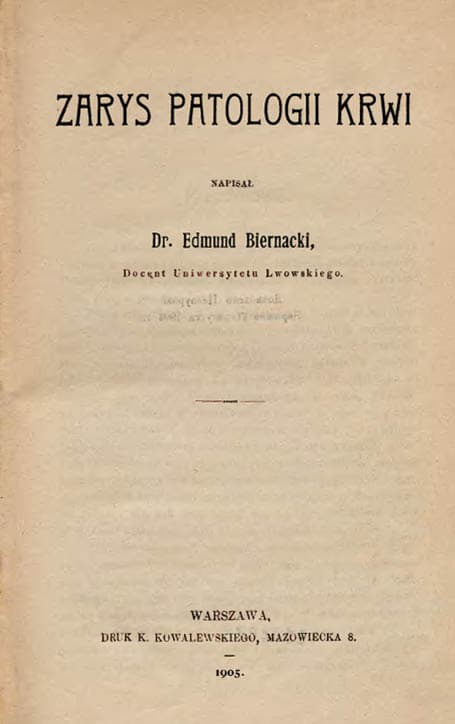
This year marks the 120th anniversary of the publication of the first Polish textbook on hematology, authored by one of the most distinguished Polish physicians of the early 20th century—Edmund Faustyn Biernacki (Figure 1). His 1905 monograph, Outline of Blood Pathology (Zarys patologii krwi; Figure 2), was the first systematic, laboratory‑based comprehensive publication on hematologic diseases in the Polish medical literature. On the occasion of this anniversary, it is worth recalling both the work itself and its author, as Biernacki was the first scientist to introduce the erythrocyte sedimentation rate (ESR)—described by him in 1897—into clinical diagnostics. Unfortunately, for many decades, the historical facts surrounding this achievement remained largely absent from English‑language literature. Only within the past 40 years has Biernacki’s name appeared both in discussions of the history of the erythrocyte sedimentation phenomenon and in presentations of the Polish school of philosophy of medicine.
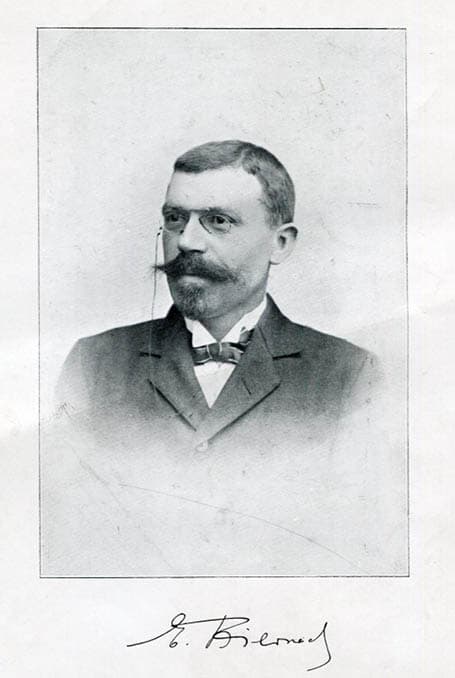
Edmund Biernacki’s life and professional career unfolded during the Partitions of Poland. He was born on December 19, 1866, in Opoczno, then under Russian rule, to Adolf Poraj‑Biernacki and Joanna Biernacka (née Baranowska). At the age of 18 years, he entered the Faculty of Medicine at the Imperial University of Warsaw, where he soon distinguished himself by his enthusiasm for experimental research. Remarkably, while still a medical student, he published 6 scientific articles in Polish and German medical journals. After graduation, Biernacki pursued postgraduate training in Heidelberg (with Wilhelm Erb and Wilhelm Kühne), Paris (with Jean‑Martin Charcot and Georges Hayem), and Giessen (with Friedrich Riegel). He specialized in neuropathology, hematology, cardiology, and the clinical diagnostics of infectious diseases. He was also a leading representative of the Polish school of philosophy of medicine, publishing extensively on fundamental theoretical and practical issues in medicine.
Biernacki served as head of the Diagnostic Clinic of the Imperial University of Warsaw, and later as chief physician of the Wolski Hospital in Warsaw. Between 1893 and 1897, he conducted hematologic research that led to his discovery of the erythrocyte sedimentation phenomenon. In 1908, he was appointed associate professor at the Department of General and Experimental Pathology of the University of Lviv. Biernacki died suddenly at the age of 45 from cardiac aneurysm. Despite his premature death, his scientific achievements were remarkable: he authored a total of 98 scientific publications.
At the turn of the 20th century, European medicine was undergoing a paradigm shift, with the rise of laboratory‑based experimentation. In Poland, academic centers in Warsaw and Lviv were adopting this approach. Biernacki, a talented young physician and pathologist, recognized a critical gap: the absence of a textbook integrating the physico‑chemical properties of blood with clinical observations. His 1905 monograph addressed this need.1 The book was structured into 6 comprehensive chapters: 1) Physical and chemical properties of blood, including viscosity, density, and oncotic pressure in relation to serum protein levels; 2) Erythrocyte pathology, with classification of anemias and discussion on the erythrocyte sedimentation phenomenon; 3) Leukocyte pathology, including leukocytosis, leukopenia, and early observations on hematologic malignancies; 4) Platelet disorders and mechanisms of coagulation; 5) Biochemical serum abnormalities, focusing on albumin and globulin concentrations; 6) Laboratory methodology, including erythrocyte sedimentation, microscopy, protein quantification, and measurement standardization.1
Among Biernacki’s most enduring contributions was his description of ESR, known in Poland as odczyn Biernackiego (OB). He was the first to correlate erythrocyte aggregation with elevated serum protein levels, proposing ESR as a simple yet clinically valuable marker of inflammation.2 His earliest report on erythrocyte sedimentation appeared in 1894 in the Memoirs of the Warsaw Medical Society (Pamiętnik Towarzystwa Medycznego Warszawy). At that time, he was uncertain of its diagnostic value. It was not until 1897 that he clearly described both its diagnostic utility and underlying mechanism, in parallel publications in Polish and German.
Independent contributions on erythrocyte sedimentation followed, authored by Ludwik Hirszfeld (1917), Robert Sanno Fahraeus (1918), and Alf Vilhelm Albertsson Westergren (1921). In English‑speaking countries, the test is most often referred to as the Westergren test or the Fahraeus–Westergren (FW) test, reflecting the fact that both scientists published in English (Biernacki published primarily in Polish and German). Nevertheless, in Poland, the test remains eponymously tied to Biernacki, acknowledging his foundational insight.3 Polish medical nomenclature formally recognized the method as the “Biernacki test” in 1923, during the 5th Congress of Polish Internal Medicine Specialists in Vilnius. Unfortunately, this eponym has remained confined to Poland and has not been adopted in other countries.
In addition to research on laboratory methods, Biernacki engaged in philosophical reflection on medical epistemology. In his earlier works, such as The Essence and Limits of Medical Knowledge (Istota i granice wiedzy lekarskiej; 1899), he emphasized the importance of balancing clinical observation with experimental rigor while maintaining skepticism about the limitations of each. This critical stance was carried into Outline of Blood Pathology, where he cautioned readers about overinterpreting laboratory results without a clinical context. His commitment to methodological reflection prefigured many later debates in medical diagnostics.4
Currently, advanced hematology relies on molecular diagnostics, automated cell counters, and high‑throughput analysis, yet the fundamental physical and chemical concepts presented by Biernacki remain essential. ESR is still one of the most commonly used laboratory tests worldwide, particularly in resource‑limited settings. Its persistence reflects both its utility and Biernacki’s far‑reaching influence.
In 2011, the centenary of Biernacki’s death was commemorated, followed by the 150th anniversary of his birth in 2017. Now, on the 120th anniversary of the publication of his seminal work, we wish to honor a pioneer whose contribution shaped generations of Polish hematologists and laboratory physicians.5
His legacy is not only scientific but also philosophical. Biernacki reminds us that medicine thrives when experimental innovation is guided by intellectual rigor, humility, and critical thinking. As clinical science continues to evolve, the lessons embedded in his 1905 work remain timely and instructive.
- Biernacki EF. Outline of Blood Pathology [in Polish]. Warszawa: Drukarnia K. Kowalewskiego; 1905. | Crossref
- Lewandowski A, Nowak J. The Biernacki reaction ‑ one hundred years later [in Polish]. Pol Arch Med Wewn. 2005; 115: 123‑130. | Crossref
- Zieliński P. The history of the Westergren method and the memory of Biernacki [in Polish]. Hematol Pol. 2010; 41: 45‑52. | Crossref
- Biernacki EF. The Essence and Limits of Medical Knowledge [in Polish]. Kraków: self‑published; 1899. | Crossref
- Piotrowski T. Digitization of Outline of Blood Pathology by Edmund F. Biernacki in the Pomeranian Digital Library [in Polish]. Rocz Hist Medycyny. 2018; 12: 89‑98. | Crossref
ARTICLE INFORMATION