
18F-prostate-specific membrane antigen-1007 positron emission tomography / computed tomography detects occult leptomeningeal metastases in poorly differentiated thyroid carcinoma misdiagnosed as vascular mimicry on magnetic resonance imaging
1


 CC BY-NC-SA 4.0
18F-prostate-specific membrane antigen-1007 positron emission tomography / computed tomography detects occult leptomeningeal metastases in poorly differentiated thyroid carcinoma misdiagnosed as vascular mimicry on magnetic resonance imaging
CC BY-NC-SA 4.0
Prostate‑specific membrane antigen (PSMA) is a type II transmembrane glycoprotein receptor expressed in prostate cancer cells and in the endothelium of tumor‑associated neovasculature of various malignancies.1,2 This specific expression profile of PSMA supports clinical application of PSMA‑targeted positron emission tomography (PET) as a theranostic tool in extraprostatic tumors. A study by Ciappuccini et al2 indicated a potential role of PSMA‑PET imaging in patients with radioiodine‑refractory thyroid cancer when other imaging techniques, including fluorine‑18 (18F) fluorodeoxyglucose PET, fail to locate the source of disease progression.
A 65‑year‑old man with a history of poorly differentiated thyroid carcinoma (PDTC), who had undergone total thyroidectomy, lymph node dissection, and adjuvant chemoradiotherapy 3 years earlier, presented in August 2023 with a 2‑week history of progressive cough and chest tightness. The postoperative histopathologic examination confirmed the diagnosis of PDTC with cervical lymph node metastases. Chest computed tomography (CT) showed right‑sided pleural effusion with bilateral pulmonary and pleural nodules, while contrast‑enhanced brain magnetic resonance imaging (MRI) showed no significant abnormalities. Thoracoscopic biopsy confirmed metastatic PDTC. The multidisciplinary team recommended multigene mutation testing; however, the patient refused due to financial constraints, as its cost was not covered by medical insurance.
To evaluate tumor angiogenesis and the feasibility of lutetium‑177–labeled PSMA radioligand therapy (RLT) in our patient, 18F‑PSMA‑1007 PET/CT was performed. Multifocal intense PSMA‑avid metastases were detected in both lungs (maximum standardized uptake value [SUVmax], 18.4) and the right pleura (SUVmax, 52.3; Figure 1A–1E). Additionally, 2 unexpected subcentimeter PSMA‑avid foci (SUVmax, 11.8 and 13.5) without morphologic lesions were identified in the right frontal lobe (Figure 1F and 1G). A subsequent reassessment of the contrast‑enhanced brain MRI identified 2 subtle leptomeningeal metastases (measuring 0.2 and 0.3 cm in maximal diameter) within sulcal regions, precisely aligning with the PSMA‑positive foci (Figure 1H and 1I). Due to their morphologic features and enhancement pattern resembling those of sulcal vessels, these lesions were initially misdiagnosed as vascular structures. Following a multidisciplinary team consultation, the patient was initiated on a combination therapy with lenvatinib and pembrolizumab. Follow‑up imaging at 6 months showed a near‑complete resolution of all metastatic lesions. The patient remained in remission for 18 months until death from acute myocardial infarction in February 2025. The final diagnosis of leptomeningeal metastases was established based on characteristic neuroimaging findings and the clinical course.
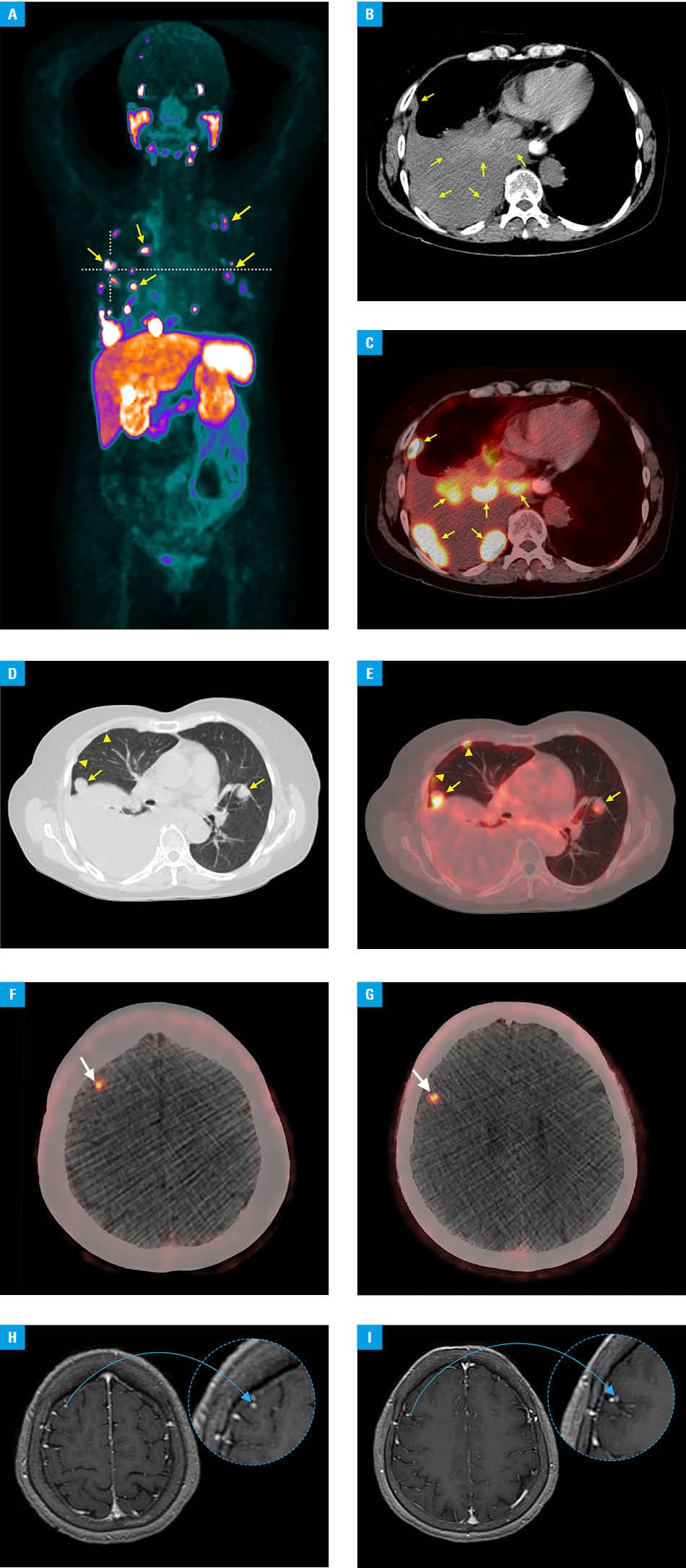
Leptomeningeal metastases from thyroid cancer are rare.3 Although contrast‑enhanced MRI is the first‑line imaging modality for evaluating leptomeningeal metastases, its sensitivity remains limited for oligometastatic subcentimeter nodules, particularly those exhibiting vascular mimicry on T1‑weighted sequences.4 Here, we reported a novel application of 18F‑PSMA‑1007 PET/CT for detecting occult millimeter‑scale metastases, leveraging PSMA overexpression in tumor neovasculature and minimal physiological brain uptake. Prior studies have demonstrated a strong correlation between PSMA uptake and vascular endothelial growth factor receptor / platelet‑derived growth factor receptor expression.5 The observed PSMA hyperexpression not only qualifies patients for PSMA‑RLT with α / β emitters but also suggests a predictive value of antiangiogenic therapy response. Further clinical studies are warranted to validate this approach.
- Oprea‑Lager DE, MacLennan S, Bjartell A, et al. European Association of Nuclear Medicine Focus 5: consensus on molecular imaging and theranostics in prostate cancer. Eur Urol. 2024; 85: 49‑60. | Crossref
- Ciappuccini R, Saguet‑Rysanek V, Giffard F, et al. PSMA expression in differentiated thyroid cancer: association with radioiodine, 18FDG uptake, and patient outcome. J Clin Endocrinol Metab. 2021; 106: 3536‑3545. | Crossref
- Solomon B, Rischin D, Lyons B, et al. Leptomeningeal metastases from anaplastic thyroid carcinoma. Aust N Z J Med. 2000; 30: 724‑725. | Crossref
- Ozair A, Wilding H, Bhanja D, et al. Leptomeningeal metastatic disease: new frontiers and future directions. Nat Rev Clin Oncol. 2025; 22: 134‑154. | Crossref
- Gao J, Meng L, Xu Q, et al. 68Ga‑PSMA‑11 PET/CT parameter correlates with pathological VEGFR‑2/PDGFR-β expression in renal cell carcinoma patients. Mol Imaging Biol. 2022; 24: 759‑768. | Crossref
ARTICLE INFORMATION