

 CC BY 4.0
Introduction
Patients with atrial fibrillation (AF) are at an increased risk of thromboembolic events, particularly ischemic stroke.1 The hypercoagulable state observed in AF is driven by complex interactions between endothelial dysfunction, inflammation, and oxidative stress.2-5 Lipid peroxidation products, such as thiobarbituric acid reactive substances (TBARS) and enzymes, for example, nicotinamide adenine dinucleotide phosphate oxidase 2 (NOX2), are important biomarkers of oxidative stress.6,7 Their increased levels have been implicated in vascular dysfunction (eg, through impaired endothelial nitric oxide signaling) and increased thromboembolic complications (eg, through reactive oxygen species), yet their specific role in modulating clot stability and fibrinolytic activity in AF patients remains incompletely understood.6,7 It has been shown that oxidative stress, reflected by protein carbonylation, is associated with a formation of denser and more lysis‑resistant clots in AF, likely due to post‑translational modifications of fibrinogen and other coagulation factors, as well as fibrinolytic proteins.8 Plasma clot lysis time (CLT) serves as a functional measure of fibrinolytic resistance.9 Prolonged CLT, reflecting impaired fibrinolysis, has been independently associated with an increased risk of cardiovascular death and myocardial infarction in high‑risk populations, such as those with acute coronary syndromes, and provides a prognostic value for major adverse cardiac events beyond traditional risk markers.10-12 Moreover, prolonged CLT has been associated with higher protein oxidation in patients with progression of AF to permanent arrhythmia.13 A key fibrinolysis regulator and a major determinant of CLT—plasminogen activator inhibitor‑1 (PAI‑1)—is also affected by oxidative pathways.14
This study aimed to elucidate whether in patients with AF, TBARS and NOX2 are associated with prolonged CLT and to evaluate the potential mediatory role of PAI‑1.
Patients and methods
We studied 100 consecutive AF patients treated with direct oral anticoagulants (DOACs) enrolled during routine visits in an outpatient center between June 2020 and December 2021. The study population, exclusion criteria, and definitions of comorbidities were described previously.15 AF classification was based on the 2020 European Society of Cardiology guidelines.16 The study was approved by the ethics committee of the Jagiellonian University (1072.6120.186.2020), and all participants provided written informed consent. Blood samples from antecubital veins were collected before the intake of the morning DOAC dose. Routine laboratory tests were conducted using standard laboratory techniques. Serum levels of TBARS and NOX2 (extracellular) were assessed using enzyme‑linked immunosorbent assays (R&D Systems, Minneapolis, Minnesota, United States and Abcam, Cambridge, United Kingdom, respectively). The reference range (RR) established in our laboratory for 30 healthy individuals was 0.65–1.05 µmol/l for TBARS and 22–69 pg/ml for NOX2. Endogenous thrombin potential and fibrin clot properties were assessed as previously described.15 There was no control group in the study.
Statistical analysis
Continuous variables are expressed as medians (interquartile ranges ([IQRs]), while categorical variables are presented as counts and percentages. The Shapiro–Wilk test was used to assess the normality of data distributions. For comparisons between 2 independent groups, the Mann–Whitney test was applied. For comparisons of 3 or more groups, the Kruskal–Wallis test was used, followed by the Dunn post‑hoc correction. Categorical variables were analyzed using the χ² test or the Fisher exact test, as appropriate. Bivariate correlations were assessed using the Pearson method for normally distributed variables and the Spearman rank correlation for nonparametric data. Multiple linear regression analysis was performed to identify independent predictors. Mediation analysis was used to evaluate indirect effects. All analyses were conducted using Statistica software, version 13.3 (TIBCO Software Inc., Palo Alto, California, United States) with significance set at P below 0.05.
Results
Median (IQR) age of all patients was 69 (62–76) years and median (IQR) body mass index (BMI) was 27.2 (25.7–30) kg/m², with most patients presenting moderate thromboembolic and bleeding risk, as indicated by median (IQR) CHA2DS2-VAS and HAS‑BLED scores of 3 (2–4) and 2 (1–2), respectively. Renal function was generally preserved, with median (IQR) estimated glomerular filtration rate of 67 (56.7–83) ml/min/1.73 m² (RR, 60–89 ml/min/1.73m²; Supplementary material, Table S1).
Median (IQR) level of TBARS in all patients was 0.94 (0.74–1.33) µmol/l and median (IQR) NOX2 concentration was 98.6 (60.14–147.27) pg/ml.
There were no differences in age, BMI, renal function, lipid profile, C‑reactive protein, or fibrinogen levels between the patients with TBARS and NOX2 levels above the median (≥0.94 µmol and ≥98.6 pg/ml, respectively) and those with values below the median. TBARS and NOX2 concentrations were by 33% and 32% higher, respectively, in the individuals with CHA2DS2-VASc scores above 2 than the remaining patients (TBARS, 1.49 [0.77–1.47] vs 1.12 [0.72–1.2] µmol; P = 0.01; NOX2, 138.7 [61.4–154.3] vs 105.4 [57.3–131.9] pg/ml; P = 0.008). Moreover, in the individuals with permanent AF, the values of TBARS (median [IQR], 1.06 [0.94–1.33] µmol/l; P = 0.03) and NOX2 (median [IQR], 97 [74–121] pg/ml; P = 0.02) were higher than in the patients with other AF types.
The patients with higher TBARS levels (≥0.94 µmol) had by 16% longer CLT (median [IQR], 123 [107–140.75] vs 106 [95.25–120.75] min; P = 0.003) and by 63% higher NOX2 concentrations (median [IQR], 119.26 [88.72–158.97] vs 73.02 [54.21–98.53] pg/ml; P <0.001) than the patients with TBARS levels below the median. The individuals with higher NOX2 concentrations (≥98.6 pg/ml) had by 25% longer median (IQR) CLT (130.5 [112.25–148.75] vs 104.5 [95.25–111] min; P <0.001) and by 19% higher median (IQR) fibrinogen levels (3.8 [3–4.5] vs 3.2 [2.6–3.8] g/l; P = 0.01) than the remaining patients.
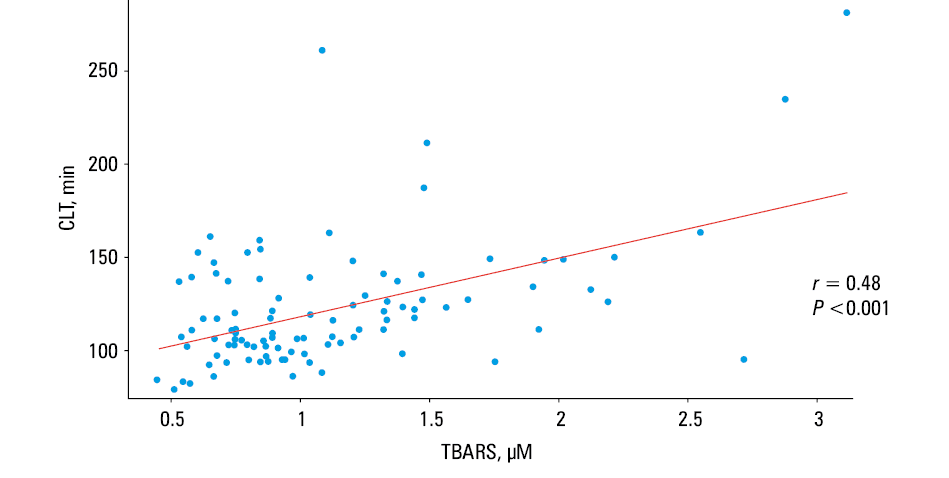
TBARS and NOX2 correlated moderately with each other (R = 0.43; P <0.001) and with CLT (r = 0.48 and R = 0.47, respectively; P <0.001; Figure 1). Multiple linear regression used unstandardized (crude) coefficients (β) with SEs. TBARS (β, 15.32 [2.1]; P <0.001) and NOX2 (β, 0.18 [0.03]; P <0.001) values were independently associated with CLT, explaining 37% of variance (adjusted R² = 0.37). A significant interaction between TBARS and NOX2 was observed (β, 0.004 [0.001]; P = 0.02), indicating a synergistic effect on CLT. Partial correlation analysis confirmed that both TBARS and NOX2 remained associated with CLT after adjusting for each other. The mediation analysis showed that approximately 18% of the association between TBARS and CLT was mediated by PAI‑1 (effect estimate, 0.128; 95% CI, 0.05–0.21). The indirect effect estimates of 0.128 indicates that for every 1-µm increase in TBARS, CLT increased by 0.128 minutes through PAI‑1 mediation, representing 18% of the total effect (95% CI, 0.05–0.21), which suggests a small but significant mediation.
Discussion
Our study is the first to show that both TBARS and NOX2 concentrations were elevated in the patients with a higher risk of thromboembolism (CHA₂DS₂-VASc >2) and in those with permanent arrhythmia, suggesting a sustained systemic oxidative burden in more advanced stages of the disease. This aligns partially with observations made by Böhm et al,17 who found that lowered TBARS levels following pulmonary vein isolation were associated with a reduction in AF burden, which implies a potential role of oxidative signaling in atrial remodeling. In contrast, Corradi et al18 reported reduced TBARS concentrations in atrial tissue collected from patients with persistent AF, as compared with individuals without evidence of heart disease, suggesting possible oxidative exhaustion or compartment‑specific depletion of redox activity in chronic AF. Our findings showed that systemic TBARS and NOX2 positively correlate with one another, and that both are independently associated with prolonged CLT. Additionally, we found that PAI‑1 partially mediates the relationship between TBARS and CLT. These results highlight the complex and possibly synergistic role of oxidative stress in driving hypofibrinolysis in AF. TBARS reflect lipid peroxidation and oxidative stress, which may secondarily influence clot properties and fibrinolysis. However, previous studies, including those conducted on healthy individuals, have also demonstrated correlations between CLT and lipid parameters, such as low‑density lipoprotein and high‑density lipoprotein cholesterol.9 These results reinforce the importance of interpreting oxidative stress markers in a disease stage and compartment‑specific context. Additionally, our findings highlight the role of NOX2‑driven oxidative stress in the progression of AF and its emerging link to fibrinolytic dysfunction. Cangemi et al19 compared AF subtypes and found that patients with paroxysmal or persistent AF exhibited higher systemic NOX2 activation—measured via soluble NOX2‑derived peptide and urinary isoprostanes—as compared with both permanent arrhythmia patients and controls, indicating a dynamic, stage‑dependent oxidative phenotype. In a manner congruent with our research, Sridhar et al20 demonstrated an association between oxidative stress parameters, notably NOX2 activity, in AF patients with obesity. The authors proposed that obesity leads to AF through increased NOX2‑dependent oxidative stress, which induces electrical and structural remodeling of the atria, thereby promoting arrhythmogenesis. Furthermore, through inhibition of NOX2 in individuals with obesity, atrial myocytes ameliorated electrophysiological alterations and decreased AF burden. Together, these studies proposed NOX2 as a potential initiator of AF through redox‑mediated electrophysiological changes.
This study has several limitations, the most significant being a relatively small sample size, which may limit the generalizability of the findings. Additionally, the absence of a matched control group prevents definitive comparisons and may introduce potential bias.
Conclusions
The patients with permanent arrhythmia and CHA₂DS₂-VASc scores above 2 had higher levels of TBARS and NOX2, linking oxidative stress to thromboembolic risk. Elevated TBARS or NOX2 levels were associated with lower PAI‑1 concentrations, suggesting an inverse relationship between oxidative stress and fibrinolysis regulation. Both markers were moderately correlated with CLT and independently predicted prolonged CLT. The TBARS‑CLT association is in part driven by PAI‑1.
- Cheng YJ, Deng H, Wei HQ, et al. Association between age at diagnosis of atrial fibrillation and subsequent risk of ischemic stroke. J Am Heart Assoc. 2025; 14: e038367. | Crossref
- Atar D, Linde C. Subclinical atrial fibrillation: who benefits from oral anticoagulation? Kardiol Pol. 2025; 83: 808‑813. | Crossref
- Ząbczyk M, Natorska J, Undas A. Novel factors affecting fibrin clot formation and their clinical implications. Pol Arch Intern Med. 2024; 134: 16884. | Crossref
- Sawczyńska K, Wrona P, Wrobel D, et al. Short- and long‑term outcomes of mechanical thrombectomy in acute ischemic stroke patients with chronic kidney disease. Pol Arch Intern Med. 2024; 134: 16800. | Crossref
- Ząbczyk M. Incredible fibrin(ogen): from basic mechanisms to clinical implications. Prz Lek Jagiellonian Med Rev. 2025; 77: 17945. | Crossref
SUPPLEMENTARY MATERIAL
ARTICLE INFORMATION