


 CC BY-NC-SA 4.0
To the editor
Although the World Thrombosis Day (WTD) officially falls on October 13, this year, it was celebrated in Poland on Saturday, October 11, 2025. The Scientific Conference was held in Warsaw under the patronage of the Polish Society of Phlebology, with the participation of the Working Group for Hemostasis of the Polish Society of Hematology and Transfusion Medicine.
WTD was established in 2014 by the International Society on Thrombosis and Haemostasis (ISTH),1 and since then it has also been organized in Poland.2,3
In 2025, the event attracted a total of 313 participants—180 on‑line and 133 on‑site (Figures 1, 2, 3). For physicians who were unable to participate, all lectures are freely available on the educational platform run by Medycyna Praktyczna.4
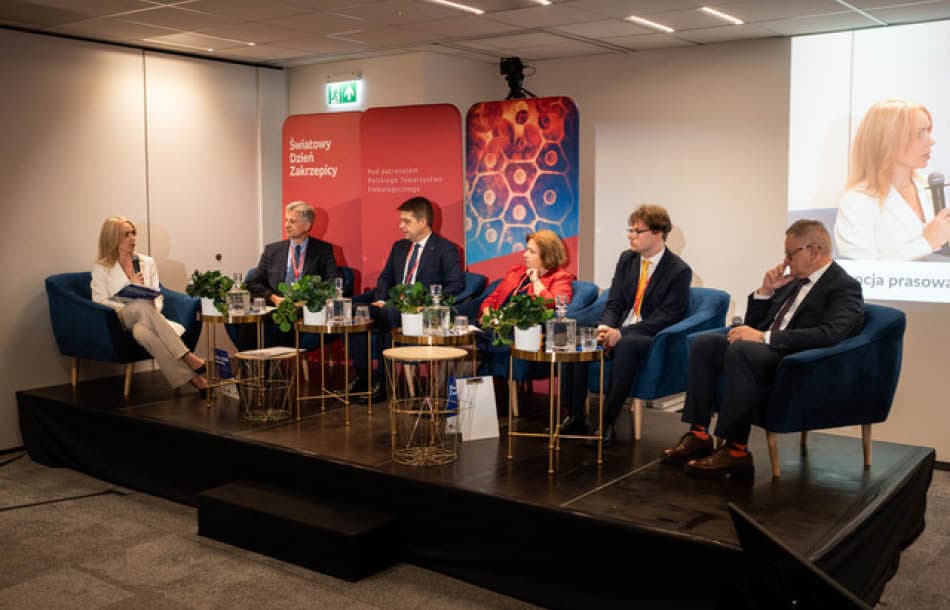
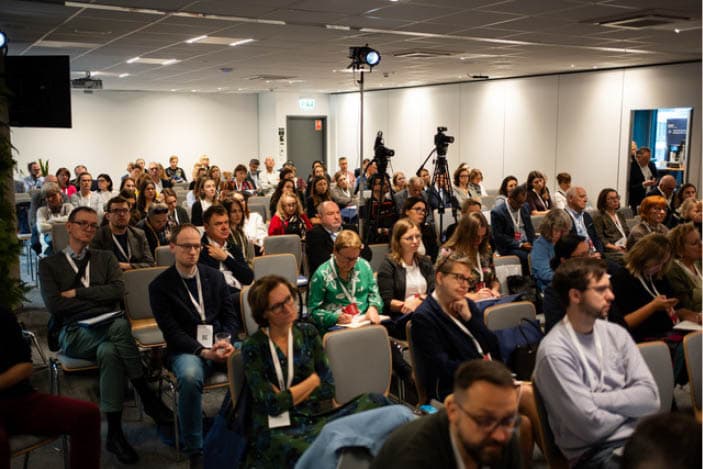
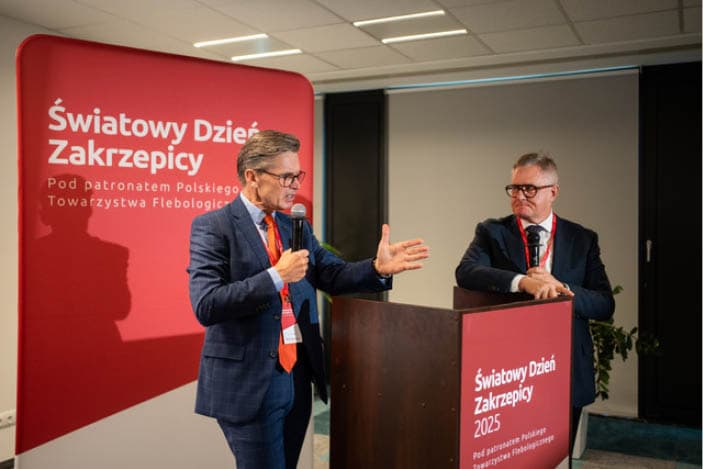
The conference was chaired by Professor Zbigniew Krasiński, President of the Polish Society for Vascular Surgery and Rector of the Poznan University of Medical Sciences.
The speakers emphasized the ongoing necessity to raise awareness—not only among patients but also among physicians of various specialties—about how insidious and dangerous thrombosis can be, especially when not recognized in time. While patients are often willing to use thromboprophylaxis before long journeys, they tend to be less diligent in addressing other risk factors, such as overweight, maintaining proper hydration, limiting alcohol consumption, or adhering to anticoagulant therapy as prescribed. It is worth remembering that the treatment of thrombotic complications may be ineffective, and is always very costly.
A 27‑year‑old patient shared his story. Since birth, he had struggled with thrombosis causing obstruction of the inferior vena cava and iliac veins. In May 2025, he underwent a successful surgical procedure at the Department of Vascular and Endovascular Surgery, Angiology and Phlebology of the Poznan University of Medical Sciences, and subsequently returned to his professional duties as a physiotherapist.
Professor Zbigniew Krasiński presented a video showing a venous recanalization procedure, in which blood flow had been obstructed by post‑thrombotic changes.
The conference covered a wide range of topics, with several lectures focusing on the diagnosis and treatment of pulmonary embolism, the most dangerous complication of venous thromboembolism (VTE) (A. Araszkiewicz, P. Pruszczyk, M. Kurzyna). Other presentations addressed the current approach to the management of superficial vein thrombosis (T. Urbanek), endothermal heat–induced thrombosis (P. Terlecki), the risk of thrombotic complications associated with venous insufficiency and the principles of prevention and treatment of catheter‑related thrombosis (Z. Krasiński), as well as new directions in thrombosis research (W. Tomkowski).
The achievements highlighted during the conference included: 1) substantial changes in the reimbursement of direct oral anticoagulants in Poland following the introduction of over 30 generic rivaroxaban and dabigatran preparations, which significantly reduced the cost of VTE treatment since 2024 and improved patient access to guideline‑recommended therapeutic and preventive strategies (A. Undas); 2) appropriate selection of treatment (F. Szymański) and skilled management of bleeding complications (A. Klotzka); 3) the operation of pulmonary embolism response teams (PERTs) providing rapid assistance to patients with pulmonary embolism (P. Pruszczyk, Z. Krasiński); 4) an increased number of successful mechanical thrombectomies enabling safe removal of thromboembolic material without the use of fibrinolytic agents, as demonstrated by the center in Poznań (Z. Krasiński, M‑G. Stanišić); and 5) consideration of the specific aspects of thrombosis management in patients with malignancy (S. Szmit).
Hematologists pointed out that thrombocytopenia may precede the development of thrombosis, and that thrombosis complicating paroxysmal nocturnal hemoglobinuria remains a serious condition (J. Windyga). They also emphasized that thrombosis frequently complicates severe liver diseases, requiring modified anticoagulation strategies (M. Podolak‑Dawidziak), that thrombosis in atypical locations should always prompt a thorough diagnostic evaluation (J. Treliński), and that thrombosis in children continues to pose a significant clinical challenge (J. Rupa‑Matysek).
The actions proposed to further improve the detection and management of VTE included: 1) wider implementation of modern ultrasound diagnostics (M. Gabriel), 2) consideration of multimorbidity when selecting anticoagulant therapy (M. Podolak‑Dawidziak), and 3) the establishment of a structured care pathway for patients after pulmonary embolism (P. Pruszczyk). An important task for the media was also emphasized, namely, spreading knowledge about the symptoms of thrombosis and the importance of adhering to medical and nutrition recommendations (Z. Krasiński).
In 2025, the latest Polish recommendations on the diagnostic and therapeutic management of VTE in medical and surgical patients were published.5
- ISTH Steering Committe for World Thrombosis Day. Thrombosis a major contributor to the global disease burden. J Thromb Haemost 2014; 12: 1580‑1590. | Crossref
- Podolak‑Dawidziak M, Łętowska M, Windyga J. World Thrombosis Day in Poland, October 14, 2023. Pol Arch Intern Med. 2023; 133: 16598. | Crossref
- Podolak‑Dawidziak M, Krasiński Z. World Thrombosis Day in Poland, October 12, 2024. Pol Arch Intern Med. 2024; 134: 16876. | Crossref
- World Thrombosis Day 2025 [in Polish]. Medycyna Praktyczna website. https://www.mp.pl/konferencje/zakrzepica/2025/. Accessed October 26, 2025. | Crossref
- Krasiński Z, Undas A, Podolak‑Dawidziak M, et al. Thromboprophylaxis in medical patients: a 2025 update of Polish recommendations. Pol Arch Intern Med. 2025; 135: 17047. | Crossref
ARTICLE INFORMATION