
A novel ACVRL1 mutation in a patient with hereditary hemorrhagic telangiectasia coexisting with pulmonary arterial hypertension

 CC BY 4.0
A novel ACVRL1 mutation in a patient with hereditary hemorrhagic telangiectasia coexisting with pulmonary arterial hypertension
CC BY 4.0
A 53‑year‑old man was referred for diagnostic evaluation of progressive dyspnea classified according to the World Health Organization (WHO) as functional class (FC) III. The patient reported recurrent episodes of epistaxis for 20 years and a hemoglobin level of 8.6 g/dl (reference range [RR], 14–18 g/dl). Family history showed bleeding complications suggestive of hereditary hemorrhagic telangiectasia (HHT): the patient’s sister died at 48 years after developing sepsis during severe hemoptysis; his mother died at 56 years from recurrent hemoptysis; and several maternal relatives experienced severe epistaxis. All had visible telangiectasias.
Physical examination showed multiple cutaneous telangiectasias on the face, tongue, and hands (Figure 1A and 1B). Abdominal ultrasound identified numerous arteriovenous malformations (AVMs) in the liver, confirmed on computed tomography (Figure 1C and 1D). A definitive diagnosis of HHT was made based on the Curaꞔao criteria.1 Genetic testing using targeted next‑generation sequencing of HHT- and pulmonary arterial hypertension (PAH)-related genes identified a novel heterozygous ACVRL1 variant (NM_000020.3:c.1412G>T; p.Cys471Phe, exon 10/10), classified as likely pathogenic according to the 2015 American College of Medical Genetics and Genomics / Association for Molecular Pathology guidelines,2 with full methodological details provided in Supplementary material. Segregation analysis confirmed the presence of this variant in 2 male maternal relatives, who presented with clinical features of HHT.
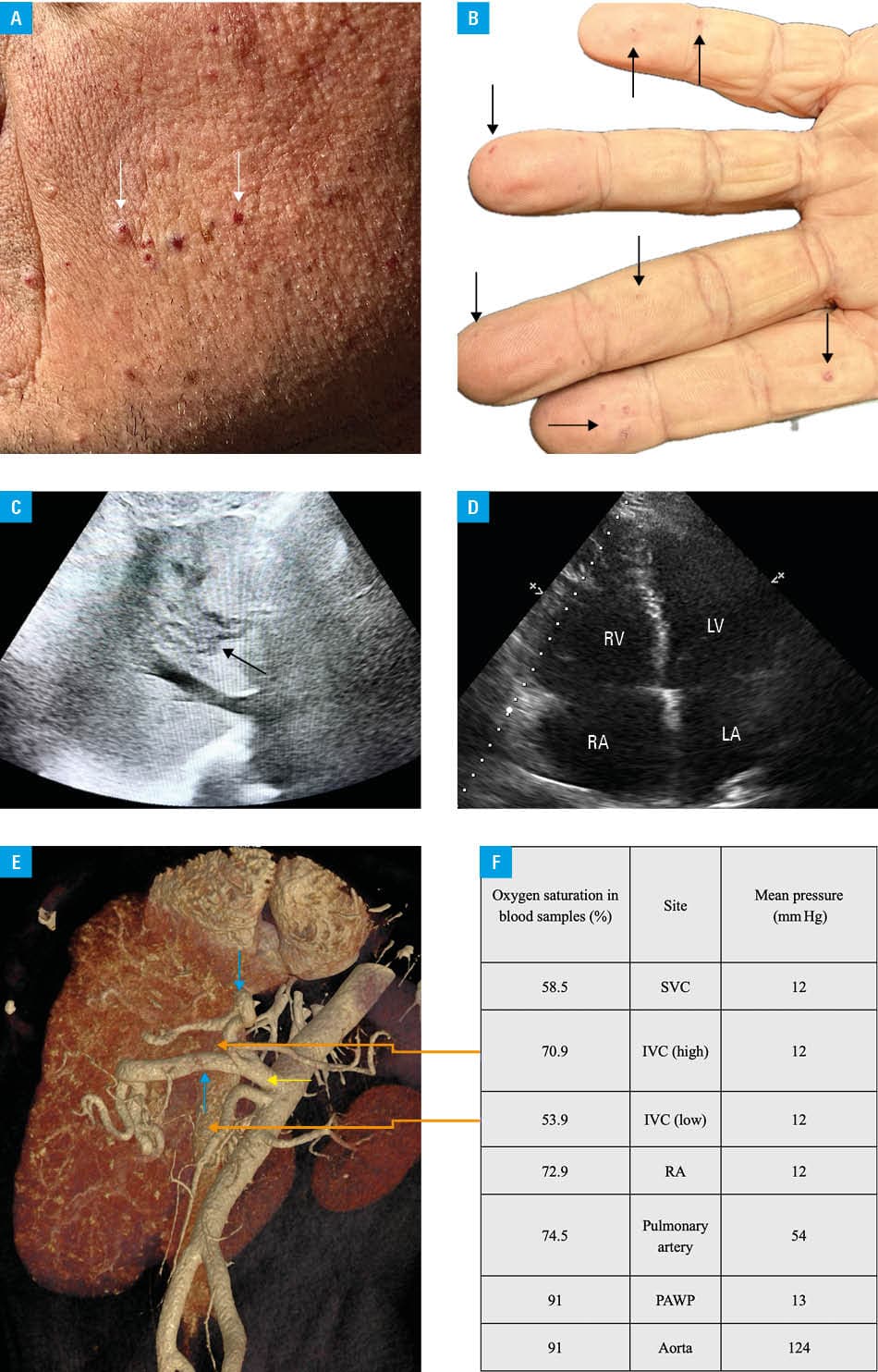
Pulmonary hypertension was suspected based on echocardiography results (Figure 1E), prompting workup to exclude left heart, pulmonary, and thromboembolic disease (ventilation–perfusion scintigraphy). Pulmonary angiography excluded pulmonary AVMs. Test results for liver disease, HIV, and antinuclear antibodies were negative.
Right heart catheterization (Figure 1F; at the hemoglobin level of 15.6 g/dl) suggested an infradiaphragmatic arteriovenous shunt. Pulmonary vascular resistance (PVR) was 3.9 Wood units (WUs) and mean pulmonary artery pressure (mPAP) was 54 mm Hg. Acute vasoreactivity test results were negative. As the ACVRL1 variants have been associated with both HHT and PAH, we diagnosed heritable PAH.3
The initial PAH treatment with bosentan and sildenafil resulted in clinical improvement, reducing the WHO‑FC to II, mPAP to 34 mm Hg, PVR to 2.8 WUs, cardiac index from 1.8 to 2 l/min/m2, and N‑terminal pro–B‑type natriuretic peptide from 827 to 139 pg/ml (RR <125 pg/ml).
In almost all patients with HHT, a mutation can be identified in either the ENG, ACVRL1 (in which liver AVMs are more severe, and PAH emerges earlier),3 or SMAD4 genes.
HHT is often complicated by epistaxis, gastrointestinal bleeding, anemia, liver AVMs, pulmonary AVMs, or cerebral AVMs. The treatment approach to AVMs depends on the organ involved.4 Pulmonary AVMs should be treated with transcatheter embolotherapy.5 Invasive treatment of liver AVMs by hepatic artery embolization should be avoided, as it is a temporizing procedure associated with a significant risk. In patients with liver AVMs and symptomatic high‑output cardiac failure (HOCF) unresponsive to optimized heart failure management, bevacizumab should be initiated. If it is ineffective, liver transplantation should be considered. Cerebral AVMs require individual management in expertise centers. Patients with HHT and pulmonary hypertension (PH) should be referred to PH centers for thorough diagnostics. The most common diagnosis is group 2 PH, resulting from HOCF. Less frequently, HHT‑related gene mutations lead to the development of PAH, whose treatment should follow current clinical guidelines.
PAH is a rare but manageable coexisting condition in patients with HHT and should be considered in the differential diagnosis of dyspnea.
- Shovlin CL, Guttmacher AE, Buscarini E, et al. Diagnostic criteria for hereditary hemorrhagic telangiectasia (Rendu‑Osler‑Weber syndrome). Am J Med Genet. 2000; 91: 66‑67. | Crossref
- Richards S, Aziz N, Bale S, et al. Standards and guidelines for the interpretation of sequence variants: a joint consensus recommendation of the American College of Medical Genetics and Genomics and the Association for Molecular Pathology. Genet Med. 2015; 17: 405‑424. | Crossref
- Eichstaedt CA, Belge C, Chung WK, et al. Genetic counselling and testing in pulmonary arterial hypertension: a consensus statement on behalf of the International Consortium for Genetic Studies in PAH. Eur Respir J. 2023; 61: 2201471. | Crossref
- Faughnan ME, Mager JJ, Hetts SW, et al. Second international guidelines for the diagnosis and management of hereditary hemorrhagic telangiectasia. Ann Intern Med. 2020; 173: 989‑1001. | Crossref
- Stępniewski J, Waligóra M, Kurczyna P, et al. Percutaneous embolization of pulmonary arteriovenous malformation for the treatment of chronic hypoxemia in a patient with Osler‑Weber‑Rendu syndrome. Pol Arch Intern Med. 2024; 134: 16795. | Crossref
SUPPLEMENTARY MATERIAL
ARTICLE INFORMATION