
Successful reconstruction of the infrarenal inferior vena cava and bilateral iliac vein occlusion 27 years after catheter-related thrombosis

 CC BY 4.0
Successful reconstruction of the infrarenal inferior vena cava and bilateral iliac vein occlusion 27 years after catheter-related thrombosis
CC BY 4.0
Chronic occlusion of the inferior vena cava (IVC) and iliac veins may result from thrombosis associated with central venous catheters in the neonatal period.1-3 Long‑standing iliocaval obstruction leads to significant morbidity, including venous claudication, edema, varicosities, and venous ulceration.4 Endovascular recanalization has become the treatment of choice, offering high technical success and sustained patency.5
A 27‑year‑old man presented with bilateral lower limb edema, extensive abdominal and limb varicosities, venous claudication, and a chronic ulcer on the right lower extremity. His medical history showed a premature birth at 28 weeks of gestation and catheter‑related thrombosis during neonatal intensive care unit stay. Computed tomography angiography demonstrated chronic occlusion of the infrarenal IVC and both iliac veins, with patent common femoral veins. Extensive collateral circulation was present in the periaortic, pelvic, and abdominal wall regions. Under intravascular ultrasound (IVUS) guidance and general anesthesia, intraluminal position of wires, fibrosis, and vessel diameters were assessed. Six self‑expanding venous stents (Venovo, Bard; Becton, Dickinson and Company, Franklin Lakes, New Jersey, United States) were implanted. The procedure lasted 200 minutes (Figure 1A–1F), and the patient was discharged on postoperative day 2.
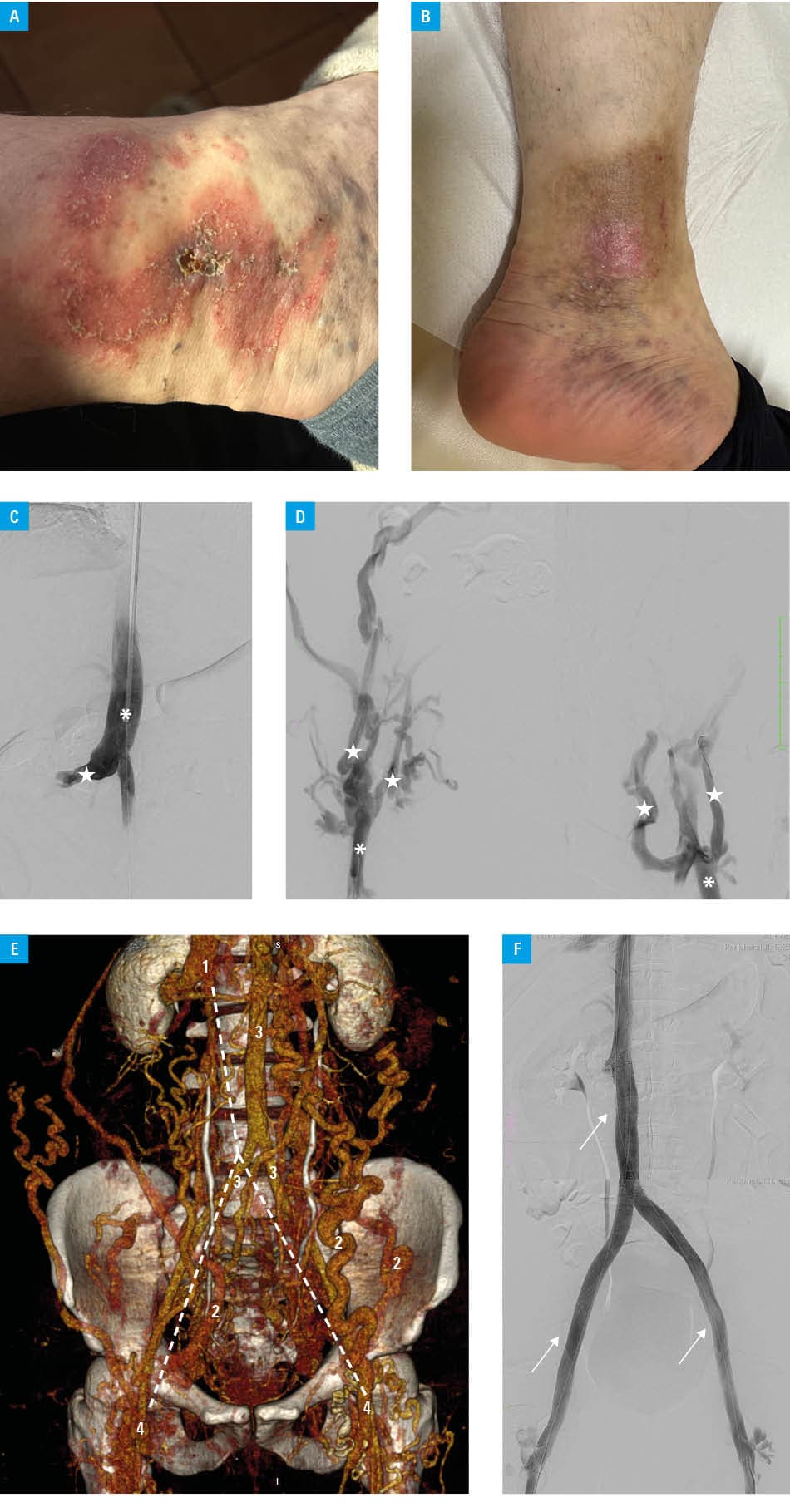
Antithrombotic therapy included apixaban (5 mg twice daily) and clopidogrel (75 mg daily) for 12 months. Direct oral anticoagulants (DOACs) should be administered for the duration of the patient’s life. The decision to discontinue DOACs or clopidogrel before surgery should be informed by established guidelines6 after careful evaluation of the surgical bleeding risk and the urgency of the procedure. The use of bridging therapy during interruption in DOAC administration has been demonstrated to be associated with an elevated risk of substantial bleeding, without concomitant reduction in the incidence of thromboembolic events.6 Therefore, it is not generally recommended for individuals who are taking DOACs. In the event of suboptimal treatment tolerance, the initial step should be the discontinuation of clopidogrel. This should be followed by a reduction in DOAC dose. Duplex ultrasonography at 1 and 6 months confirmed persistent patency of all stents with no restenosis. The venous ulcer healed completely, and the patient reported substantial improvement in symptoms and functional capacity.
In young patients with extensive collateral circulation and long‑segment iliocaval obstruction, the condition is often misinterpreted as congenital IVC agenesis. However, evidence suggests that many such cases represent long‑term sequelae of unrecognized catheter‑related thrombosis in infancy or childhood.4 Therefore, in young individuals with presumed IVC agenesis, obtaining a detailed medical history—particularly regarding neonatal or childhood central venous catheterization—should be considered mandatory. Differentiating true congenital agenesis from chronic post‑thrombotic occlusion has significant therapeutic implications, since the latter can often be successfully reconstructed endovascularly, as demonstrated in this case. Additionally, IVUS has become a crucial component of iliocaval reconstruction, enabling precise assessment of venous anatomy and accurate sizing of self‑expanding stents. Adequate inflow and outflow evaluation is essential for durable technical success.1
Endovascular recanalization under IVUS guidance allows for successful and durable treatment of chronic iliocaval occlusions. This approach leads to significant clinical improvement and restoration of venous function, even in long‑standing post‑thrombotic obstruction originating in the neonatal period.
- Kinariwala D, Liles A, Williams DM, Khaja MS. Iliocaval reconstruction: review of technique, challenges, and outcomes. Semin Intervent Radiol. 2022; 39: 464‑474. | Crossref
- Cieśla‑Dul M, Gawęda B, Wypasek E, et al. Residual iliofemoral thrombosis in a 31‑year‑old woman on oral contraceptives possessing heterozygous factor V Leiden, factor XIII Val34Leu allele and α-fibrinogen Thr312Ala allele. Pol Arch Med Wewn. 2009; 119: 822‑825. | Crossref
- Nowak SP, Pielok Ł, Stefaniak J. Thrombosis of inferior vena cava in the course of advanced alveolar echinococcosis. Pol Arch Intern Med. 2019; 129: 204‑205. | Crossref
- López‑Rubio M, Lago‑Rodríguez MO, Ordieres‑Ortega L, et al. A comprehensive review of catheter‑related thrombosis. J Clin Med. 2024; 13: 7818. | Crossref
- Kelly R, Blecha M. Recanalization of inferior vena cava and bilateral iliac veins 15 years after May‑Thurner syndrome‑related occlusion. Am Surg. 2023; 89: 6317‑6319. | Crossref
ARTICLE INFORMATION