
Applying international urinary tract infection guidelines in Poland: epidemiologic insights from southern Poland
Key words: AWaRe, guidelines, susceptibility, urinary tract infection, urology

 CC BY 4.0
Applying international urinary tract infection guidelines in Poland: epidemiologic insights from southern Poland
CC BY 4.0
Introduction: Urinary tract infections (UTIs) are a common condition and represent the second most prevalent infectious illness globally.
Objectives: This study aimed to determine the species‑specific share in positive cultures of UTIs in both inpatients and outpatients, and to assess the applicability of recent UTI treatment guidelines in patients from Silesia, southern Poland.
Patients and methods: This retrospective multicenter study analyzed 85 485 urine samples collected in Poland (2022–2023) from inpatients (n = 52 294) and outpatients (n = 33 191) with suspected UTIs. The study participants were grouped into 3 categories: premenopausal women, postmenopausal women, and men. Antibiotics were classified according to the World Health Organization Access, Watch, Reserve framework.
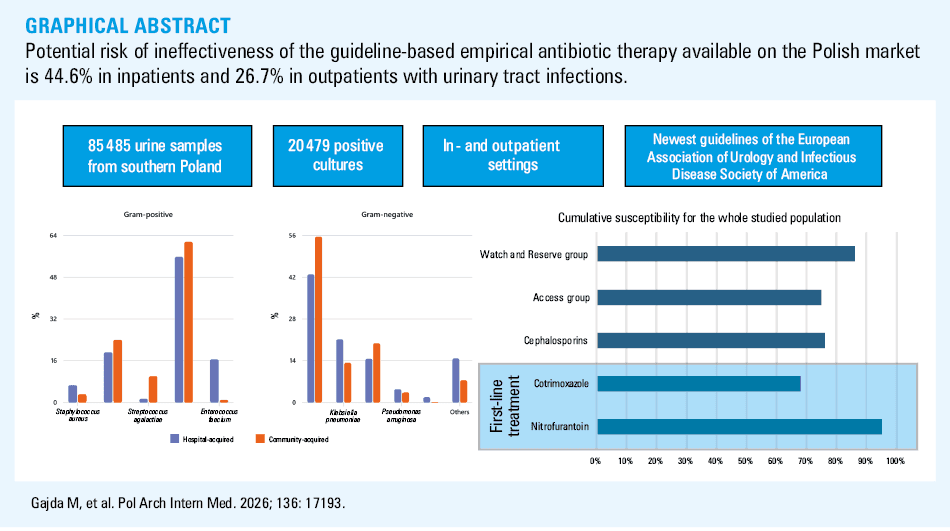
Results: The study showed low antibiotic susceptibility. The potential risk of empirically available therapy ineffectiveness was between 26.7% and 44.6%, depending on in- or outpatient status. In the inpatients, susceptibility of Escherichia coli to cotrimoxazole was 73%, and to cephalosporins at least 86.9% in premenopausal women, and about 76.6% in men and postmenopausal women. Susceptibility of Klebsiella pneumoniae exceeded 80% only in the case of cefoperazone / sulbactam (86.3%), but was below 60% for other drugs. Outpatient E. coli isolates showed 91.9% susceptibility to nitrofurantoin, but most other Access group agents fell below 60%, except for gentamicin (92%). Resistance was frequent: extended‑spectrum β-lactamases occurred in 12.8% of the outpatients and 32.9% of the inpatients, Enterobacterales and high‑level aminoglycoside resistance in 56.5% of the inpatients with Enterococcus faecalis and 63.7% of E. faecium.
Conclusions: Due to a high potential risk of ineffective empirical therapy based on current guidelines, its applicability to clinical practice should be further evaluated using more locally derived data.
What's new?
Our study showed estimated cumulative failure of empirical treatment of urinary tract infections based on the latest guidelines in one‑quarter to nearly one‑half of patients (outpatients vs inpatients, respectively). Furthermore, resistance to cotrimoxazole exceeded the 20% accepted in the guidelines as a safe local level. Due to the unavailability of nitrofurantoin on the Polish market and the lack of labeling for the newly introduced drug pivmecillinam, it is necessary, based on this study, to adapt the guidelines to local epidemiologic conditions considering further newly acquired data. Currently, in practice, none of the first- or second‑line drugs proposed in the guidelines demonstrate an adequate level of evidence‑based efficiency.
Introduction
Urinary tract infections (UTIs) are a common condition that pose a significant health burden for both patients and health care systems worldwide. The absolute number of UTI cases increased by 60%, from 252.25 million in 1990 to 404.61 million in 2019. Global deaths due to UTIs rose by 140%, from 98 590 in 1990 to 236 790 in 2019.1
UTIs can affect various structures of the urinary system, including the bladder (cystitis), urethra (ureteritis) and kidneys (pyelonephritis). Clinical consequences range from discomfort to serious complications, such as sepsis or kidney damage, often resulting in costly medical interventions. The 2025 Infectious Diseases Society of America (IDSA) guidelines introduced a new definition of a complicated UTI (cUTI) that significantly updates previous classifications. They now classify cUTIs as infections above the bladder in both women and men, as well as pyelonephritis, febrile or bacteremic UTI, catheter‑associated UTI, or prostatitis.2 This classification is based on clinical presentation, risk factor stratification, and the availability of appropriate antimicrobial therapy.3 Importantly, underlying conditions, such as diabetes, immunocompromise, or benign prostatic hyperplasia do not automatically classify a UTI as complicated unless accompanied by the above features. Therefore, according to the new IDSA definition, the vast majority of UTIs are uncomplicated.2
In community‑acquired UTIs (CA‑UTIs), Escherichia coli predominates. In health care–acquired UTIs (HA‑UTIs), E. coli remains the most common pathogen, but with a higher proportion of nonfermenting strains, enterococci, and polymicrobial infections. In studies conducted in southern Italy, 95% of CA‑UTIs were caused by gram‑negative bacteria, with E. coli accounting for nearly 60% and Klebsiella pneumoniae for 25%. HA‑UTIs showed a higher share of enterococci and Pseudomonas spp. (approximately 10% each), as well as an increased proportion of K. pneumoniae (up to 30%), while the proportion of E. coli was lower (39%), as compared with CA‑UTIs.4
UTIs also exhibit one of the most pronounced sex disparities among infectious diseases, with premenopausal women being 20–40 times more likely to develop a UTI than men of the same age.5 Between 50% and 60% of adult women will experience at least 1 UTI in their lifetime, and nearly 10% of postmenopausal women report having had a UTI in the previous year.6
UTIs present differently in pre- and postmenopausal women due to physiological and microbiological factors. Premenopausal women with UTIs more frequently report severe symptoms, such as malaise, pain during urination, and dysuria, whereas postmenopausal women tend to have milder symptoms. In premenopausal women, UTIs are most often caused by E. coli, while postmenopausal women exhibit a greater variety of pathogens and often more resistant infections, likely due to increased hospitalization and higher cumulative antibiotic exposure.7,8 The incidence of UTIs is by approximately 50% lower among older men than women; however, in individuals over 80 years, the proportion of women to men with UTIs is nearly equal.9-11
In 2017, the World Health Organization (WHO) proposed the Access, Watch, Reserve (AWaRe) classification as an antibiotic management strategy.12 This framework categorizes antibiotics according to their resistance potential into 3 groups. The Access group (A) includes agents with a low potential for resistance development, and should be used as the first‑line options. The Watch group comprises antibiotics that require strict monitoring, and should only be used when there is no alternative to A group agents. The Reserve group comprises agents that should be preserved as the last‑resort treatments, and includes newly developed drugs requiring special protection as well as older, more toxic antibiotics that should only be used when no alternatives are available. The AWaRe classification is updated every 2 years.12 According to the WHO AWaRe Book, the recommended first‑line options for the treatment of lower urinary tract infections in primary health care are nitrofurantoin (A), sulfamethoxazole + trimethoprim, trimethoprim (A), and amoxicillin + clavulanic acid (A).13
However, in the face of increasing antimicrobial resistance, an evidence‑based approach and the use of local antibiotic guidelines are crucial when selecting optimal treatment options. The most effective strategy is to align empirical therapy with international recommendations, such as those of the IDSA or the WHO AWaRe framework, while also incorporating data from local cumulative antibiograms. These antibiograms provide a comprehensive overview of antimicrobial susceptibility patterns of bacterial isolates within a specific hospital or region, thereby reflecting the local epidemiology of resistance. This is particularly important, as resistance profiles can vary significantly between geographic locations and health care settings.
In clinical decision‑making, especially when data on optimal susceptibility thresholds are limited, it is generally recommended to select agents with 90%–95% susceptibility when the risk of morbidity or mortality is high. Antibiotics with 80%–85% susceptibility may be considered acceptable for patients with a lower risk of adverse outcomes within the next 24–48 hours.14,15 Agents with susceptibility below 80% should be avoided as empirical treatment and reserved for situations when no alternatives are available. Nevertheless, interpretation of antibiograms should not occur in isolation; clinical and epidemiologic factors must also be considered to ensure optimal therapeutic outcomes.16
According to the latest guidelines of the European Association of Urology (EAU)17 and the Polish Urological Association,18 the first‑line treatment for uncomplicated UTIs in women includes fosfomycin, nitrofurantoin, or pivmecillinam. The Polish guidelines additionally recommend furazidine. As second‑line therapy for women, but first‑line for men, cephalosporins or trimethoprim‑sulfamethoxazole are advised.17,18 However, the availability of certain antibiotics and resistance rates differ between Poland and other European countries; for example, nitrofurantoin is not available in Poland. Moreover, no prospective studies have validated the guideline‑recommended empirical treatments in the European settings. Given the limited representation of specific populations in the studies underlying these recommendations, countries such as Poland may face a higher risk of the empirical therapy ineffectiveness. Therefore, this study aimed to analyze the bacterial etiology of UTIs and their resistance patterns in the context of empirical regimens recommended by the European and national guidelines for for CA‑UTIs and HA‑UTIs. The analysis also assessed the safety of UTI treatments using the WHO AWaRe classification.
Patients and methods
Patients and sampling
This retrospective, laboratory‑based, multicenter study included 85 485 urine samples collected between 2022 and 2023 from inpatients (n = 52 294) and outpatients (n = 33 191) presenting with clinical symptoms suggestive of a UTI, such as dysuria, urinary frequency, suprapubic pain, flank pain, and fever, as determined by physicians. Samples described by a physician as tests for bacteriuria were excluded. During the study period, 124 urine samples (0.15%) were collected from residents of long‑term care homes, and were not subject to a separate analysis. Microbiological identification and antimicrobial susceptibility testing (AST) data were analyzed. Diagnostic procedures were conducted at KORLAB Ruda Śląska, a large accredited commercial medical laboratory in Ruda Śląska, Poland, in accordance with applicable microbiological and infectious disease quality standards. During the study period, microbiological data were obtained from a single diagnostic laboratory that collaborated with over 200 outpatient clinics—including general practitioners and specialists such as urologists and gynecologists—and more than 100 single- and multiprofile hospitals across the Silesia region in southern Poland. This laboratory served approximately one‑sixth of the local microbiological diagnostics market in the region with a population exceeding 4.3 million.19 Based on international estimates of urine culture utilization (5000–10 000 per 100 000 population annually),20 the expected number of urine cultures performed annually in the Silesia region ranges from approximately 215 000 to 430 000.
Exclusion criteria included urine samples obtained via cystoscopy or other invasive procedures, age under 18 years, and cases involving yeast‑like organisms or polymicrobial infections. The dataset included patient age and sex, care setting (inpatient or outpatient), microbial species, and AST results; however, clinical diagnoses and comorbidity data were not available. Urine samples obtained via catheterization were not excluded from the analysis. Although catheter‑derived cultures are common in hospital laboratories and often exhibit distinct microbiological profiles—frequently reflecting colonization rather than true infection—they were included to reflect real‑world diagnostic practices.
HA‑UTIs were defined as cases diagnosed in a hospital, with urine collected on the third day of hospitalization or later. CA‑UTIs were defined as cases diagnosed in outpatients or in inpatients when urine was collected within 48 hours of admission. Due to the retrospective, laboratory‑based nature of this study, it was not possible to correlate urine culture results with clinical findings or to determine whether UTIs were uncomplicated or complicated. Based on the authors’ experience with exceptionally high device utilization rates in Polish hospitals, all HA‑UTIs were classified as complicated.
In accordance with the updated 2025 IDSA definition of cUTI, the study population was stratified into 3 clinically relevant subgroups to reflect differences in risk profiles and infection complexity2: 1) premenopausal hospitalized women (aged 18–54 y); this subgroup was distinguished due to its clinical significance, which includes women of childbearing potential—a factor that may influence both the course and management of UTI; 2) postmenopausal hospitalized women (>54 y); 3) men (both inpatients and outpatients) and outpatient women (>18 y).
This classification aligns with the current IDSA criteria, which emphasize anatomical and clinical factors over sex alone in defining complicated and uncomplicated UTI. Therefore, inclusion of both men and women in the analysis of uncomplicated UTI is consistent with contemporary standards, provided they do not meet the criteria for a complicated infection. The methodology was similar to a previous study carried out in Germany.21
Culture and identification
Our study included urine samples collected using different techniques (ie, newly inserted indwelling catheter, straight catheterization [in / out], or midstream collection) and analyzed quantitatively according to standard methods. Only nonduplicate urine samples with monoculture and a bacterial count of at least 102 CFU/ml (straight catheter) or at least 105 CFU/ml (midstream) were included. In total, 20 479 samples were positive; duplicate test results from the same patient were excluded based on the national personal identification number. The samples were cultured on the MacConkey agar and blood agar (37 °C, 24 h; all media from Becton Dickinson, Warszawa, Poland). The isolates were identified by matrix‑assisted laser desorption / ionization time‑of‑flight mass spectrometry (Biotyper; Bruker Corporation, Billerica, Massachusetts, United States).
All samples were classified according to the identified pathogen. For inpatient samples, the bacterial species identified more than 20 times were included in the Tables, with Streptococcus agalactiae retained regardless of frequency due to its clinical significance. For outpatient samples, the inclusion threshold was at least 50 samples of the same species, with Enterococcus faecium and Acinetobacter baumannii additionally included to allow comparison with inpatient data. For clarity, less frequent pathogens were clustered into groups of related species: coagulase‑negative staphylococci and other Enterobacterales, the latter defined as Enterobacterales other than E. coli and K. pneumoniae. The pathogens not meeting the above criteria were classified as others.
Antibiotic susceptibility
Antimicrobial susceptibility testing was performed with automated microbroth dilution using the MIDITECH system (BEL‑MIDITECH s.r.o., Bratislava, Slovak Republic). For the analysis of resistance mechanisms and antibiotic susceptibility, the 3 most common pathogens in both groups, E. coli, K. pneumoniae, and E. faecalis, were chosen. In addition, E. faecium was included due to its frequency in the inpatient group and its notorious resistance to multiple therapeutic classes.
Antimicrobial susceptibility, including susceptibility to oral mecillinam (pivmecillinam; uncomplicated UTI only, from 2021) for E. coli, Citrobacter spp., Klebsiella spp., Raoultella spp., Enterobacter spp., and P. mirabilis, was assessed according to the current guidelines of the European Committee on Antimicrobial Susceptibility Testing (EUCAST; clinical breakpoint Tables versions 12.0 and 13.1).22 Susceptibility was expressed as the percentage of susceptible isolates among all tested samples of a given species. Categorical interpretation of the antimicrobial test results followed the 3‑tier system (S, susceptible, standard dosing regimen; I, susceptible, increased exposure [equivalent to “susceptible dose‑dependent” in Clinical and Laboratory Standards Institute {CLSI} M39]; R, resistant), and was applied to the following antimicrobials: ampicillin, ampicillin / sulbactam, piperacillin, piperacillin / tazobactam, cefoperazone / sulbactam, cefotaxime, cefuroxime, ertapenem, imipenem, meropenem, ciprofloxacin, amikacin, gentamicin, colistin, cotrimoxazole, tigecycline, tobramycin, tetracycline, cefepime, ceftazidime, vancomycin, teicoplanin, linezolid, and nitrofurantoin. For all other antibiotics, the microorganisms were classified as either resistant (R) or susceptible (S). The strains with intermediate susceptibility (I) were included in the resistant group.
Percent susceptibility thresholds
Antibiotic susceptibility was categorized using CLSI M39‑based thresholds: green for susceptibility exceeding 80%, yellow for 61%–80%, and red for susceptibility below 60%. These cutoffs were applied to color‑code the antibiogram but were not used in isolation; clinical context and patient‑specific factors were always taken into account when making decisions regarding empirical therapy.16 The antibiotics were further classified according to the WHO AWaRe classification framework.13
Resistance mechanisms
The mechanisms of resistance were investigated according to the current guidelines of the EUCAST (Clinical Breakpoints Tables version 12.0 and 13.1).22 A variety of methods were used, with all disks obtained from Oxoid (Basingstoke, United Kingdom). Methicillin‑resistant Staphylococcus aureus was detected phenotypically by determination of the minimal inhibitory concentration (MIC) for cefoxitin and oxacillin. Macrolide‑lincosamide‑streptogramin B resistance was assessed using a method from MIDITECH (BEL‑MIDITECH s.r.o.); disk diffusion tests were performed with clindamycin (2 µg) and erythromycin (15 µg). Extended‑spectrum β-lactamase (ESBL) and AmpC β-lactamase production was evaluated using MIDITECH (BEL‑MIDITECH s.r.o.) and disk diffusion tests with amoxicillin with clavulanic acid (20/10 µg), cefotaxime (30 µg), ceftazidime (30 µg), cefepime (30 µg), and cefoxitin (30 µg). ESBL detection and characterization were recommended or mandatory for infection control purposes. High‑level aminoglycoside resistance (HLAR) was detected phenotypically by disk diffusion tests with gentamicin (30 µg). Glycopeptide‑resistant enterococci (GRE) were detected by MIC determination using the E‑test. Carbapenem resistance for imipenem, meropenem, and ertapenem was tested with the MIDITECH test (BEL‑MIDITECH s.r.o.) and MIC determination. In carbapenem‑resistant isolates, the presence of K. pneumoniae carbapenemase (KPC) was investigated using disk diffusion tests with meropenem and meropenem‑boronic acid disks. Metallo-β-lactamase production was investigated using disk diffusion tests with imipenem and ceftazidime, with and without EDTA. High‑level temocillin resistance (MIC >128 mg/l) was used as a phenotypic marker for OXA‑48‑like carbapenemase producers. The Carba Nordmann–Poirel test (bioMérieux SSC Europe Sp. z o. o., Warszawa, Poland) test was performed as a confirmatory assay for carbapenem hydrolysis.
Due to a low share in total resistance phenotypes, KPC, MBL, and GRE resistance was described in Supplementary material.
This study was approved by the Research Ethics Committee of the Jagiellonian University (118.0043.1.538.2024). All data were anonymized prior to analysis. The study was based on data obtained during routine clinical care and did not include any individual participant data. Therefore, informed consent from participants was not required.
Statistical analysis
Absolute values and percentages were used to describe the study population. The χ2 test was applied for group comparisons. Statistical analysis was performed using Microsoft Excel version 16.102.3 (Redmond, Washington, United States).
The potential risk of available empirical therapy ineffectiveness was estimated as weighted average based on the following equation:

where S% is a susceptibility rate.
A P value below 0.05 was considered significant.
Results
Etiology of community- and health care–acquired urinary tract infections
Overall, 20 479 patients, including 5690 hospitalized individuals, were eligible for the study.
The share of isolated bacteria differed significantly between outpatients and inpatients, but in both groups, the most frequently isolated organisms were Enterobacterales (69.3% in the outpatients and 61.8% in the inpatients). E. coli was present in 43.3% of the outpatients and 33.7% of the inpatients. Among the gram‑positive cocci, the most common species was E. faecalis (13.6% in the outpatients and 12.1% in the inpatients; Table 1).
Pathogen | Inpatients, n (%) | Outpatients, n (%) | P valuea |
a χ2 test | |||
Gram‑positive bacteria | |||
Staphylococcus aureus | 82 (1.4) | 104 (0.7) | <0.001 |
Coagulase‑negative staphylococci | 238 (4.2) | 785 (5.3) | <0.001 |
Streptococcus agalactiae | 19 (0.3) | 331 (2.2) | <0.001 |
Enterococcus faecalis | 688 (12.1) | 2011 (13.6) | <0.001 |
Enterococcus faecium | 204 (3.6) | 36 (0.2) | <0.001 |
Gram‑negative bacteria | |||
Escherichia coli | 1918 (33.7) | 6402 (43.3) | <0.001 |
Klebsiella pneumoniae | 945 (16.6) | 1548 (10.5) | <0.001 |
Other Enterobacterales | 654 (11.5) | 2292 (15.5) | <0.001 |
Pseudomonas aeruginosa | 201 (3.5) | 390 (2.6) | <0.001 |
Acinetobacter baumannii | 81 (1.4) | 22 (0.1) | <0.001 |
Other | 660 (11.6) | 868 (5.9) | <0.001 |
Total | 5690 (100) | 14 789 (100) | <0.001 |
Opportunistic pathogens, including Acinetobacter baumannii and Pseudomonas aeruginosa were more common in the inpatients than outpatients (1.4% vs 0.1% and 3.5% vs 2.6%, respectively), similarly to K. pneumoniae and E. faecium, which were significantly more frequent in the hospitalized individuals (16.6% vs 10.5% and 3.6% vs 0.2%, respectively; Table 1).
Antibiotic susceptibility testing
First- and second‑line antibiotics
In the entire study population, only 2 first‑line antibiotics were tested frequently enough to meet the inclusion criterion: cotrimoxazole and nitrofurantoin (eg, no susceptibility tests were performed for oral fosfomycin and pivmecillinam).
The inpatients showed 73% susceptibility to cotrimoxazole across all patient groups, while susceptibility was lower in the outpatients. Among the outpatient women, E. coli isolates demonstrated 91.85% susceptibility to nitrofurantoin, with even higher rates observed for E. faecalis.
In the inpatient setting, E. coli isolates from premenopausal women showed high susceptibility to all recommended cephalosporins (≥86.99%), whereas in men and postmenopausal women, susceptibility exceeded 76.58%. For K. pneumoniae, regardless of sex or age, the only second‑line treatment with high susceptibility was cefoperazone / sulbactam (86.25%), while all other agents did not reach 60%.
In the outpatient setting, E. coli isolates remained highly susceptible to cephalosporins (>86%), whereas K. pneumoniae showed lower susceptibility (<69%).
With the exception of outpatient treatment for E. faecalis, the data were insufficient to assess the recommended treatment for Enterococcus spp. (Table 2).
Inpatients | Premenopausal women | Others | ||||||
Antimicrobial agent | Escherichia coli | Klebsiella pneumoniae | Enterococcus faecalis | Enterococcus faecium | Escherichia coli | Klebsiella pneumoniae | Enterococcus faecalis | Enterococcus faecium |
a I scores – susceptible, increased exposure (or susceptible dose‑dependent)
Abbreviations: iv, intravenous; n/a, not available; ND, no data, not routinely examined; po, per os; uUTI, uncomplicated urinary tract infection | ||||||||
First‑line treatment, % | ||||||||
Fosfomycin, po | ND | ND | n/a | n/a | ND | ND | n/a | n/a |
Fosfomycin, iv | n/a | n/a | n/a | n/a | n/a | n/a | n/a | n/a |
Nitrofurantoin (uUTI) | n/a | n/a | n/a | n/a | n/a | n/a | n/a | n/a |
Pivmecillinam | ND | ND | n/a | n/a | ND | ND | n/a | n/a |
Cotrimoxazole | 75.8 | 60 | n/a | n/a | 67.5 | 40.5 | n/a | n/a |
Second‑line treatment, % | ||||||||
Cefepime | 91.9 | 59.5a | n/a | n/a | 86.5 | 42.2 | n/a | n/a |
Cefoperazone / sulbactam | 100 | 97.2 | n/a | n/a | 98.8 | 86.3 | n/a | n/a |
Cefotaxime | 87.7 | 55 | n/a | n/a | 78.2 | 30.9 | n/a | n/a |
Ceftazidime | 89.5 | 52.8 | n/a | n/a | 82.7 | 33.3 | n/a | n/a |
Cefuroxime, iv | 87a | 50 | n/a | n/a | 76.6 | 29 | n/a | n/a |
Outpatients | Women | Men | ||||||
First‑line treatment, % | ||||||||
Fosfomycin, po | ND | ND | n/a | n/a | ND | ND | n/a | n/a |
Fosfomycin, iv | ND | ND | n/a | n/a | ND | ND | n/a | n/a |
Nitrofurantoin (uUTI) | 91.9 | ND | 98.9 | n/a | n/a | ND | n/a | n/a |
Pivmecillinam | ND | ND | n/a | n/a | ND | ND | n/a | n/a |
Cotrimoxazole | 72.4 | 69.2 | n/a | n/a | 71.5 | 52.1 | n/a | n/a |
Second‑line treatment, % | ||||||||
Cefotaxime | 91.9 | 68.3 | n/a | n/a | 88.9 | 47.1 | n/a | n/a |
Cefuroxime, iv | 90.5a | 67.8a | n/a | n/a | 86.9a | 46.9a | n/a | n/a |
Other antibiotics: Access group
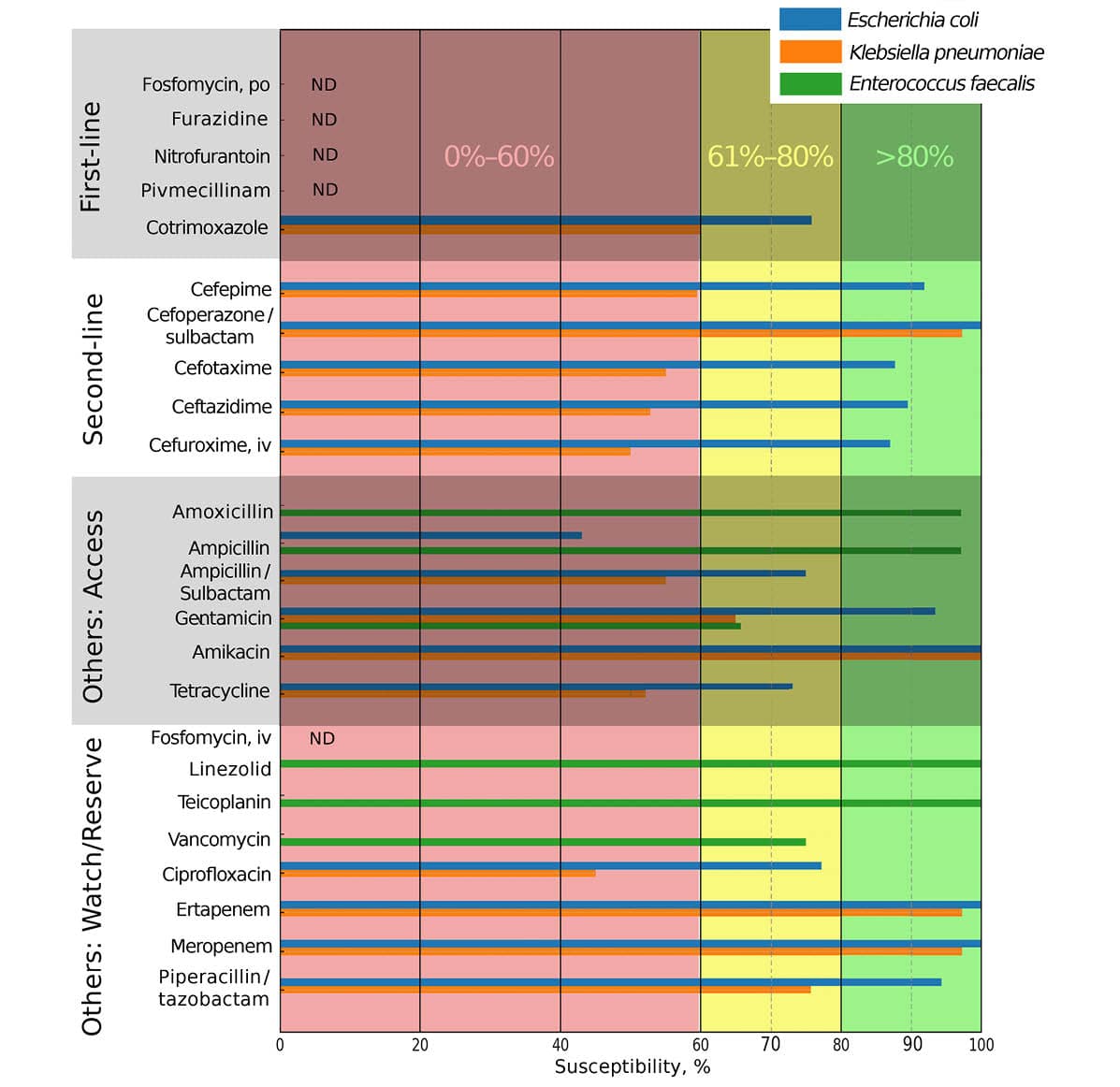
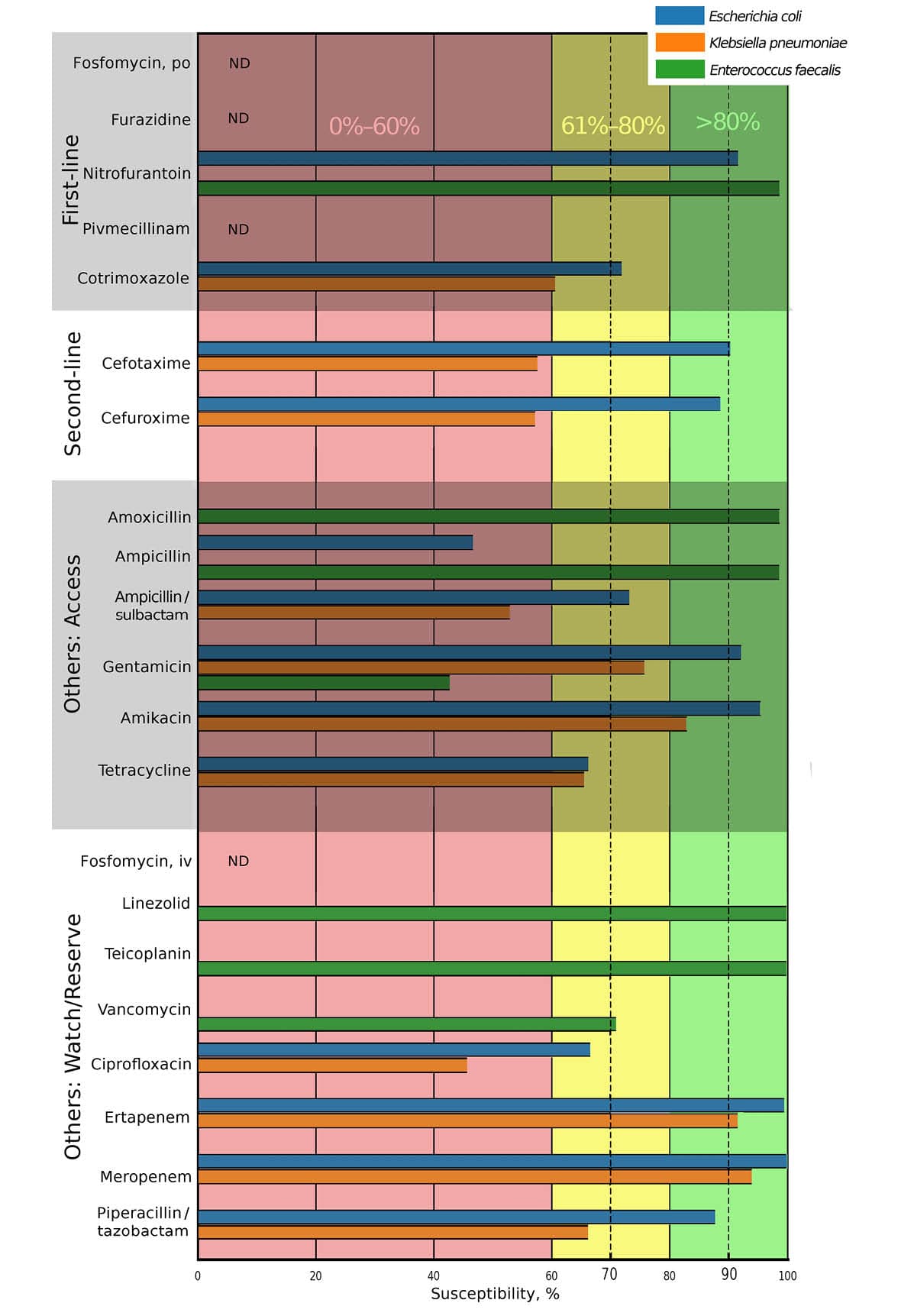
Among the first‑line antibiotics listed in the WHO AWaRe Book, only nitrofurantoin from the A group showed sufficient susceptibility in selected outpatient populations. Among the other A group antibiotics, only gentamicin was potentially useful against the most common isolates in our study, with susceptibility ranging from 92% for E. coli to 38% for E. faecium.
An over 80% susceptibility threshold was reached only by aminoglycosides for E. coli and by amoxicillin and ampicillin for E. faecalis.
In the 60%–80% range, aminoglycosides for K. pneumoniae, as well as ampicillin / sulbactam and tetracycline for E. coli, met the threshold. All other routinely assessed A group antibiotics showed susceptibility below 60% (Figures 1 and 2).
Abbreviations: see Table 2
Abbreviations: see Table 2
Other antibiotics: Watch and Reserve groups
Susceptibility exceeding 80% was observed for carbapenems and piperacillin / tazobactam in E. coli, and for carbapenems in K. pneumoniae. In E. faecalis, all recommended EAU agents (linezolid, teicoplanin), except vancomycin, reached the above 80% threshold, whereas in E. faecium only linezolid met this criterion.
Within the 60%–80% range, only piperacillin / tazobactam in K. pneumoniae and vancomycin in E. faecalis met the threshold. All other Watch / Reserve group antibiotics demonstrated susceptibility below 60% (Figures 1 and 2).
Resistance phenotypes
Among Enterobacterales isolated from outpatient samples, 13% exhibited at least 1 β-lactamase resistance mechanism. ESBL production was the most common, with prevalence of 12.8% in positive cultures.
In the inpatient samples, ESBL and carbapenemases production was observed in 32.9% and 3% of Enterobacterales isolates, respectively.
Among E. faecalis isolates, HLAR was detected in 28.4% of the outpatient samples and 56.5% of the inpatient samples.
Discussion
Gram‑negative bacilli were the dominant isolates in both inpatients and outpatients, accounting for 60% and 70% of cases, respectively. This was expected based on epidemiologic data; however, the proportion of Enterococcus spp., including multidrug‑resistant strains, was alarmingly high, accounting for about 15% of cases.23 Antibiotic susceptibility data differed markedly from the EAU expectations. Resistance to cephalosporins reached up to 70% depending on the microorganism, while cotrimoxazole resistance was as high as 60%. Fluoroquinolone efficacy did not exceed 70% in the overall population. The prevalence of HLAR in the cultures positive for E. faecium exceeded 55%, and ESBL production in K. pneumoniae reached 41%. ESBL‑producing bacteria were the most common resistance phenotype.
Additionally, there was a high share of bacteria classified as “susceptible, increased exposure” (formerly “susceptible‑dose dependent”), particularly to cephalosporins. This indicates that standard doses or dosing frequencies may be insufficient to achieve therapeutic efficacy.
The latest 2025 IDSA guidelines12 recommend cephalosporins for cUTIs. However, our results show that empirical use of cephalosporins in this patient population is questionable. Alternative options include carbapenems or piperacillin‑tazobactam, which were effective against E. coli and K. pneumoniae in our cohort but are unsuitable for oral outpatient therapy. Fluoroquinolones remain an oral option but susceptibility rates in Poland are unacceptably low.23 Importantly, in severely ill patients with sepsis, antibiotic efficacy should exceed 80% at the population level.2
In Poland, as in other European countries, current guidelines recommend several safe options for empirical treatment of UTIs, with pivmecillinam and fosfomycin among the primary choices.18 However, to the best of our knowledge, susceptibility testing for pivmecillinam and oral fosfomycin is not routinely performed in Poland. Limited availability of reagents for manual testing, together with the absence of these antibiotics in most automated AST systems, further hinder their routine assessment in clinical microbiology laboratories. Consequently, based on data from southern Poland, where the susceptibility of Enterobacterales strains to pivmecillinam and fosfomycin is unknown, and susceptibility to cotrimoxazole is approximately 60%, there is a potential risk of therapeutic failure with their use as empirical therapy.
Nitrofurantoin is not available on the Polish pharmaceutical market, but it is routinely included in Polish AST. Both nitrofurantoin and furazidine are approved for use within the European Union; however, furazidine (commonly used in Poland) is not routinely tested because of the lack of standardized protocols and interpretation criteria. At present, EUCAST does not provide clinical breakpoints for furazidine and does not recommend susceptibility testing for nitrofuran derivatives other than nitrofurantoin.24 Furthermore, furazidine is the only antibiotic available in Poland without prescription, and no evidence supports extrapolating of nitrofurantoin susceptibility results to furazidine. This creates significant challenges in assessing the potential effectiveness of empirical treatments recommended by the EAU.18
Additionally, cephalosporins recommended as the first‑line alternatives showed reduced efficacy, with resistance rates up to 55% in outpatients and over 70% in inpatients, consistent with the high share of ESBL producers in positive cultures. Aththanayaka et al25 reported similar findings, with 70% resistance to cotrimoxazole despite ESBL prevalence of less than 19%. In their study, the highest efficacy was observed for mecillinam and nitrofurantoin, which were not assessed in Poland. Findings from other Polish studies also support our hypothesis that current guidelines may have limited applicability to the Polish population.26 Among E. coli isolates, reported susceptibility was 85% to nitrofurantoin, 82% to cefuroxime, just over 60% to fluoroquinolones, and approximately 55% to cotrimoxazole.26
In a large population‑based study from Scandinavian countries, where pivmecillinam has been widely used for more than a decade, resistance rates remained between 4%–6%, which was unusual given the substantial increase in its consumption during this period.27 In our study, susceptibility to cephalosporins in premenopausal women was below 90% which, given the favorable safety profile of β-lactam antibiotics, may significantly limit available treatment options. Pivmecillinam may therefore represent a valuable therapeutic alternative for the Polish market.
The differences resulting from patient sex and age are primarily attributable to anatomical and hormonal factors, the latter mainly affecting the premenopausal period due to higher estrogen levels.5 Gu et al28 highlighted the different distribution of pathogens by sex, which affects AST results. In their study, higher susceptibility to cephalosporins, trimethoprim / sulfamethoxazole, and penicillins was observed in premenopausal women, as compared with men.28 In our cohort, sex‑related differences were mainly associated with variations in causative organisms rather than antimicrobial susceptibility. However, as shown in Figure 1, treatment of UTIs or bacteriuria in premenopausal women, particularly during pregnancy, may be challenging when K. pneumoniae is involved.
In a large United States (US) study conducted by Ku et al,29 UTI treatment was primarily based on cephalosporins and fluoroquinolones, with resistance rates of around 10% during the first infectious episode. In our study, similar cephalosporin resistance patterns were observed only for E. coli, which was also the dominant pathogen in the US study. However, the susceptibility of E. coli to fluoroquinolones in our cohort was too low to justify empirical treatment (64.72%–68.47% vs 91.2% in the US).29
The European Medicines Agency (EMA) issued warnings in 2019 regarding the use of fluoroquinolones due to rare but extremely serious adverse effects.30 Consequently, the EAU guidelines recommend reserving fluoroquinolones as the last‑line option, to be used only in the absence of alternatives. The EMA Pharmacovigilance Risk Assessment Committee reaffirmed these recommendations in 2023, emphasizing that fluoroquinolones should not be used in nonsevere infections that may resolve spontaneously or in recurrent lower UITs.31 Our findings support the recommendation against fluoroquinolone use for UTIs in Poland, particularly for empirical therapy, given the high resistance rates among the most common bacterial uropathogens.
A comparable challenge in evaluating the EAU‑recommended empirical regimens involves Enterococcus spp., for which susceptibility testing to the first‑line antibiotics (fosfomycin, nitrofurantoin, pivmecillinam, and cotrimoxazole) is routinely performed. Moreover, we observed high resistance rates to aminoglycosides (>30%) and glycopeptides (>20% for vancomycin), particularly in hospitalized patients. El‑Mahdy et al32 reported similar HLAR prevalence in a study from Egypt, although in their cohort all isolates were resistant to penicillins but remained fully susceptible to glycopeptides. A large Hungarian study analyzing over 40 000 urine samples found HLAR prevalence of approximately 45%, with an increasing trend over several years, although high susceptibility to ampicillin was preserved, consistent with our findings.33 Therefore, considering the recommended empirical options and the lack of determination of enterococcal susceptibility to the most used antibiotics (lack of routine AST), the risk of potential ineffectiveness of empirical therapy in this group may be considerable.
Although amoxicillin demonstrates high susceptibility rates against the most common isolates, it is not recommended for treatment, and its efficacy against E. coli has not been routinely assessed.
Considering the WHO AWaRe classification, our findings show that among the antibiotics recommended for the most frequently isolated pathogens, only aminoglycosides—despite their known toxicity—and penicillin derivatives for enterococci demonstrate acceptable susceptibility rates. Overall, the data suggest that empirical treatment based on current EAU guidelines carries a 50%–70% risk of potential empirical therapy ineffectiveness. This underscores the need to adapt international recommendations to local antibiotic susceptibility patterns, particularly within the Polish health care context. Our results highlight the substantial limitations of empirical therapy guided solely by international standards and support the use of β-lactam–based regimens as the most rational first‑line option in Poland, with aminoglycosides reserved for severe or complicated cases. Unfortunately, the limited effectiveness of the A group antibiotics and the overreliance on Watch and Reserve category drugs further emphasize the urgent need for revising national treatment guidelines to reflect local resistance trends.
Limitations
This study has several limitations. First, its retrospective design relied exclusively on anonymized laboratory reports, without access to individual clinical data. As a result, important clinical parameters, such as the anatomical site of the infection or the patient ability to receive oral treatment, could not be assessed, which limits the applicability of guideline‑based therapeutic recommendations to the studied cohort. Moreover, based on the authors’ experience, particularly in inpatient settings, urine cultures are often collected without clear symptoms of UTI, for example, as part of fever diagnostics or routine laboratory panels. Consequently, a proportion of isolates may represent asymptomatic bacteriuria rather than true infection, especially in catheter‑derived cultures. Nonetheless, these findings remain valuable for antimicrobial surveillance and resistance monitoring. Second, due to the retrospective nature of the dataset, the analysis was limited to antibiotics routinely tested in the participating diagnostic laboratory. For instance, intravenous fosfomycin was included, whereas the oral formulation was not assessed. HA‑UTIs in relation to cUTI status may also be affected by the retrospective nature of this study. Based on our clinical experience, we assumed that all HA‑UTIs should be treated as complicated due to more frequent use of medical devices.
Conclusions
Our findings, based on weighted averages, indicate that Polish patients receiving empirical therapy for UTIs face a potential risk of available empirical therapy ineffectiveness of up to 44.6% in the inpatients and 26.7% in the outpatients. Fortunately, this may be an exaggeration, as some key recommended antibiotics have not been evaluated. Current microbiological diagnostics and susceptibility testing in Poland do not provide a comprehensive assessment of all antibiotics recommended by the EAU, limiting the applicability of these guidelines. Within the context of the WHO AWaRe framework, greater emphasis should be placed on identifying effective, locally relevant alternatives. Based on our results and the available literature, pivmecillinam and oral fosfomycin may represent promising options; however, additional susceptibility studies in the Polish population are needed to confirm their utility. Given the limited support for empirical strategies outlined in the current guidelines and the high prevalence of ESBL‑producing strains, rigorous evaluation of the efficacy of available agents is essential to improve therapeutic outcomes in Poland.
- Yang X, Chen H, Zheng Y, et al. Disease burden and long‑term trends of urinary tract infections: a worldwide report. Front Public Health. 2022; 10: 888205. | Crossref
- Complicated Urinary Tract Infections (cUTI): Clinical Guidelines for Treatment and Management. https://www.idsociety.org/practice‑guideline/complicated‑urinary‑tract‑infections/. Accessed August 12, 2025.
- Johansen TEB, Botto H, Cek M, et al. Critical review of current definitions of urinary tract infections and proposal of an EAU/ESIU classification system. Int J Antimicrob Agents. 2011; 38 Suppl: 64‑70. | Crossref
- Trinchera M, Midiri A, Mancuso G, et al. A four‑year study of antibiotic resistance, prevalence and biofilm‑forming ability of uropathogens isolated from community- and hospital‑acquired urinary tract infections in Southern Italy. Pathogens. 2025; 14: 59. | Crossref
- Deltourbe L, Lacerda Mariano L, Hreha TN, et al. The impact of biological sex on diseases of the urinary tract. Mucosal Immunol. 2022; 15: 857‑866. | Crossref
SUPPLEMENTARY MATERIAL
ARTICLE INFORMATION