
Assessment of the type 2 diabetes risk using the Finnish Diabetes Risk Score questionnaire, and its predictors at the population level in Poland
Key words: diabetes, epidemiology, pollution, population, risk

 CC BY 4.0
Assessment of the type 2 diabetes risk using the Finnish Diabetes Risk Score questionnaire, and its predictors at the population level in Poland
CC BY 4.0
Introduction: Type 2 diabetes (T2D) represents a major public health challenge in Poland. This study investigated geographic heterogeneity and municipality‑level ecological predictors of a high T2D risk in the Świętokrzyskie Voivodeship (Poland), a region undergoing rapid socioeconomic transition.
Objectives: We aimed to identify associations between the T2D risk, assessed by the Finnish Diabetes Risk Score (FINDRISC), and socioeconomic and environmental factors.
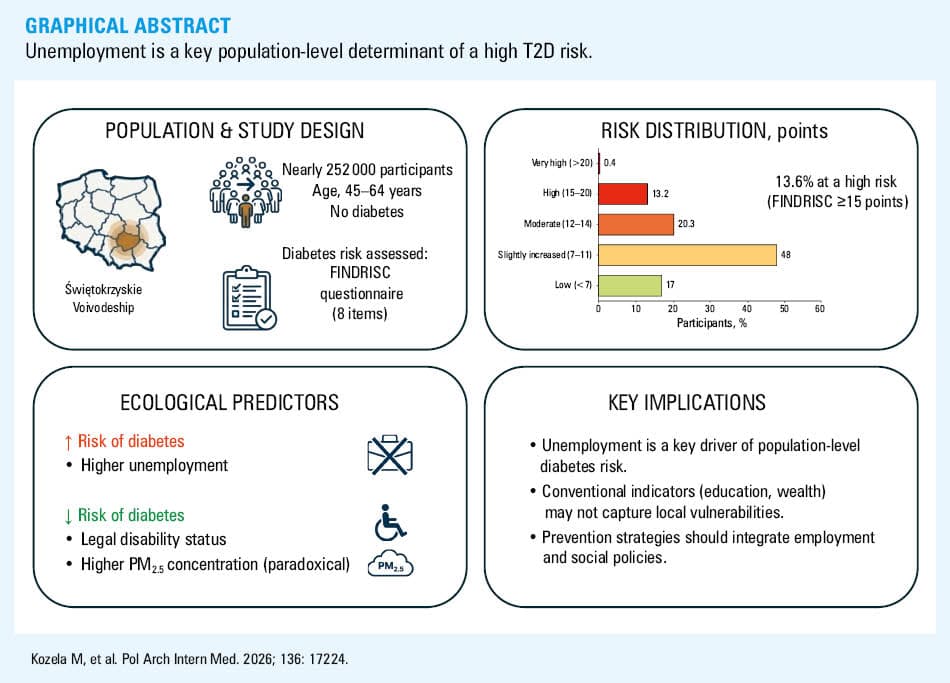
Patients and methods: This cross‑sectional study analyzed data from 252 427 residents of the Świętokrzyskie Voivodeship aged 45–64 years, without diagnosed diabetes, who participated in a regional prevention program (2019–2022). Individual risk, assessed via the FINDRISC questionnaire, was linked with municipality‑level ecological data. We used a logistic regression model with municipality‑clustered standard errors to identify predictors of a high T2D risk (FINDRISC ≥15).
Results: Overall, 13.6% of the participants were at a high risk of diabetes (FINDRISC ≥15), with significant geographic variation (P <0.001). Among municipality‑level predictors, higher unemployment rate was significantly associated with increased odds of a high T2D risk (odds ratio [OR], 1.14 per 1% increase; P <0.001), whereas higher proportions of legally disabled residents and higher annual mean concentrations of particulate matter with aerodynamic diameter of 2.5 μm or smaller were inversely associated with the prevalence of a high T2D risk (OR, 0.98; P = 0.03 and OR, 0.92 per 1 μg/m3; P = 0.001, respectively).
Results: were robust across sensitivity analyses using alternative FINDRISC cutoffs.
Conclusions: Unemployment was a key population‑level determinant of a high T2D risk, whereas other socioeconomic and environmental factors showed null or inverse associations. These findings underscore the importance of considering local context when assessing population‑level health determinants.
What's new?
This large, population‑based study of over 250 000 adults examined associations between the risk of developing type 2 diabetes (T2D), as assessed by the Finnish Diabetes Risk Score, and socioeconomic and environmental factors. We observed pronounced geographic variation in T2D risk across municipalities and counties in the Świętokrzyskie Voivodeship, identifying areas with particularly high prevalence of high‑risk individuals. Unemployment emerged as a significant population‑level predictor of an elevated risk, emphasizing the need to consider employment and social policies in preventive strategies. The absence of associations between university education or municipal wealth and T2D risk suggests that conventional socioeconomic indicators may not fully capture local vulnerabilities in postindustrial regions. These findings have practical implications for public health planning, indicating that targeting high‑risk municipalities with tailored prevention programs and community‑based interventions could improve diabetes outcomes at the population level.
Introduction
Type 2 diabetes (T2D) has emerged as a formidable global health challenge, constituting a noncommunicable disease epidemic of the 21st century.1,2 The International Diabetes Federation estimates that hundreds of millions of adults worldwide are living with diabetes, with projections indicating continued growth driven by economic development, urbanization, and corresponding shifts toward unhealthy diets and reduced physical activity.3 The socioeconomic costs associated with T2D are immense, threatening to overwhelm health care systems and making prevention and control a major development imperative.4,5 In Poland, the burden of T2D reflects these global trends. The disease affects a significant portion of the adult population, with prevalence estimates reaching 9.5% in men and 7.5% in women, posing a substantial and growing challenge to the national health care system.6,7 This situation is compounded by numerous undiagnosed cases, where treatment is delayed and the risk of severe complications increases. Population aging and lifestyle changes associated with economic progress are key drivers of this trend, underscoring the urgent need for effective, large‑scale prevention strategies.8
The Świętokrzyskie Voivodeship provides a particularly salient setting for investigating the drivers of T2D risk. As a region of a postcommunist country, it has undergone profound and rapid socioeconomic transition since the 1990s.9 This transformation has reshaped its economy, health care system, and residents’ daily lives, leading to significant lifestyle modifications, including shifts in dietary patterns and physical activity levels. The post‑1991 period saw the end of state subsidies for certain foods and the opening of markets to Western products, contributing to a “nutrition transition,” where traditional diets were increasingly replaced by those richer in animal fats and processed foods.10 This unique historical trajectory provides a valuable opportunity to study how modern risk factors for T2D manifest in a population with a distinct recent past, where the interplay between socioeconomic status and health may differ from that observed in countries with longer histories of market‑based economies.11,12
The Finnish Diabetes Risk Score (FINDRISC) is a widely validated, noninvasive, and cost‑effective questionnaire designed to identify individuals at a high risk of developing T2D within 10 years.13-16 Comprising 8 simple, self‑reported or easily measurable items—including age, body mass index (BMI), waist circumference, physical activity level, diet, as well as family and personal medical history—it is ideal for large‑scale public health screening programs, such as the one implemented in the Świętokrzyskie Voivodeship.13 The utility of FINDRISC lies in its ability to stratify populations by risk level, allowing targeted deployment of preventive interventions, such as lifestyle counseling, for those most likely to benefit. However, a critical consideration in applying FINDRISC is its generalizability. The score was developed and validated in a Finnish population, and its performance can vary significantly across different ethnic and geographic settings due to differences in genetic predispositions, lifestyle factors, and the prevalence of underlying risk factors.13 Studies have demonstrated the need to validate and sometimes modify the score—for instance, by adjusting BMI or waist circumference cutoffs—to ensure accuracy in diverse populations, from other European countries to Asia and Latin America. This necessity for population‑specific validation is a crucial lens through which the findings of the present study must be interpreted. So far, the score has been validated in Germany, Belgium, Switzerland, Greece, and Spain, but also in China and Saudi Arabia.
While individual lifestyle choices are the proximal causes of T2D, a growing body of evidence indicates that these choices are heavily shaped by the broader context in which people live. Adverse socioeconomic and environmental exposures often cluster in certain communities, amplifying individual risks by shaping behaviors, such as diet or physical activity, through structural rather than individual mechanisms. Unlike genetic factors, socioeconomic and environmental determinants are modifiable via public health policies.11,17 To develop effective public health strategies, it is essential to move beyond focusing on individual behaviors and understand how population‑level factors impact disease risk.
The availability of a large, population‑based dataset from the regional screening program in Świętokrzyskie Voivodeship provides a unique opportunity to evaluate the burden of T2D risk in this region and examine how broader population‑level variables, beyond the individual components of the FINDRISC score, are associated with an individual’s likelihood of developing T2D. Therefore, the objectives of this study were: 1) to describe the risk of T2D within the Świętokrzyskie Voivodeship and characterize its geographic heterogeneity across the region, and 2) to assess the effect of population‑level characteristics on T2D risk. These characteristics include socioeconomic indicators (education level, unemployment rate, disability rate) and features of the physical and built environment (air pollution, availability of green spaces and sports facilities).
Patients and methods
Study design and setting
This cross‑sectional study utilized data from the Regional Health Program for the Prevention and Early Detection of Type 2 Diabetes, a comprehensive public health initiative implemented in the Świętokrzyskie Voivodeship, Poland, and cofinanced by the European Social Fund. Originally scheduled for 2019–2021, the program was extended due to COVID‑19 pandemic–related operational challenges, with data collection ultimately spanning April 1, 2019 through December 31, 2022.
The study protocol received approval from the Bioethics Committee at the Jan Kochanowski University in Kielce, Poland (61/2025). Research was conducted in accordance with the Declaration of Helsinki, with all participants providing written informed consent before enrollment.
Study population
The program targeted all residents of the Świętokrzyskie Voivodeship aged 45–64 years, with no prior diagnosis of T2D. The final analytical dataset comprised 252 427 individuals who met these inclusion criteria and had complete data available. This corresponded to approximately 75% of the population in this age group and showed a sex distribution comparable to that of the target population, supporting the representativeness of the sample.
Data collection
Individual‑level variables
Trained nurses collected data on individual characteristics and risk factors during initial enrollment visits (different complementary models of data collection were utilized in order to access the maximum target population: computer‑assisted web interview, computer‑assisted telephone interview, computer‑assisted personal interview, paper‑and‑pencil interview). The primary assessment instrument was the validated FINDRISC questionnaire, which evaluated 8 domains: age, BMI (calculated based on height and weight measurements), waist circumference, daily physical activity (<30 vs ≥30 min), daily consumption of fruit and vegetables, history of antihypertensive treatment, history of elevated blood glucose, and family history of diabetes (first- or second‑degree relatives). Following assessment, all participants received individualized healthy lifestyle education based on the Polish Diabetes Association recommendations.18 The participants with specific risk factors, such as obesity, were offered additional comprehensive support, including consultations with a dietitian and physician. Quality assessment identified implausible values for waist circumference, body mass, and body height in a subset of participants. To address these anomalies, we recorded body height measurements greater than 210 cm and waist circumference values below 50 cm or above 150 cm as missing. Consequently, we could not compute the FINDRISC score for 2773 participants.
Municipality‑level data
To investigate potential associations between broader contextual factors and T2D risk, individual‑level data were linked with municipality‑level ecological data obtained directly from Statistics Poland through a formal data request. We received complete Tables containing all relevant indicators for the Świętokrzyskie Voivodeship, which were merged with individual records using official TERYT municipality codes. Data on unemployment (2020) and social assistance (2020) originated from the ongoing public statistical reporting system. Because disability status and educational attainment data are not collected within this system, data from the 2021 National Census were used. We selected reference years that most closely corresponded to the FINDRISC data collection period (2019–2022). All population‑level variables were originally provided as absolute counts and converted into relative measures (percentages or rates per 1000 inhabitants) using population denominators, also provided by Statistics Poland. The G‑score, an indicator calculated by the Ministry of Finance as a municipal tax revenue from the previous year divided by the number of residents, was included as a measure of fiscal capacity.
Environmental exposure was represented by annual mean concentration of particulate matter with aerodynamic diameter of 2.5 μm or smaller (PM2.5; µg/m3). Daily PM2.5 data for 2020 were obtained from 11 monitoring stations in the Świętokrzyskie Voivodeship operated by the Chief Inspectorate of Environmental Protection (https://www.gov.pl/web/gios) and averaged to produce annual values. Station locations largely corresponded to municipalities of participant residence, allowing estimation of ambient exposure; however, this ecological assignment represents an extrapolation and a study limitation.
Outcome definition
The participants were stratified by the total FINDRISC score. The primary outcome was a high risk for developing T2D, defined as a FINDRISC score equal to or greater than 15 points, combining the “high” (15–20 points) and “very high” (>20 points) risk categories. Individuals scoring below 15 points served as the lower‑risk reference group.
Statistical analysis
Baseline population characteristics were summarized using means (SD) for continuous variables and counts with percentages for categorical variables. The χ2 tests were used to assess whether the prevalence of a high T2D risk varied significantly across counties and municipalities within the voivodeship. Multivariable generalized linear model for binary outcome with municipality‑clustered standard errors was used to examine associations between regional socioeconomic and environmental characteristics and a high T2D risk, defined as a FINDRISC score ≥15. The binary outcome indicated whether an individual’s FINDRISC score met or exceeded this threshold. Sensitivity analyses were conducted using alternative cutoff values of 7, 10, and 12 points (Supplementary material). Observations with missing data were excluded using listwise deletion. Standard errors were clustered at the municipality level to account for potential within‑municipality correlation. Multicollinearity among predictors was assessed using variance inflation factors (VIFs) calculated from coefficients of determination obtained in auxiliary regression models; values exceeding 5 were considered indicative of high multicollinearity. All analyses were performed using R software (version 4.2.1; R Foundation for Statistical Computing, Vienna, Austria), with statistical significance set at a P value below 0.05.
Results
Population characteristics
The final study group comprised 252 427 individuals from the Świętokrzyskie Voivodeship, with near‑even sex distribution (women vs men, 49.5% vs 50.5%). The mean age of the participants was 52 (5.6) years. Detailed baseline characteristics are outlined in Table 1. The FINDRISC score distribution showed a substantial T2D risk burden (Figure 1). While almost half of the participants presented with slightly increased risk (48%), over one‑fifth (20.3%) demonstrated moderate risk. Cumulatively, 13.6% of the participants (n = 34 406) scored ≥15 points, placing them in the high‑to‑very‑high‑risk category, which represented the primary study outcome.
Parameter | Value |
Data are presented as mean (SD) or number (percentage).
Abbreviations: BMI, body mass index | |
Age, y | 52 (5.6) |
Women | 124 892 (49.5) |
Body mass, kg | 81.6 (17.4) |
Body height, cm | 170.8 (12.4) |
BMI, kg/m² | 28 (5.7) |
Waist circumference, cm | 95.6 (13.5) |
Cardiovascular disease | 26 043 (10.3) |
Dyslipidemia | 84 835 (33.6) |
Low physical activity | 87 807 (34.8) |
Family history of diabetes | 86 051 (34.1) |
Personal history of hyperglycemia | 65 829 (26.1) |
Hypertension treatment | 85 550 (33.9) |
Fruit / vegetable consumption (not daily) | 83 490 (33.1) |
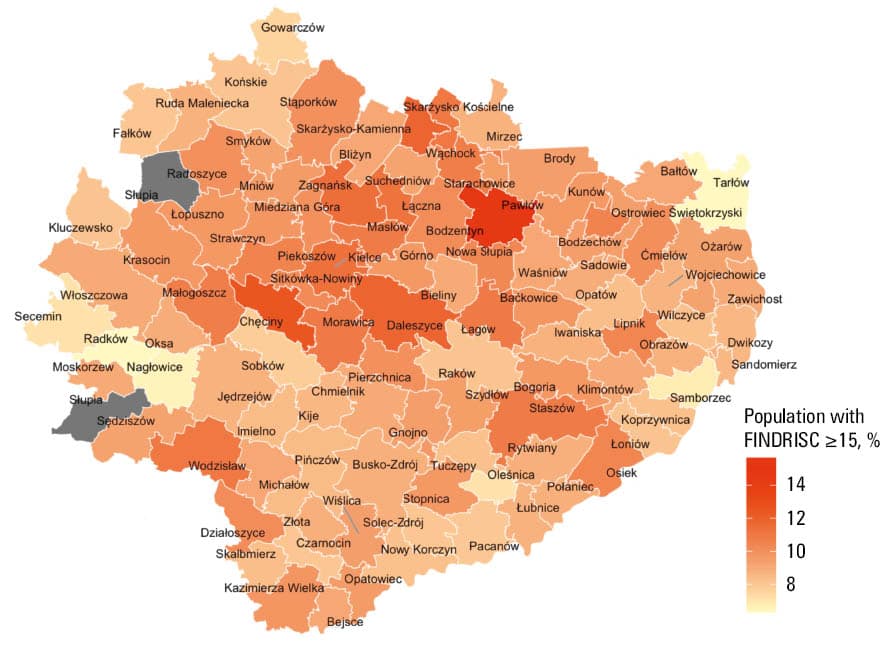
![Spatial distribution of individuals at a high risk of type 2 diabetes (T2D; Finnish Diabetes Risk Score [FINDRISC] ≥15 points) across municipalities in the Świętokrzyskie Voivodeship. Darker shades indicate higher prevalence of individuals at a high risk for developing T2D within 10 years. Gray areas represent municipalities with missing or insufficient data.](/paim/_next/image/?url=https%3A%2F%2Fpamw.pl%2Fsites%2Fdefault%2Ffiles%2Fjson_zip_files%2Funcompressed%2F17224%2FIMAGES%2FKP_WEB__FIG_01.png&w=3840&q=75)
Geographic heterogeneity
We noted pronounced, significant geographic disparities in the prevalence of a high T2D risk across the Świętokrzyskie Voivodeship. The χ2 tests confirmed significant variation between 14 counties (P <0.001) and across 102 municipalities (P <0.001). County‑level prevalence of high‑risk status ranged from 8.4% in Sandomierski County to 11.3% in Kielce city. The Pearson standardized residuals analysis identified Kielce city, Starachowicki, and Skarżyski counties as ones with significantly more at‑risk individuals than expected by chance. Municipality‑level variation proved even more striking, with the prevalence of a high T2D risk ranging over 2‑fold, from 6.3% in Tarłów to 15.2% in Pawłów. Several municipalities emerged as risk hotspots, including Pawłów, Kielce city, and Skarżysko‑Kamienna (Figure 2). This pronounced geographic clustering strongly suggests that local environmental and socioeconomic factors crucially shape regional T2D risk.
Population‑level predictors of a high type 2 diabetes risk
Population‑level predictors of a high T2D risk are presented in Table 2. Among socioeconomic factors, higher unemployment rate was associated with an increased T2D risk; each 1‑percentage‑point increase corresponded to 14% higher odds of a high‑risk status (odds ratio [OR], 1.14; P <0.001). Conversely, a higher percentage of legally disabled residents was associated with modestly lower odds (OR, 0.98; P = 0.03). The proportion of residents with university education, the proportion of those receiving social assistance, and the G‑score were not associated with a high T2D risk. With respect to environmental factors, higher annual mean PM2.5 concentrations were associated with lower odds of a high T2D risk (OR, 0.92 per 1 µg/m3 increase; P = 0.001). VIFs for all predictors were below 5, indicating no substantial multicollinearity.
Variable | Estimate | SE | z score | OR (95% CI) | P value | VIF |
a Results were derived from a multivariable model.
Abbreviations: G‑score, composite index of socioeconomic development; OR, odds ratio; PM2.5, particulate matter with aerodynamic diameter ≤2.5 μm; VIF, variance inflation factor | ||||||
Socioeconomic factors | ||||||
Unemployment, % | 0.13 | 0.03 | 3.84 | 1.14 (1.08–1.3) | <0.001 | 1.21 |
University education, % | 0 | 0 | 0.67 | 1 (0.99–1.01) | 0.51 | 3.94 |
Registered disability, % | −0.02 | 0.01 | −2.2 | 0.98 (0.97–0.99) | 0.03 | 2.31 |
Social assistance recipients, % | −0.01 | 0.01 | −0.67 | 0.99 (0.98–1.01) | 0.5 | 1.84 |
G‑score | 0 | 0 | −1.37 | 1 (0.99–1) | 0.17 | 3.4 |
Environmental factors | ||||||
Annual mean PM2.5 concentration, μg/m³ | −0.08 | 0.03 | −3.37 | 0.92 (0. 89–0.94) | 0.001 | 2.2 |
Discussion
This large‑scale analysis shows a complex and sometimes counterintuitive picture of population‑level factors determining the T2D risk in the Świętokrzyskie Voivodeship. Unemployment emerged as the only socioeconomic factor positively associated with a high T2D risk, whereas the level of education, being a recipient of social assistance, and municipal wealth showed no significant associations. Unexpectedly, inverse associations were observed for legal disability status and PM2.5 concentration. These results underscore that relationships between social determinants and health may not be universal but profoundly shaped by local context, particularly in regions with a unique history of socioeconomic transition.
The positive association between unemployment and elevated T2D risk highlights the importance of employment status as a social determinant of metabolic health at the population level. This finding aligns with individual‑level evidence: a systematic review and meta‑analysis of population‑based studies reported that unemployed individuals had approximately 1.7‑fold higher odds of T2D and 1.6‑fold higher odds of prediabetes, as compared with the employed participants.19 Subsequent studies have corroborated this association.20-22
In our analysis, no significant association was observed between municipal‑level educational attainment and T2D risk. This may appear unexpected, as education is commonly regarded as a key indicator of socioeconomic status. Typically, higher educational levels are associated with healthier lifestyles, better access to health care, and lower individual‑level diabetes risk.23-25 However, at the population level in the Świętokrzyskie Voivodeship, this expected protective effect was not found. This finding illustrates that ecological associations do not always mirror individual‑level relationships and may be influenced by unmeasured confounding arising from regional socioeconomic transitions, historical industrial decline, and demographic shifts that shape health outcomes in complex ways.
We observed an inverse association between the municipality‑level proportion of legally disabled residents and high T2D risk—a finding that appears counterintuitive, as disability is often linked with higher diabetes prevalence in individual‑level studies.26,27 Although many scientific societies and patient organizations recognize diabetes as a valid basis for legal disability status, in Poland, T2D alone does not qualify an individual for official registration.28 Such a status may be obtained only when T2D leads to significant complications and functional limitations. Therefore, the proportion of residents with registered disabilities should not be interpreted as a specific or sensitive marker of T2D risk, but rather as an indirect measure of the population‑level burden of diabetes complications.
The observed associations between environmental variables and estimated T2D risk at the population level show several important patterns. The negative relationship between annual average PM2.5 concentrations and estimated T2D risk appears paradoxical, particularly given the extensive literature linking long‑term exposure to fine PM with increased T2D incidence. The latest umbrella review and meta‑analysis confirmed that outdoor exposure to PM2.5, PM10, NO2, and O3 was significantly associated with an increased risk of T2D.29 However, subgroup analyses suggested that this relationship is complex and may be substantially confounded by contextual factors, such as age, study design, regions of exposure, and air pollution concentration levels. The analysis of air pollution in epidemiological studies presents substantial challenges, particularly in ecological designs, where reliance on external, highly aggregated exposure data and limited possibility to control for confounding may significantly bias the results. Our analysis relied on aggregate outdoor PM2.5 concentrations at the municipal level. In this context, the observed association is likely attributable to residual confounding rather than a true causal effect.30-32
Strengths and limitations
This study has several strengths that enhance the validity and importance of findings. The most important one is the exceptional population scale. With data from over 250 000 individuals, the analysis has high statistical power, enabling detection of even modest associations with high confidence. This large sample makes it one of the most comprehensive regional diabetes risk assessments in Poland. Second, the study applied robust statistical modeling, including VIF assessment, to evaluate potential multicollinearity among predictors and ensure reliable estimates. Third, sensitivity analyses using alternative FINDRISC cutoff values confirmed the robustness of the observed associations. Finally, the study offered context‑specific insights into how historical and socioeconomic transitions may shape the population‑level T2D risk, providing evidence to inform local public health policy. Additionally, the changing landscape of new antiobesity medications (glucagon‑like peptide‑1 receptor agonists [GLP‑1RAs]) prescribed in Poland, also in patients without diabetes, may alter prospective diabetes risk in the studied population.33 However, since the Świętokrzyskie Voivodeship is struggling with higher unemployment and economic problems relative to other voivodships, the use of GLP‑1RAs, which are mostly not reimbursed, was low and negligible as a factor influencing the study results.34
Despite these strengths, the study faces several important limitations requiring consideration when interpreting the results. The most significant one is its cross‑sectional design. Collecting exposure and outcome data at a single time point makes it impossible to establish causality and determine the temporal sequence of events. Another key limitation is the use of FINDRISC as a proxy for T2D risk rather than direct clinical diagnosis of T2D or prediabetes. Although FINDRISC is a well‑validated screening tool, its performance and optimal cutoff values vary across populations. In the absence of a Polish validation study against a gold standard, such as the oral glucose tolerance test, uncertainty remains regarding how accurately the score reflects the true prevalence of underlying dysglycemia. Using aggregated municipal‑level exposure data introduces potential ecological fallacy. Municipal characteristics do not necessarily apply to every resident. This measurement level mismatch between exposures and outcome can mask or distort true relationships. As highlighted by the paradoxical findings, the study was likely affected by unmeasured confounding. The analysis lacked granular individual‑level data on several key variables influencing T2D risk, such as personal income, detailed dietary patterns beyond the simple assessment of fruit / vegetable intake, specific physical activity types and intensity, and indoor environmental exposures. These unmeasured factors most probably explain the counterintuitive results regarding PM2.5 or disability status. Finally, associations could be further shaped by survey response biases.
Furthermore, some variables were derived from different reference years, potentially introducing temporal mismatches between exposure and outcome data. Although the time window was relatively narrow, such discrepancies may affect the precision of observed associations. Most socioeconomic indicators do not fluctuate substantially over short periods and can be considered relatively stable, reducing the likelihood of major bias from these temporal differences.
Because air pollution levels may vary from year to year, reliance on single‑year data may not fully capture long‑term exposure patterns. These limitations may lead to exposure misclassification, potentially attenuating true associations.
Although the Świętokrzyskie Voivodeship may be considered broadly typical of Poland, it exhibits some demographic and socioeconomic differences, such as faster population decline, accelerated aging, outmigration of younger residents, slightly lower education levels, and greater unemployment rate, which require caution when generalizing these results to the entire Polish population.
Conclusions
Unemployment was identified as a key population‑level determinant of T2D, whereas other socioeconomic and environmental factors showed null or inverse associations. These findings underscore the importance of considering local context when assessing population‑level health determinants.
- Abel ED, Gloyn AL, Evans‑Molina C, et al. Diabetes mellitus – progress and opportunities in the evolving epidemic. Cell. 2024; 187: 3789‑3820. | Crossref
- Pan C, Cao B, Fang H, et al. Global burden of diabetes mellitus 1990–2021: epidemiological trends, geospatial disparities, and risk factor dynamics. Front Endocrinol. 2025; 16: 1596127. | Crossref
- Collaborators GBD 2021 Diabetes. Global, regional, and national burden of diabetes from 1990 to 2021, with projections of prevalence to 2050: a systematic analysis for the Global Burden of Disease Study 2021. Lancet. 2023; 402: 203‑234. | Crossref
- Ganasegeran K, Hor CP, Jamil MFA, et al. A systematic review of the economic burden of type 2 diabetes in Malaysia. Int J Environ Res Public Health. 2020; 17: 5723. | Crossref
- Seuring T, Archangelidi O, Suhrcke M. The economic costs of type 2 diabetes: a global systematic review. Pharmacoeconomics. 2015; 33: 811‑831. | Crossref
SUPPLEMENTARY MATERIAL
ARTICLE INFORMATION