
Systemic and health care burden of elevated Fibrosis-4 index in the general population: a nationwide matched-cohort analysis
1,2 ,
Key words: chronic disease burden, comorbidity, Fibrosis-4 index, health care costs, health care utilization
,
Key words: chronic disease burden, comorbidity, Fibrosis-4 index, health care costs, health care utilization

 CC BY 4.0
Systemic and health care burden of elevated Fibrosis-4 index in the general population: a nationwide matched-cohort analysis
, CC BY 4.0
Introduction: The Fibrosis‑4 (FIB‑4) index, a widely used noninvasive marker of hepatic fibrosis, shows prognostic value beyond hepatology, yet its broader systemic and health care implications remain unclear.
Objectives: We aimed to characterize the systemic disease burden, health care utilization, and long‑term outcomes linked to elevated FIB‑4 score.
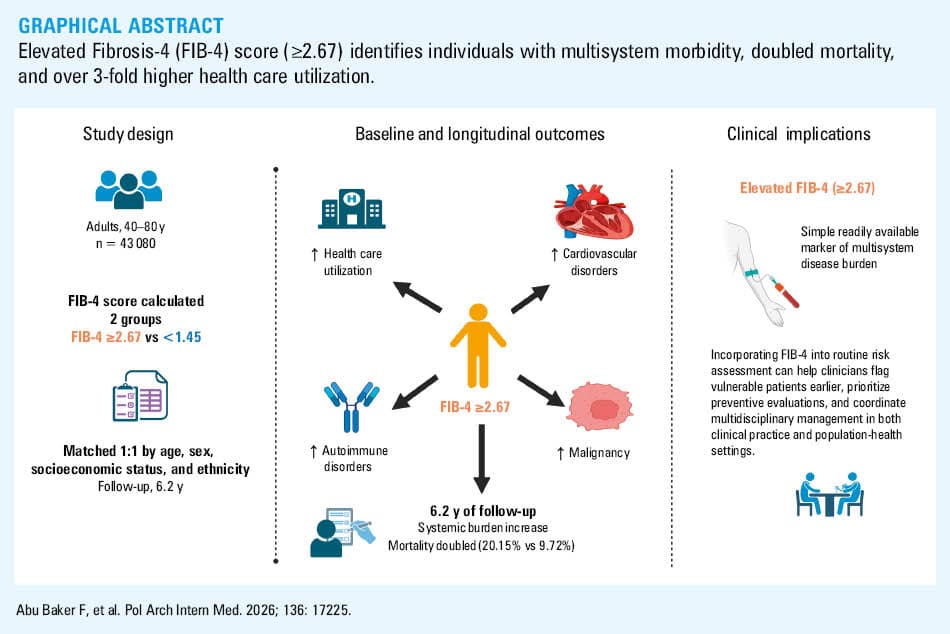
Patients and methods: We conducted a large‑scale, matched‑cohort study using real‑world data from a nationally representative health care provider. Adults aged 40–80 years with available laboratory data were included, comprising 21 540 individuals with FIB‑4 equal to or above 2.67, matched 1:1 to 21 540 controls with FIB‑4 below 1.45 by age, sex, socioeconomic status, and ethnicity. Cross‑sectional and longitudinal analyses assessed clinical characteristics, health care utilization, and long‑term outcomes over median (interquartile range) follow‑up of 6.2 (4.9–7.8) years.
Results: The individuals with elevated FIB‑4 exhibited substantially higher baseline rates of cardiovascular disease, autoimmune disorders, and malignancies. Elevated FIB‑4 was associated with greater pharmacologic exposure and higher utilization of multidisciplinary, diagnostic, procedural, and hospital‑based services. Over the follow‑up period, the individuals with FIB‑4 equal to or above 2.67 experienced consistently greater cumulative incidence of systemic diseases and doubled all‑cause mortality (20.2% vs 9.7%; P <0.001). Annual health care expenditures were more than 3‑fold higher in the high–FIB‑4 group, driven by hospitalizations, specialist care, and procedural intensity.
Conclusions: FIB‑4 equal to or above 2.67 robustly identifies individuals with disproportionate systemic morbidity, elevated mortality risk, and substantial health care resource utilization. Beyond staging hepatic fibrosis, FIB‑4 may function as a low‑cost marker of multimorbidity and health care complexity. Its incorporation into multidisciplinary risk stratification frameworks may enable earlier detection of high‑risk patients, inform preventive strategies, and support proactive population health management.
What's new?
The Fibrosis‑4 (FIB‑4) index, long used to stage hepatic fibrosis, signals a clinical picture much broader than fibrosis alone. In a nationwide matched cohort, individuals with FIB‑4 equal to or above 2.67 showed a substantially greater multisystem disease burden—spanning cardiovascular, immune‑mediated, and malignant conditions—together with markedly higher use of specialty care, diagnostic and interventional procedures, and hospital services. Over follow‑up, high FIB‑4 score was associated with roughly doubled all‑cause mortality and more than 3‑fold annual health care costs. These results reframe FIB‑4 as a simple, widely available marker of multimorbidity and health care complexity rather than a liver‑specific metric. Incorporating FIB‑4 into routine risk assessment can help clinicians flag vulnerable patients earlier, prioritize preventive evaluations, and coordinate multidisciplinary management in both clinical practice and population‑health settings.
Introduction
Chronic liver disease is a major and growing global health challenge, often progressing silently to advanced fibrosis, cirrhosis, and hepatocellular carcinoma (HCC).1-3 Early identification of individuals at a risk for advanced fibrosis is essential to enable timely surveillance, preventive measures, and disease‑modifying interventions.4 In recent years, noninvasive fibrosis assessment tools have become indispensable in both clinical practice and population screening.5
Among these, the Fibrosis‑4 (FIB‑4) index—derived from age, aspartate aminotransferase (AST) and alanine aminotransferase (ALT) levles, and platelet count—has achieved broad adoption due to its simplicity, reproducibility, and validation across diverse liver disease etiologies.6,7 Initially developed for viral hepatitis, FIB‑4 is now integrated into algorithms for metabolic dysfunction–associated steatotic liver disease (MASLD), hepatitis C elimination programs, and HCC surveillance.8,9
While its role in predicting liver‑related outcomes is well established, recent evidence highlights its prognostic value beyond hepatology. Elevated FIB‑4 has been linked to adverse cardiovascular outcomes, hypertension, stroke, heart failure (HF), chronic kidney disease (CKD), malignancies, and mortality in conditions such as atrial fibrillation and type 2 diabetes.10-14 These associations may reflect shared pathophysiological mechanisms—systemic inflammation, endothelial dysfunction, and metabolic dysregulation—between hepatic fibrosis and extrahepatic diseases.15 Elevated FIB‑4 has also been associated with gallstones, carotid atherosclerosis, insulin resistance, and worse outcomes in immune‑mediated disorders, such as psoriasis and rheumatoid arthritis.16,17
Despite this expanding literature, population‑based evaluations of FIB‑4 in unselected cohorts remain limited, particularly regarding studies linking FIB‑4 with health care utilization, pharmacologic exposures, and multisystem morbidity. Moreover, few investigations have comprehensively profiled the demographic, clinical, and health care characteristics of individuals across FIB‑4 strata outside liver‑focused cohorts.
To address these gaps, we conducted a large‑scale, matched, population‑based analysis using real‑world national health care data. We aimed to characterize the systemic disease burden, health care utilization patterns, and long‑term outcomes associated with elevated FIB‑4, and to assess its potential as a scalable, low‑cost marker for multimorbidity and health care complexity in the general population.
Patients and methods
Study design and data source
We conducted a retrospective, matched cohort study using the electronic health records (EHR) of Leumit Health Services (LHS), a national health maintenance organization covering about 1 million inhabitants in Israel. The database contains longitudinal, individual‑level data on demographics, diagnoses, laboratory results, prescriptions, imaging, procedures, hospitalizations, and mortality. The cohort included individuals identified between 2015 and 2019, with follow‑up extending through December 31, 2023. All data were deidentified prior to analysis; the study was approved by the LHS Institutional Review Board (LEU‑0033‑23), and conducted in accordance with the Declaration of Helsinki. The requirement for informed consent was waived due to the retrospective, noninterventional nature of the study and the use of deidentified data.
Study population and matching
Adults aged 40–80 years with available laboratory data for FIB‑4 calculation—(age × AST)/(platelets × √ALT)—were included. Cases were defined by the first recorded FIB‑4 score of 2.67 or above, a threshold with high specificity for advanced fibrosis (≥F3).18,19 Controls had FIB‑4 below 1.45 on all available measurements, indicating low fibrosis probability. Each case was matched 1:1 to a control by the year of birth within approximately 1 year, sex, ethnicity, and socioeconomic status (SES) to minimize confounding. The index date was defined as the first qualifying FIB‑4 measurement (≥2.67) for cases; for each matched control, the index date was assigned as the same calendar date as the corresponding case’s index date. Baseline variables were anchored to the closest available measurements within 6 months before the index date.
Demographic, lifestyle, and laboratory data
Demographics included age, sex, ethnicity (Arab, Jewish general, Jewish ultraorthodox), and SES (national census–derived 20‑point scale, grouped into 6 categories). Lifestyle factors comprised smoking status (never, past, current), alcohol use, intravenous drug use, and self‑reported physical activity (none, occasional, 1–3 h/week, >3 h/week). Based on body mass index (BMI) the patients were categorized as underweight, overweight, or obese. Comprehensive laboratory data were retrieved, including liver enzymes, hematologic indices, metabolic and lipid profiles, renal function, and inflammatory markers.
Clinical diagnoses and medication use
Diagnoses were ascertained from the International Classification of Diseases, Ninth Revision codes recorded by treating physicians, and grouped into predefined cardiovascular / metabolic, autoimmune, and malignancy categories.
Prescription data were extracted from pharmacy records using Anatomical Therapeutic Chemical codes and verified by free‑text review. The medications were grouped into analgesics, antibiotics, antiplatelets, anticoagulants, biologics, chemotherapeutics, and anticonvulsants. A patient was classified as a user if at least 1 dispensation occurred within the 12 months before the index date.
Health care utilization
Data on specialist consultations (eg, hepatology, cardiology, nephrology, oncology, rheumatology) and procedures (imaging, cardiovascular tests, endoscopy, endoscopic retrograde cholangiopancreatography, endoscopic ultrasound, major surgeries) were extracted from the EHR. Hospital‑based services included inpatient admissions, emergency visits, intensive care unit stays, oncology day hospitalizations, ambulance use, dialysis, radiation therapy, and associated health services. Annual direct health care costs were calculated from standardized Ministry of Health tariffs, expressed in New Israeli Shekels (NIS) and converted to USD.
Statistical analysis
Baseline characteristics were compared using the χ2 or Fisher exact test for categorical variables. Continuous variables were examined for distributional characteristics using histograms, Q–Q plots, and summary statistics. Variables demonstrating approximate symmetry are reported as mean (SD), and were compared using the t test, which is robust to mild deviations from normality in large samples. Skewed variables are presented as median (interquartile range), and were analyzed using the Mann–Whitney test. Missing data were minimal (<4% across all variables); therefore, a complete‑case approach was applied for all descriptive and follow‑up analyses.
Associations between FIB‑4 category and categorical outcomes are reported as odds ratios (ORs) with 95% CIs. The ORs were derived from exact 1:1 matched comparisons based on age, sex, ethnicity, and SES; therefore, effect estimates are adjusted for the matching variables by design, and no additional multivariable regression modeling was performed, consistent with the descriptive aims of the study. Because the analyses involved multiple groups of related outcomes, the Benjamini–Hochberg false discovery rate correction was applied within each analytic domain to account for multiple comparisons. The predefined domains included: 1) baseline comorbidities, 2) medication classes, 3) specialist consultations, 4) diagnostic and interventional procedures, and 5) incident long‑term outcomes.
Longitudinal outcomes—including cardiovascular, oncologic, autoimmune, renal, and those related to other chronic conditions—were assessed until death, last electronic record entry, or December 31, 2023. All statistical tests were 2‑sided, and a P value below 0.05 was deemed significant. All analyses were performed in R software, version 4.4.1 (R Foundation for Statistical Computing, Vienna, Austria), and visualizations were generated in Python, version 3.10 (Python Software Foundation, Wilmington, Delaware, United States).
Results
Baseline characteristics of the study population
A total of 21 540 individuals with elevated FIB‑4 scores (≥2.67) were matched 1:1 to controls with low FIB‑4 scores based on sex, year of birth, SES category, and ethnicity (Table 1). As expected, no between‑group differences were observed in sex distribution (53.7% women in both groups), ethnicity (12.9% Arab, 76% Jewish general, and 11.2% Jewish ultraorthodox in both groups), or SES categories, confirming adequacy of the matching strategy.
Variable | High–FIB‑4 (n = 21 540) | Controls (n = 21 540) | P valuea | |
Data are presented as number and percentage.
a P values are not shown for variables used in the matching procedure.
Abbreviations: BMI, body mass index; IV, intravenous; FIB‑4, Fibrosis‑4 index; SES, socioeconomic status | ||||
Demographics | ||||
Sex | Women | 11 572 (53.7) | 11 572 (53.7) | – |
Men | 9968 (46.3) | 9968 (46.3) | – | |
Ethnic group | Arab | 2778 (12.9) | 2778 (12.9) | – |
Jewish general | 16 360 (76) | 16 360 (76) | – | |
Jewish ultraorthodox | 2402 (11.2) | 2402 (11.2) | – | |
SES category | 0–3 | 522 (2.57) | 522 (2.57) | – |
4–6 | 4001 (19.69) | 4001 (19.68) | – | |
7–9 | 5171 (25.44) | 5171 (25.44) | – | |
10–11 | 5275 (25.95) | 5275 (25.96) | – | |
12–14 | 3954 (19.45) | 3954 (19.45) | – | |
≥15 | 1402 (6.9) | 1402 (6.9) | – | |
Age category, y | 30–49 | 3304 (15.33) | 3326 (15.44) | – |
50–59 | 5943 (27.59) | 6073 (28.19) | – | |
60–69 | 7267 (33.73) | 7277 (33.78) | – | |
70–89 | 5026 (23.33) | 4864 (22.68) | – | |
BMI category, kg/m2 | Underweight <18.5 | 367 (1.82) | 173 (0.87) | <0.001 |
Normal, 18.5–24.9 | 6021 (29.92) | 4701 (23.66) | <0.001 | |
Overweight, 25–29.9 | 7338 (36.47) | 8025 (40.38) | <0.001 | |
Obese ≥30 | 6396 (31.79) | 6973 (35.09) | <0.001 | |
Lifestyle factors | ||||
Physical activity | None | 8625 (44.92) | 7913 (41.59) | <0.001 |
Occasional | 5591 (29.12) | 6006 (31.57) | <0.001 | |
1–3 h/wk | 3621 (18.86) | 3763 (19.78) | 0.02 | |
>3 h/wk | 1363 (7.1) | 1342 (7.05) | 0.87 | |
Smoking status | Nonsmoker | 15 110 (76.3) | 14 525 (74.44) | <0.001 |
Past smoker | 614 (3.1) | 568 (2.91) | 0.27 | |
Current smoker | 4079 (20.6) | 4420 (22.65) | <0.001 | |
Alcohol use | 3209 (14.9) | 3555 (16.5) | 0.01 | |
IV drug use | 452 (2.1) | 326 (1.5) | 0.02 | |
BMI differed significantly between the groups. The high–FIB‑4 group had a higher proportion of individuals with normal BMI (29.9% vs 23.7%; absolute difference, 6.2 percentage points [pp]; P <0.001), whereas overweight and obesity were more prevalent among the controls (40.4% vs 36.5%; 3.9 pp; and 35.1% vs 31.8%; 3.3 pp, respectively; P <0.001 for both).
Several lifestyle‑related characteristics differed significantly between the groups. Individuals in the high–FIB‑4 group were more likely to report a lack of physical activity (44.9% vs 41.6%, 3.3 pp; P <0.001), while occasional or regular activity (>1 h per week) was more common in the control group. Smoking was slightly more prevalent in the controls (22.7% vs 20.6%; 2.1 pp; P <0.001). Importantly, alcohol consumption was higher among the controls (16.5% vs 14.9%; 1.6 pp; P = 0.01), while intravenous drug use was more prevalent in the high–FIB‑4 group (2.1% vs 1.5%; 0.6 pp; P = 0.02).
Taken together, even with closely matched demographic and socioeconomic characteristics, the individuals with elevated FIB‑4 displayed a distinct lifestyle profile, characterized by a higher prevalence of normal BMI, lower physical activity, modestly lower smoking and alcohol use, and slightly higher intravenous drug use.
Laboratory characteristics by Fibrosis‑4 index category
A comprehensive comparison of laboratory parameters between the individuals with high (≥2.67) and low (<1.45) FIB‑4 scores is presented in Supplementary material, Figures S1 and S2. Notable differences were observed across hepatic, metabolic, and hematologic indices.
Liver biochemistries were consistently higher in the high–FIB‑4 group, including transaminases, cholestatic enzymes, and ferritin (all P <0.001; Supplementary material, Figure S1). In contrast, lipid profiles demonstrated modest but significant differences, with lower high‑density lipoprotein cholesterol concentrations and lower low‑density lipoprotein cholesterol and triglyceride levels in the individuals with elevated FIB‑4.
As shown in Supplementary material, Figure S2, markers of synthetic liver function and systemic status differed significantly between the groups. The high–FIB‑4 group exhibited lower serum albumin and hemoglobin levels, alongside higher international normalized ratio (INR), bilirubin, and creatinine values (all P <0.001). Glycemic and hematologic indices were also significantly altered, reflecting broader metabolic and inflammatory perturbations associated with advanced fibrosis risk.
Overall, the laboratory profile of the high–FIB‑4 group was consistent with more advanced hepatic dysfunction, subtle metabolic attenuation, and broader systemic derangements in renal and hematologic indices.
Cardiovascular, autoimmune, and oncologic comorbidities
Marked differences in the burden of systemic comorbidities were observed between the individuals with high FIB‑4 (≥2.67) and those with low FIB‑4 (<1.45), encompassing cardiovascular, immune‑mediated, and malignant conditions.
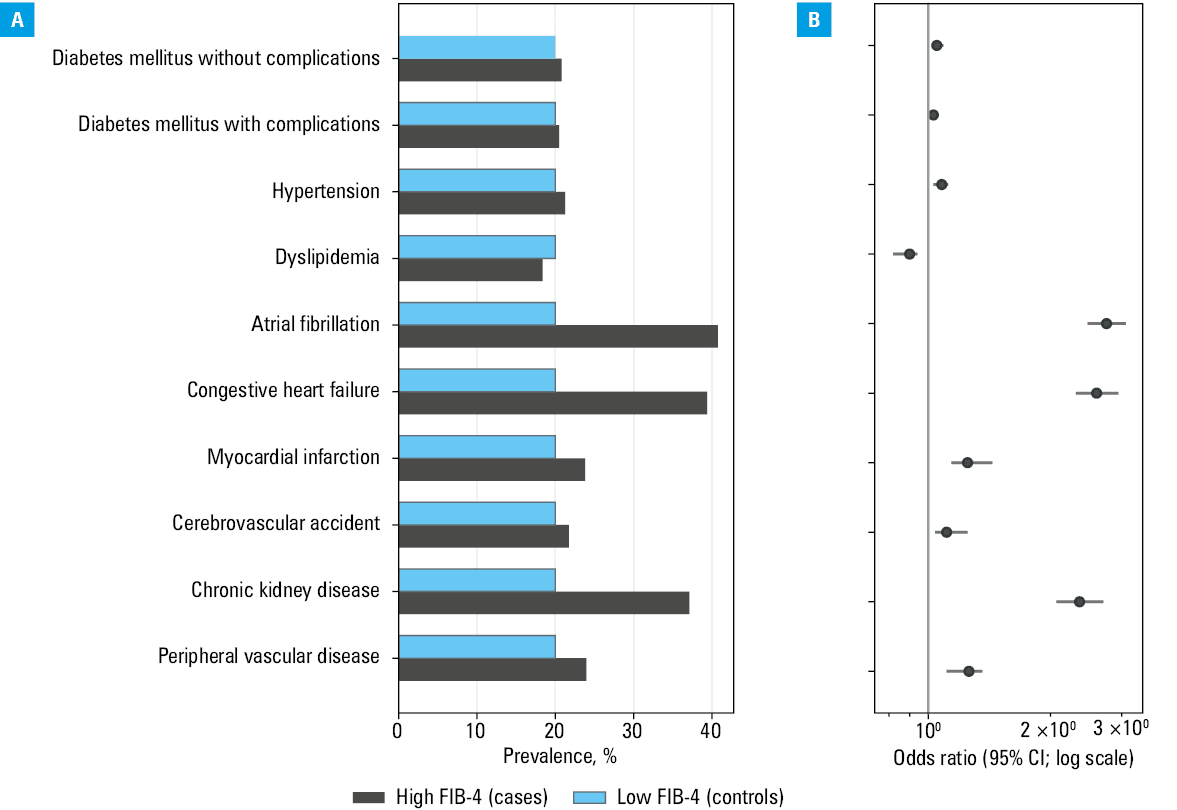
The patients in the high–FIB‑4 group had a significantly higher prevalence of major cardiovascular diseases (Figure 1). Congestive HF (CHF) was more than twice as common (OR, 2.6; 95% CI, 2.31–2.94), with similarly elevated odds of CKD (OR, 2.36; 95% CI, 2.07–2.7) and atrial fibrillation (OR, 2.75; 95% CI, 2.47–3.07). Atrial flutter demonstrated an even stronger association (OR, 3.68; 95% CI, 2.38–5.86). Hypertension was only minimally more frequent (OR, 1.08; 95% CI, 1.04–1.12), and dyslipidemia was slightly less common in the individuals with elevated FIB‑4 (OR, 0.9; 95% CI, 0.87–0.94).
Autoimmune conditions showed consistently higher prevalence in the high–FIB‑4 cohort (Supplementary material, Figure S3). Autoimmune hepatitis showed a strong association with elevated FIB‑4 (OR, 26.09; 95% CI, 8.3–82.3), with similarly higher odds observed for scleroderma (OR, 6.14; 95% CI, 3.73–10.11), Sjögren syndrome (OR, 3.25; 95% CI, 2.14–4.92), systemic lupus erythematosus (OR, 1.44; 95% CI, 1.38–1.5), and inflammatory bowel disease (IBD; OR, 1.91; 95% CI, 1.52–2.46). Additional moderate associations were observed for rheumatoid arthritis (OR, 1.77; 95% CI, 1.54–2.03), multiple sclerosis (OR, 1.83; 95% CI, 1.10–3.05), sarcoidosis (OR, 2.61; 95% CI, 1.78–3.83), celiac disease (OR, 1.74; 95% CI, 1.04–2.91), and autoimmune thyroiditis (OR, 1.48; 95% CI, 1.14–1.92).
Cancer prevalence was substantially higher among the patients with elevated FIB‑4 (Figure 2). Particularly strong associations were observed for metastatic cancer (OR, 17.47; 95% CI, 12.92–24.16; P <0.001), pancreatic cancer (OR, 27.54; 95% CI, 12.38–76.18; P <0.001), and hematologic malignancies (OR, 7.11; 95% CI, 5.68–8.99; P <0.001). Lung cancer also demonstrated a pronounced association (OR, 6.99; 95% CI, 5.08–9.83; P <0.001).
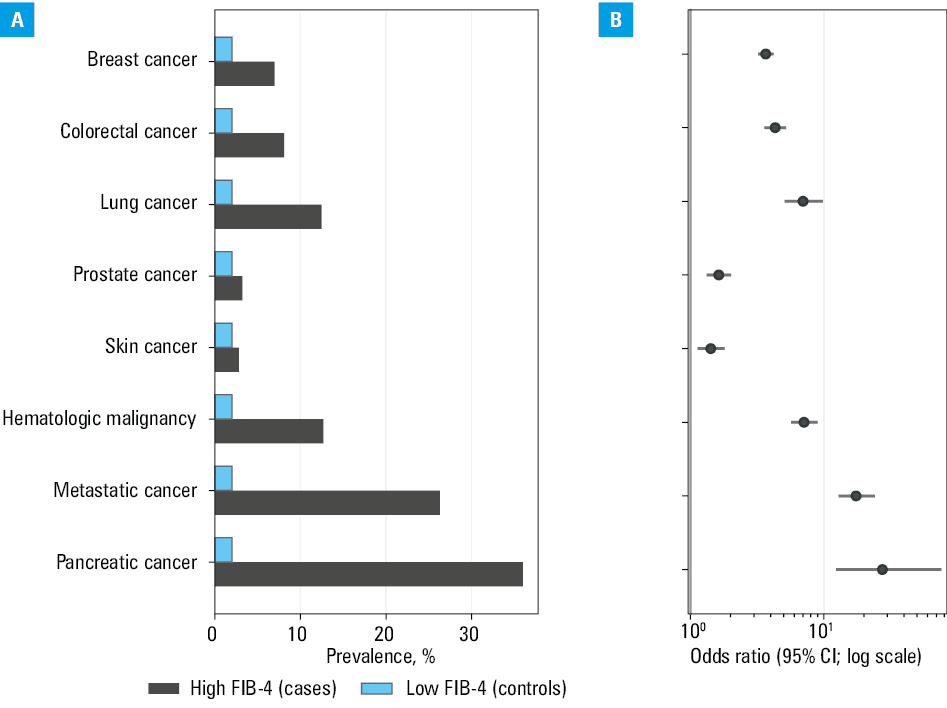
More common solid tumors showed markedly elevated odds in the high–FIB‑4 group, including breast cancer (OR, 3.67; 95% CI, 3.22–4.2; P <0.001), colorectal cancer (OR, 4.32; 95% CI, 3.59–5.22; P <0.001), and prostate cancer (OR, 1.63; 95% CI, 1.32–2.02; P <0.001). Skin cancer was also more frequent among the individuals with elevated FIB‑4, although with a more modest effect size (OR, 1.42; 95% CI, 1.13–1.8; P <0.001).
Thus, the patients with elevated FIB‑4 carried a substantially higher burden of cardiovascular, autoimmune, and malignant comorbidities, with the largest relative excess observed for hematologic and hepatobiliary cancers.
Medication prescriptions and specialist consultations
The patients with elevated FIB‑4 scores (≥2.67) exhibited significantly greater medication use across multiple therapeutic classes (Supplementary material, Figure S4).
Specialty consultation patterns further reflected the multisystem disease burden in the patients with elevated FIB‑4. Hepatology visits were markedly more frequent (OR, 6.13; 95% CI, 4.91–7.73), with similarly higher odds of outpatient consultations with specialists in oncology (OR, 3.47; 95% CI, 3.23–3.72), hematology (OR, 2.51; 95% CI, 2.34–2.7), and nephrology (OR, 1.74; 95% CI, 1.6–1.9). Elevated utilization also extended to cardiology (OR, 1.53; 95% CI, 1.47–1.6), neurology (OR, 1.4; 95% CI, 1.34–1.46), endocrinology (OR, 1.4; 95% CI, 1.34–1.48), pulmonology (OR, 1.34; 95% CI, 1.27–1.41), and rheumatology (OR, 1.45; 95% CI, 1.35–1.56), as demonstrated in Supplementary material, Figure S5.
These patterns indicate that high–FIB‑4 status is associated with broader pharmacologic exposure and more intensive, multispecialty outpatient care.
Health care procedure utilization
Elevated FIB‑4 scores were consistently associated with greater utilization of diagnostic and interventional procedures across cardiovascular, imaging, endoscopic, surgical, and hospital‑based domains. Cardiovascular assessments were more common, including transthoracic echocardiography (OR, 1.7; 95% CI, 1.64–1.77), cardiac Holter monitoring (OR, 1.53; 95% CI, 1.45–1.61), and treadmill stress testing (OR, 1.21; 95% CI, 1.14–1.28). Several imaging modalities demonstrated higher use in the high–FIB‑4 group, particularly abdominal ultrasound (OR, 2.3; 95% CI, 2.21–2.39), computed tomography scanning (OR, 1.77; 95% CI, 1.7–1.84), and chest X‑ray (OR, 1.55; 95% CI, 1.49–1.61; Supplementary material, Figure S6).
Endoscopic procedures showed strong associations, including colonoscopy (OR, 1.62; 95% CI, 1.56–1.69), upper gastrointestinal endoscopy (OR, 1.72; 95% CI, 1.65–1.8), and capsule endoscopy (OR, 1.96; 95% CI, 1.55–2.46). Hepatopancreaticobiliary interventions were also more common, including endoscopic retrograde cholangiopancreatography (OR, 4.14; 95% CI, 2.84–6.02) and endoscopic ultrasound (OR, 2.37; 95% CI, 1.81–3.1). Among surgical procedures, the patients with high FIB‑4 score were more likely to undergo colorectal surgery (OR, 1.75; 95% CI, 1.44–2.11) and laparoscopic cholecystectomy (OR, 2.13; 95% CI, 1.77–2.57). In contrast, several nonhepatobiliary procedures, including orthopedic and gynecologic surgeries (eg, total knee replacement and hysterectomy), showed similar or lower utilization rates, with ORs approximating unity, suggesting that the observed increases were not attributable to generalized procedural overuse. Liver transplantation occurred in the high–FIB‑4 group but not among the controls (50 vs 0 events), precluding a finite crude OR estimate without continuity correction (Supplementary material, Figure S7).
Hospital‑based services and supportive therapies were also more frequently utilized in the high–FIB‑4 group, including general hospital admission (OR, 2.33; 95% CI, 2.23–2.44), emergency department visits (OR, 1.62; 95% CI, 1.56–1.69), and ambulance transport (standard ambulance: OR, 1.93; 95% CI, 1.82–2.06; mobile intensive care ambulance: OR, 1.78; 95% CI, 1.66–1.91). Collectively, these findings show that elevated FIB‑4 is associated with higher use of diagnostic, endoscopic, and hospital‑based services, alongside relatively lower rates of elective nonurgent surgery, consistent with a more complex clinical profile.
Long‑term outcomes following median 6‑year follow‑up
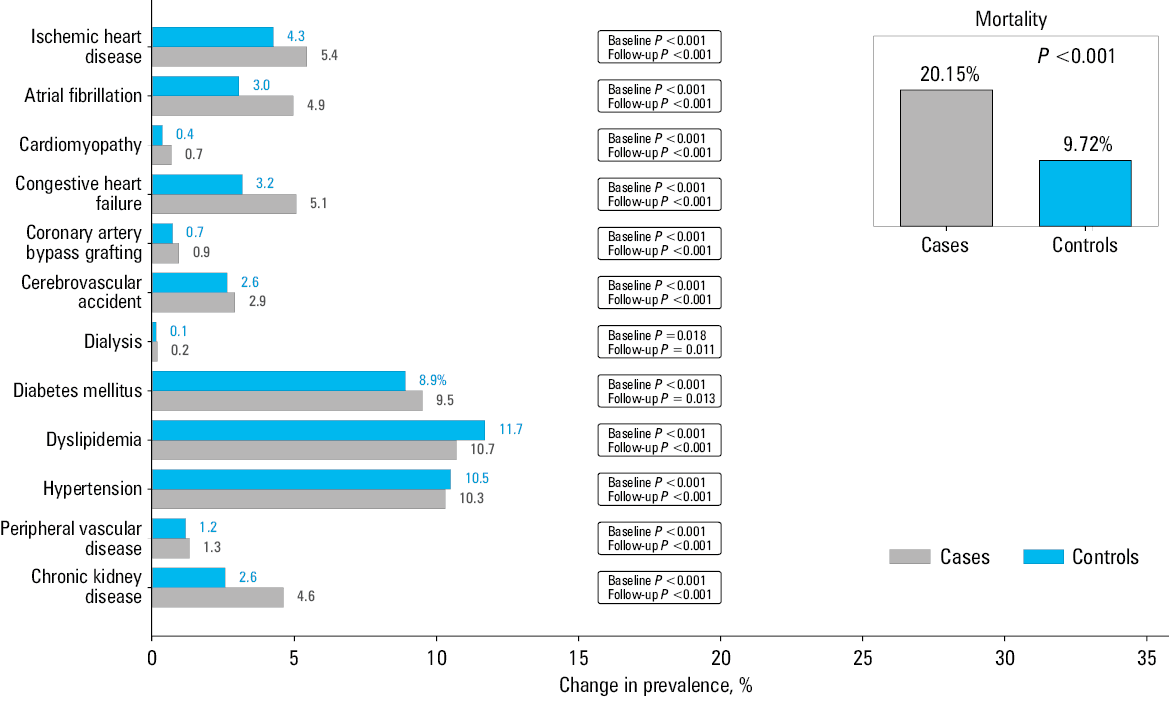
Among the individuals with elevated FIB‑4 scores (≥2.67), as compared with matched controls with low FIB‑4 (<1.45), longitudinal follow‑up over a median of 6.2 years (vs 6.8 y in the controls) demonstrated a markedly higher cumulative incidence of adverse clinical outcomes. All‑cause mortality was substantially higher in the high–FIB‑4 group (20.2% vs 9.7%; OR, 2.34; 95% CI, 2.22–2.48; P <0.001; Figure 3). Cardiovascular outcomes showed a consistent excess burden. CHF incidence nearly doubled over follow‑up (9.7% vs 4.6%; OR, 2.6; 95% CI, 2.31–2.94), CKD was more frequent (4.6% vs 2.6%; OR, 2.36; 95% CI, 2.07–2.7), and atrial fibrillation was more common in the individuals with high FIB‑4 (4.9% vs 3%; OR, 2.75; 95% CI, 2.47–3.07). Ischemic heart disease was also more frequent (5.4% vs 4.3%; OR, 1.62; 95% CI, 1.52–1.72), though with a comparatively smaller relative effect (all P <0.001).
Cancer incidence was substantially higher in the high–FIB‑4 cohort. Hematologic malignancies showed one of the strongest associations (1.7% vs 0.5%; OR, 7.11; 95% CI, 5.68–8.99), alongside metastatic cancer (OR, 17.47; 95% CI, 12.92–24.16). Solid tumors overall were markedly more prevalent (OR, 3.69; 95% CI, 3.43–3.97), with notable excess risks for colorectal cancer (2% vs 1.2%; OR, 4.32; 95% CI, 3.59–5.22), lung cancer (1.7% vs 1%; OR, 6.99; 95% CI, 5.08–9.83), and pancreatic cancer (OR, 27.54; 95% CI, 12.38–76.18; (Supplementary material, Figure S8).
Immune‑mediated diseases were also disproportionately more prevalent. Autoimmune hepatitis demonstrated a strong association (OR, 6.01; 95% CI, 2.67–15.86), with higher odds of scleroderma (OR, 6.44; 95% CI, 2.88–16.93), Sjögren syndrome (OR, 2.12; 95% CI, 1.51–3.01), systemic lupus erythematosus (OR, 7.03; 95% CI, 4.21–12.48), and IBD (2.4% vs 1.1%; OR, 1.91; 95% CI, 1.54–2.37; Supplementary material, Figure S9).
Endocrine and metabolic disorders accumulated similarly over time. Hypothyroidism (4.1% vs 2.3%; OR, 1.4; 95% CI, 1.3–1.51) and hyperparathyroidism (1% vs 0.4%; OR, 1.89; 95% CI, 1.55–2.32) were significantly more common in the individuals with elevated FIB‑4, as was gout (1.7% vs 1.1%; OR, 1.69; 95% CI, 1.5–1.91).
Taken together, longitudinal follow‑up demonstrated that elevated FIB‑4 identified the individuals with consistently higher cumulative incidence of cardiovascular, oncologic, autoimmune, and metabolic outcomes, as well as approximately doubled the risk of all‑cause mortality.
Health care–related costs
Health care expenditures were significantly higher among the individuals with elevated FIB‑4 scores across all domains of care (Figure 4). Annual mean (SD) per‑patient hospitalization costs were substantially greater in the high–FIB‑4 group than in the controls (14 944 [4750] vs 4756 [2200] NIS; mean difference, approximately 10 188 NIS [2750 USD]; P <0.001). The costs associated with emergency room visits, day hospitalizations, diagnostic and therapeutic procedures (4379 vs 1613 NIS), outpatient clinic visits, special treatments (3587 vs 342 NIS), dialysis, and surgical interventions (6380 vs 2501 NIS) were likewise significantly elevated (all P <0.001).
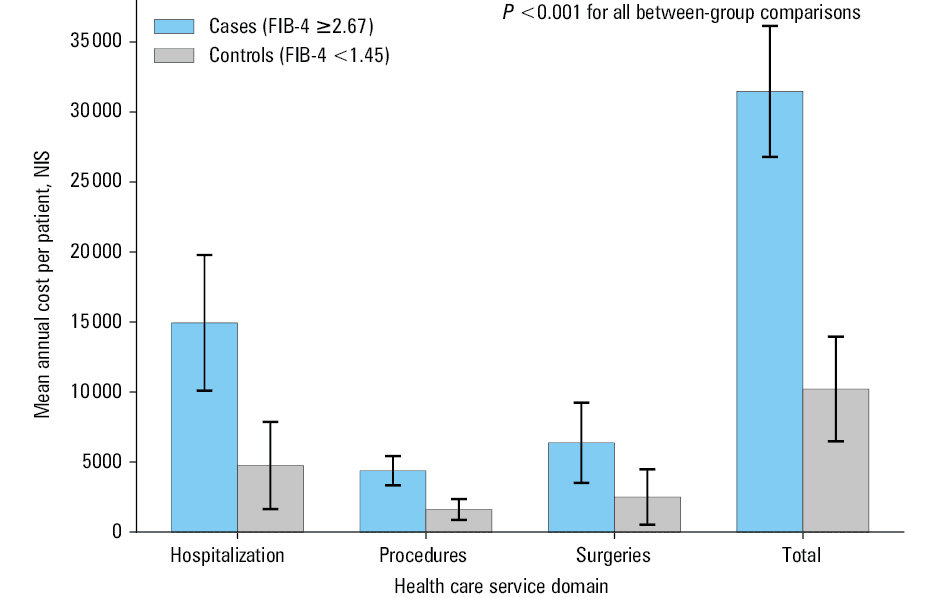
Abbreviations: NIS, New Israeli Shekel
The mean (SD) total annual cost per patient was 31 475 (4420) NIS (8510 USD) in the high–FIB‑4 group, and 10 217 (3480) NIS (2760 USD) among the controls—an excess of 21 258 NIS (5750 USD) per patient‑year (P <0.001).
These data underscore that elevated FIB‑4 is accompanied by a markedly higher direct health care cost burden at the individual level across all major domains of care.
Discussion
Our findings from this large, matched population‑based analysis underscore that elevated FIB‑4 score (≥2.67)—a widely used noninvasive index of advanced hepatic fibrosis—is not merely a surrogate of liver disease severity, but a sentinel marker of multisystem morbidity and systemic health care complexity.
The patients with high FIB‑4 exhibited classical biochemical features of advanced liver disease, including elevated transaminases, cholestatic markers (γ-glutamyl transferase, alkaline phosphatase), and impaired synthetic function (low albumin, elevated INR), consistent with hepatic dysfunction. Paradoxically, lower lipid levels and a lower prevalence of dyslipidemia were noted in this group, consistent with previous reports in advanced fibrosis, where impaired hepatic synthesis masks classical metabolic syndrome features despite persistent cardiovascular risk.20,21 This metabolic attenuation is also described in cirrhotic patients who maintain normal BMI, lipid, and glycemic indices despite significant vascular and inflammatory risk.22
In this context, the apparently paradoxical finding of a higher proportion of individuals with a normal BMI and a lower prevalence of current smoking in the high–FIB‑4 group is consistent with established clinical and biological patterns. Normal‑weight or nonobese phenotypes with substantial hepatic and cardiometabolic risk are well described in MASLD and “lean MASLD,” where a normal BMI may obscure excess visceral adiposity and a metabolically adverse profile.23 Advanced liver disease and systemic multimorbidity also predispose to sarcopenia, sarcopenic obesity, and cachexia, lowering measured body weight and creating a “normal‑BMI but high‑risk” phenotype observed in cirrhosis, HF, malignancy, and chronic inflammatory disorders.24 Furthermore, chronic disease trajectories often include unintentional weight loss and behavioral shifts, such as smoking cessation, so cross‑sectional smoking status may underestimate cumulative tobacco exposure in the high–FIB‑4 group. These mechanisms together may account for the observed BMI and smoking distributions and support the interpretation of high FIB‑4 as an indicator of systemic vulnerability rather than a simple surrogate for adiposity or lifestyle patterns.
Critically, the systemic disease burden extended far beyond the liver. The individuals with FIB‑4 equal to or above 2.67 had significantly higher rates of cardiovascular (HF, atrial fibrillation, ischemic heart disease), renal (CKD), autoimmune, and malignant conditions. These findings are consistent with and extend prior evidence from National Health and Nutrition Examination Survey and United Kingdom Biobank cohorts showing that elevated FIB‑4 predicts major adverse cardiovascular events and all‑cause mortality, independent of traditional risk factors.25,26 Shared mechanisms—including chronic inflammation, endothelial dysfunction, and insulin resistance—may underlie these associations.27,28
The burden of immune‑mediated and oncologic disease was particularly notable. While liver‑specific autoimmune disorders (eg, primary sclerosing cholangitis, autoimmune hepatitis) may directly influence FIB‑4 values, our findings revealed disproportionate rates of extrahepatic autoimmune diseases—including IBD, Sjögren syndrome, and systemic sclerosis—suggesting broader immune dysregulation. These findings echo recent studies highlighting FIB‑4 as a marker of systemic immune activation and chronic inflammatory load, even in nonhepatic contexts.29
In parallel, we observed significantly elevated rates of both solid organ and hematologic malignancies, with striking enrichment in gastrointestinal, hepatobiliary, and hematologic cancers, consistent with emerging literature linking advanced fibrosis to increased cancer risk.30,31 In interpreting the markedly higher prevalence of hematologic malignancies among the individuals with elevated FIB‑4, it is important to recognize that several disease‑related features may influence the score independent of hepatic fibrosis. Hematologic cancers, such as lymphoma, leukemia, and myelodysplastic syndromes commonly present with thrombocytopenia, systemic inflammation, and cytokine‑mediated fluctuations in aminotransferases, mechanisms that directly affect the platelet and transaminase components of the FIB‑4 equation. Similar influences have been described in chronic inflammatory and autoimmune disorders, where cytopenias and systemic inflammatory activity elevate noninvasive fibrosis scores despite limited histologic evidence of cirrhosis.32 These considerations suggest that higher FIB‑4 values in the context of hematologic or immune‑mediated disease may reflect broader physiological disturbance rather than liver‑specific fibrotic burden alone, providing a more nuanced interpretation of the observed association between FIB‑4 and cancer risk and underscoring its relevance as an indicator of systemic vulnerability.
These systemic patterns translated into markedly greater real‑world health care utilization. The patients with high FIB‑4 exhibited higher medication use across diverse pharmacologic classes—including antimicrobials, immunosuppressants, chemotherapeutics, and biologics—reflecting complex multisystem disease. Specialist consultations were also more frequent, particularly in hepatology, cardiology, nephrology, rheumatology, and oncology—mirroring the comorbidity landscape. These patterns support the interpretation of high FIB‑4 as a flag for care coordination needs, rather than a liver‑specific referral marker alone.33
Procedural utilization was also significantly higher among the high–FIB‑4 patients, spanning cardiovascular testing, abdominal imaging, endoscopy, hepatobiliary interventions, and oncologic surgeries. While some of this burden likely reflects surveillance for known conditions, it may also reflect the downstream consequences of under‑recognized systemic vulnerability. Interestingly, lower rates of elective orthopedic and gynecologic procedures among the high–FIB‑4 individuals may reflect clinical hesitancy to operate on medically complex patients—a concern previously noted in cirrhosis care.
Importantly, our longitudinal follow‑up over a median of 6 years confirmed the prognostic significance of elevated FIB‑4. Despite modestly shorter follow‑up among the high–FIB‑4 patients (likely due to excess early mortality), we observed a doubling in all‑cause mortality and sustained excess risk across cardiovascular, renal, autoimmune, oncologic, and neurologic outcomes. The acceleration in chronic disease diagnoses—including HF, hematologic cancers, and autoimmune hepatitis—further supports the conceptualization of high FIB‑4 as a marker of accelerated biological aging or cumulative systemic injury.
Health care costs were substantially higher in the high–FIB‑4 group, with excess expenditures spanning hospitalizations, diagnostic procedures, specialist care, and chronic therapies. The annual per‑patient cost difference of over 21 000 NIS underscores the substantial economic impact associated with high FIB‑4 score, reinforcing its value not only as a clinical but also a health system–level risk stratification tool.
Collectively, these data reframe FIB‑4 from a fibrosis staging instrument to a generalizable, low‑cost biomarker of chronic disease complexity. Its availability from routine laboratory tests, reproducibility, and validated thresholds make it a uniquely scalable marker for early identification of high‑risk patients in both primary and specialty care. As such, FIB‑4 equal to or above 2.67 may serve as a trigger for targeted screening (eg, cardiac or cancer evaluation), structured case management, or multidisciplinary referral, particularly in systems seeking to shift toward preventive, risk‑based care delivery.
This study represents one of the largest and most granular evaluations of the clinical, pharmacologic, and health care implications of elevated FIB‑4 in the general adult population. By leveraging national‑level real‑world data and rigorous 1:1 matching on demographic and socioeconomic variables, we minimized major sources of confounding and enhanced generalizability. The breadth of diagnostic, prescription, and procedural data enabled a comprehensive cross‑domain characterization of systemic risk associated with elevated FIB‑4.
Limitations
This study has several limitations. First, although long‑term outcomes were reported, the primary analyses were cross‑sectional and do not imply causality. Second, fibrosis stage was not confirmed histologically or by imaging, and FIB‑4 may be influenced by nonhepatic factors, such as thrombocytopenia or systemic inflammation. Third, although coding accuracy in this dataset is high, some degree of misclassification is unavoidable, and detailed measures of disease severity and functional impact were not available. Fourth, despite rigorous 1:1 matching by age, sex, ethnicity, and SES, we did not build exhaustive outcome‑specific multivariable regression models adjusting for lifestyle or metabolic factors, such as BMI, smoking, or physical activity. This reflects the descriptive aims of the study, but residual confounding cannot be excluded, and the associations presented here should not be interpreted as causal. Fifth, we used standard FIB‑4 cutoffs rather than age‑adjusted thresholds; although this preserves comparability with contemporary epidemiologic studies, age‑specific cutoffs may enhance risk stratification and merit evaluation in future work. Finally, while the findings are likely generalizable to other large integrated health care systems, extrapolation to low‑resource or fragmented settings should be undertaken with caution.
Conclusions
In conclusion, FIB‑4 equal to or above 2.67 is not merely a fibrosis surrogate—it is a robust, scalable marker of systemic morbidity, early mortality, and health care burden. Its integration into multidisciplinary risk stratification frameworks may facilitate earlier, more holistic care delivery, better resource planning, and improved patient outcomes. Future research should evaluate FIB‑4–guided interventions—including screening algorithms, specialist referral protocols, and case management models—to harness its full potential as a low‑cost tool for proactive population health management.
- Shearer JE, Jones R, Parker R, et al. The natural history of advanced chronic liver disease defined by transient elastography. Clin Gastroenterol Hepatol. 2023; 21: 694‑703. | Crossref
- Lekakis V, Papatheodoridis GV. Natural history of metabolic dysfunction‑associated steatotic liver disease. Eur J Intern Med. 2024; 122: 3‑10. | Crossref
- Reddy KR, McLerran D, Marsh T, et al. Incidence and risk factors for hepatocellular carcinoma in cirrhosis: the multicenter hepatocellular carcinoma early detection strategy (HEDS) study. Gastroenterology. 2023; 165: 1053‑1063. | Crossref
- Liguori A, Zoncapè M, Casazza G, et al. Staging liver fibrosis and cirrhosis using non‑invasive tests in people with chronic hepatitis B to inform WHO 2024 guidelines: a systematic review and meta‑analysis. Lancet Gastroenterol Hepatol. 2025; 10: 332‑349. | Crossref
- Calès P, Canivet CM, Costentin C, et al. A new generation of non‑invasive tests of liver fibrosis with improved accuracy in MASLD. J Hepatol. 2025; 82: 794‑804. | Crossref
SUPPLEMENTARY MATERIAL
ARTICLE INFORMATION