
Cushing disease caused by ectopic sphenoid pituitary macroadenoma: a major interdisciplinary challenge in everyday clinical practice

 CC BY 4.0
Cushing disease caused by ectopic sphenoid pituitary macroadenoma: a major interdisciplinary challenge in everyday clinical practice
CC BY 4.0
Ectopic pituitary adenomas are extremely rare (approximately 2% of all pituitary adenomas), nonsellar benign neoplasms arising from embryonic remnants of the pituitary gland, usually located along the migration path of the Rathke pouch (sphenoid sinus, clivus, or nasopharynx).1-4 Most are hormonally active, with ectopic adrenocorticotrophin (ACTH)-secreting pituitary adenomas (EAPAs) predominating.1 Discriminating EAPAs from Cushing disease (CD) and other cases of extrapituitary ectopic ACTH secretion is particularly challenging and requires a thorough evaluation that includes clinical features, dynamic biochemical studies, and multimodal imaging.
We present a case of a 52‑year‑old woman with progressive weight gain (25 kg over 2 y), uncontrolled hypertension, easy bruising, and emotional lability. Physical examination showed central obesity and grade 3 hypertension. Biochemical evaluation confirmed the diagnosis of CD (pituitary origin); however, high‑resolution pituitary magnetic resonance imaging (MRI) identified no intrasellar lesion. Instead, a contrast‑enhanced soft‑tissue lesion was identified in the left sphenoid sinus (Figure 1A and 1B), which raised a suspicion of EAPA. Furthermore, somatostatin receptor scintigraphy (SRS) with single‑photon emission computed tomography (CT)/CT; Figure 1C and 1D) was performed, and demonstrated increased radionuclide uptake corresponding to the described lesion. CT examination of the chest, abdomen, and pelvis showed no relevant pathology. Subsequently, the patient underwent transsphenoidal removal of the mass (Figure 1E). Histopathological examination demonstrated a pituitary neuroendocrine tumor consistent with a silent corticotroph tumor, with positive immunohistochemical staining for T‑PIT (Figure 1F–1H). Clinical features of hypercortisolism resolved completely within a few months after surgery.
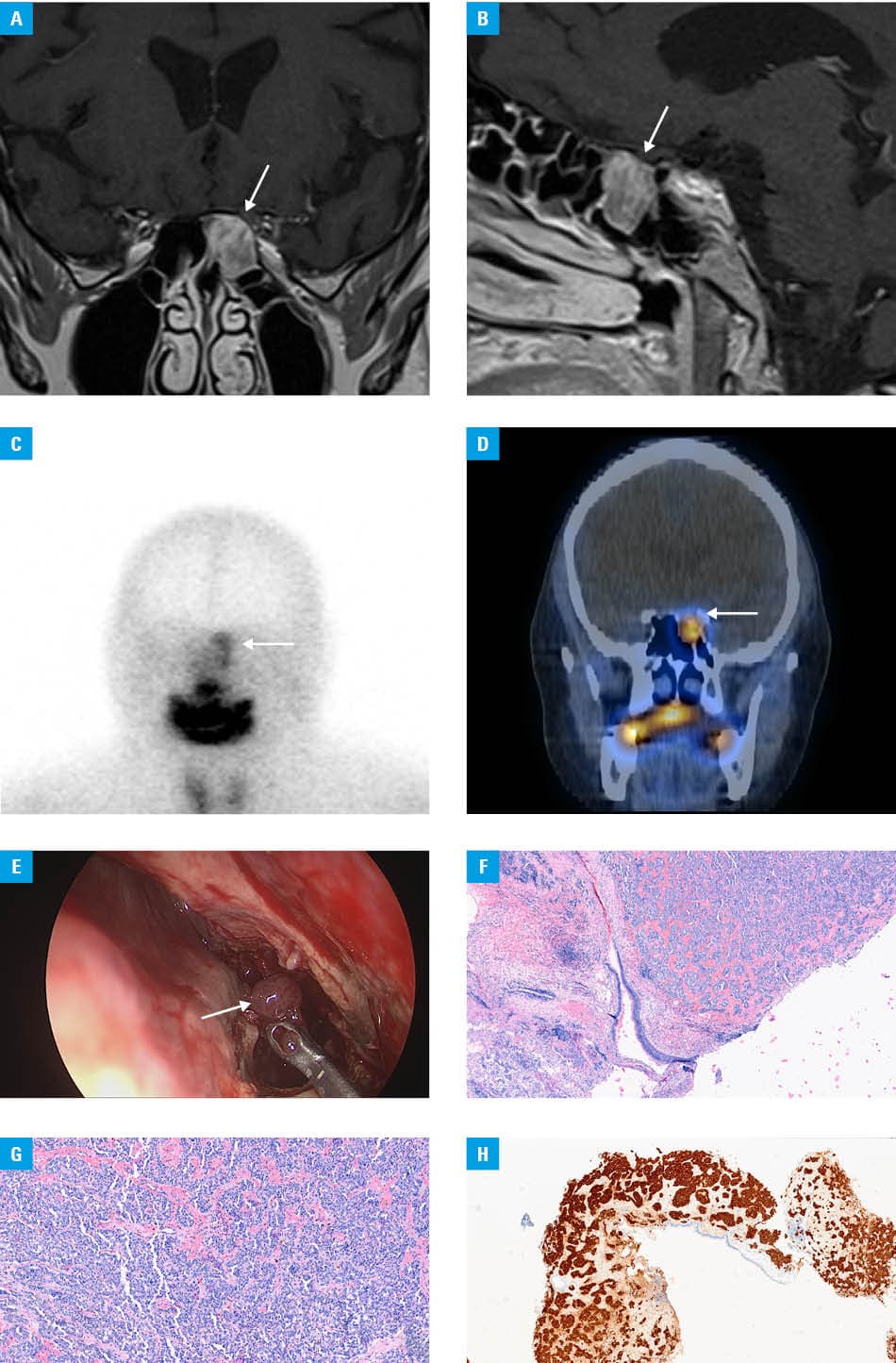
Our knowledge of CD, particularly its diverse etiologies and diagnostic criteria, is constantly improving. The diagnosis of EAPA should be strongly considered when a patient presents with clinical features of hypercortisolism, biochemical studies suggest a pituitary origin, but MRI does not demonstrate a clear lesion in the sella turcica, or when a lesion is found in unusual locations, such as the sphenoid sinus, clivus, or nasopharynx.
In a systematic literature review, 58 cases of EAPAs were reported, including 18 arising in the sphenoid sinus without direct involvement of the sella.3 Our case would represent the nineteenth. Most of these tumors affected women, were macroadenomas, and were completely resected—characteristics shared by our patient. Standard imaging techniques, such as MRI, may yield false‑negative or misleading results and, therefore, should be supplemented with other diagnostic tests, such as bilateral inferior petrosal sinus sampling, SRS, or positron emission tomography/CT. Our patient underwent SRS, which confirmed the MRI findings. Treatment should follow guidelines similar to those for intrasellar pituitary adenomas, including neurosurgical intervention, preferably endoscopic, to achieve rapid remission and histological confirmation of the disease.5
With this report, we aim to emphasize that among patients with confirmed central ACTH hypersecretion, no evident lesion on sellar MRI, and the presence of an undefined soft‑tissue mass in the sphenoid sinus, an ectopic pituitary adenoma should be strongly suspected. To establish the final diagnosis, additional investigations are necessary, including SRS and histopathological evaluation of the resected tissue.
- Sun X, Lu L, Feng M, et al. Cushing syndrome caused by ectopic adrenocorticotropic hormone‑secreting pituitary adenomas: case report and literature review. World Neurosurg. 2020; 142: 75‑86. | Crossref
- Zhu J, Wang Z, Zhang Y, et al. Ectopic pituitary adenomas: clinical features, diagnostic challenges and management. Pituitary. 2020; 23: 648‑664. | Crossref
- Zhu J, Lu L, Yao Y, et al. Long‑term follow‑up for ectopic ACTH‑secreting pituitary adenoma in a single tertiary medical center and a literature review. Pituitary. 2020; 23: 149‑159. | Crossref
- Shuman W, Loewenstern J, Pai A, et al. Variability in clinical presentation and pathologic implications of ectopic pituitary tumors: critical review of literature. World Neurosurg. 2019; 122: 397‑403. | Crossref
- Bashari WA, Gillett D, MacFarlane J, et al. Modern imaging in Cushing’s disease. Pituitary. 2022; 25: 709‑712. | Crossref
ARTICLE INFORMATION