
Advances in treatment of antineutrophil cytoplasmic antibody–associated vasculitis: current recommendations, clinical trials, and real-word data
Key words: antineutrophil cytoplasmic antibody–associated vasculitis, avacopan, rituximab, therapeutic plasma exchange

 CC BY 4.0
Advances in treatment of antineutrophil cytoplasmic antibody–associated vasculitis: current recommendations, clinical trials, and real-word data
CC BY 4.0
Antineutrophil cytoplasmic antibody (ANCA)-associated vasculitis (AAV) is a group of rare, autoimmunologic diseases that can manifest as a vital organ- and / or life‑threatening disorder. They are classified as small‑vessel vasculitis. Inflammatory infiltrations cause destruction and necrosis of the vessel wall, as well as occlusion of the vessel lumen; thus, organs supplied by these vessels become ischemic and damaged. According to the 2012 Revised International Chapel Hill Consensus Conference Nomenclature, AAV comprises 3 distinct diseases, but this review focuses on granulomatosis with polyangiitis and microscopic polyangiitis. Quick diagnosis and prompt initiation of intensive immunosuppressive therapy are crucial to prevent an unfavorable outcome in patients with AAV. Recent years have brought development in therapeutic strategies, new immunosuppressive agents, and future perspectives. Our review starts with the description of current diagnostic and long‑term follow‑up strategies, including the role of ANCA, immunoglobulin G, and CD19/CD20 cell monitoring, as well as remission assessment. The following sections present possible induction and maintenance therapies, including cyclophosphamide, rituximab, glucocorticoids, avacopan, and therapeutic plasma exchange, based on current recommendations ofthe European Alliance of Associations for Rheumatology, Kidney Disease: Improving Global Outcomes, and British Society of Rheumatology, as well as results of recent randomized controlled trials and real‑world data. These therapies are particularly relevant for specific clinical conditions, such as rapidly progressive glomerulonephritis and / or pulmonary hemorrhage. We describe in detail a new, promising molecule, avacopan, which acts by blocking the C5a receptor on neutrophils and other cell types. Avacopan is currently approved by the Food and Drug Administration and the European Medicines Agency but rigorous liver function monitoring—specifically the activity of alanine aminotransferase and aspartate aminotransferase and bilirubin level—before and during the treatment course is required to ensure the safe delivery of this steroid‑sparing therapy. Recently, in April 2026 the Food and Drug Administration proposed to withdraw approval for avacopan due to, among others, a lack of substantial evidence of effectiveness for the drug.
Pathophysiology and classification of granulomatosis with polyangiitis and microscopic polyangiitis
Antineutrophil cytoplasmic antibody (ANCA)-associated vasculitis (AAV) represents a group of rare, systemic autoimmune diseases occurring with an estimated prevalence of 46–184 per million population in Europe. However, in some European regions it exceeds 250 per million. The peak incidence occurs between the ages of 65 and 74 years.1,2
AAV is characterized by inflammation and necrosis of small to medium‑sized blood vessels. This inflammatory process can lead to severe, life‑threatening organ damage, affecting the kidneys, lungs, upper respiratory tract, ears, eyes, and other organs. The 2012 Revised International Chapel Hill Consensus Conference Nomenclature categorizes AAV into 3 primary conditions: granulomatosis with polyangiitis (GPA), microscopic polyangiitis (MPA), and eosinophilic granulomatosis with polyangiitis (EGPA).1 In 2022, new classification criteria for GPA, MPA, and EGPA have been proposed.3-5 This review focuses on the management of GPA and MPA, which share significant clinical and therapeutic overlap. The classification criteria for GPA and MPA are listed in Table 1.
2022 ACR/EAR classification criteria for granulomatosis with polyangiitis | ||
Abbreviations: ACR, American College of Rheumatology; cANCA, cytoplasmic antineutrophil cytoplasmic antibody; EAR, European Alliance of Associations for Rheumatology; PR3, proteinase 3; MPO, myeloperoxidase; pANCA, perinuclear antineutrophil cytoplasmic antibodies | ||
Clinical criteria | Nasal involvement: bloody discharge, ulcers, crusting, congestion, blockage, or septal defect / perforation | +3 |
Cartilaginous involvement (inflammation of ear or nose cartilage, hoarse voice or stridor, endobronchial involvement, or saddle nose deformity) | +2 | |
Conductive or sensineural | +1 | |
Laboratory, imaging, and biopsy criteria | Positive test for cANCA or anti‑PR3 antibodies | +5 |
Pulmonary nodules, mass, cavitation on chest imaging | +2 | |
Granuloma, extravascular granulomatous inflammation, or giant cells on biopsy | +2 | |
Inflammation, consolidation, or effusion of nasal / paranasal sinuses or mastoiditis on imaging | +1 | |
Pauci‑immune glomerulonephritis on biopsy | +1 | |
Positive test for pANCA or anti‑MPO antibodies | –1 | |
Blood eosinophil count ≥109/l | –4 | |
Sum the score for 10 items, if present. A score ≥5 is needed for classification as granulomatosis with polyangiitis. | ||
2022 ACR/EAR classification criteria for microscopic polyangiitis | ||
Clinical criteria | Nasal involvement: bloody discharge, ulcers, crusting, congestion, blockage, or septal defect / perforation | –3 |
Laboratory, imaging, and biopsy criteria | Positive test for pANCA or anti‑MPO antibodies | +6 |
Fibrosis or interstitial lung disease on chest imaging | +3 | |
Pauci‑immune glomerulonephritis on biopsy | +3 | |
Positive test for cANCA or anti‑PR3 antibodies | –1 | |
Blood eosinophil count ≥109/l | –4 | |
Sum the score for 6 items, if present. A score ≥5 is needed for classification as microscopic polyangiitis. | ||
Patients can present with severe organ- or life‑threatening diseases that include: rapidly progressive glomerulonephritis, pulmonary hemorrhage, gastrointestinal bleeding due to vasculitis, myocarditis / pericarditis due to vasculitis, cerebral vasculitis, progressive peripheral or cranial neuropathy, orbital pseudotumor, or scleritis.3,4
Non–organ- or non–life‑threatening diseases may include rhinosinusitis, arthritis, and / or pulmonary nodules. Alternatively, patients can present with none of the abovementioned manifestations of and no evidence of rapidly progressive glomerulonephritis (ie, normal serum creatinine level and no red cell casts or proteinuria).3,4
The pathogenesis of AAV is associated with an intense immunological reaction and the production of autoantibodies directed against cytoplasmic proteins in neutrophils, namely myeloperoxidase (MPO) or proteinase 3 (PR3). The immune response to the PR3 and MPO autoantigens has a distinct genetic basis, supporting a theory that these are 2 separate disease syndromes.6 The binding of ANCAs to their target antigens on the surface of neutrophils and monocytes triggers an inflammatory response leading to the release of proinflammatory cytokines, reactive oxygen species, and lytic enzymes that cause vascular inflammation and endothelial injury. A component of this pathogenic cascade is the activation of the alternative complement pathway and aberrant T‑lymphocyte activation. ANCA‑activated neutrophils produce anaphylatoxin C5a, which in turn primes additional neutrophils for an exaggerated respiratory burst upon subsequent ANCA stimulation. Activated neutrophils release neutrophil extracellular traps and, together with cytokines, lead to endothelial injury. The C5a‑C5a receptor (C5aR) signaling axis represents a powerful amplification loop for inflammation and has become a key target for novel therapeutic interventions.7,8 A summary of AAV pathogenesis is presented in Figure 1.
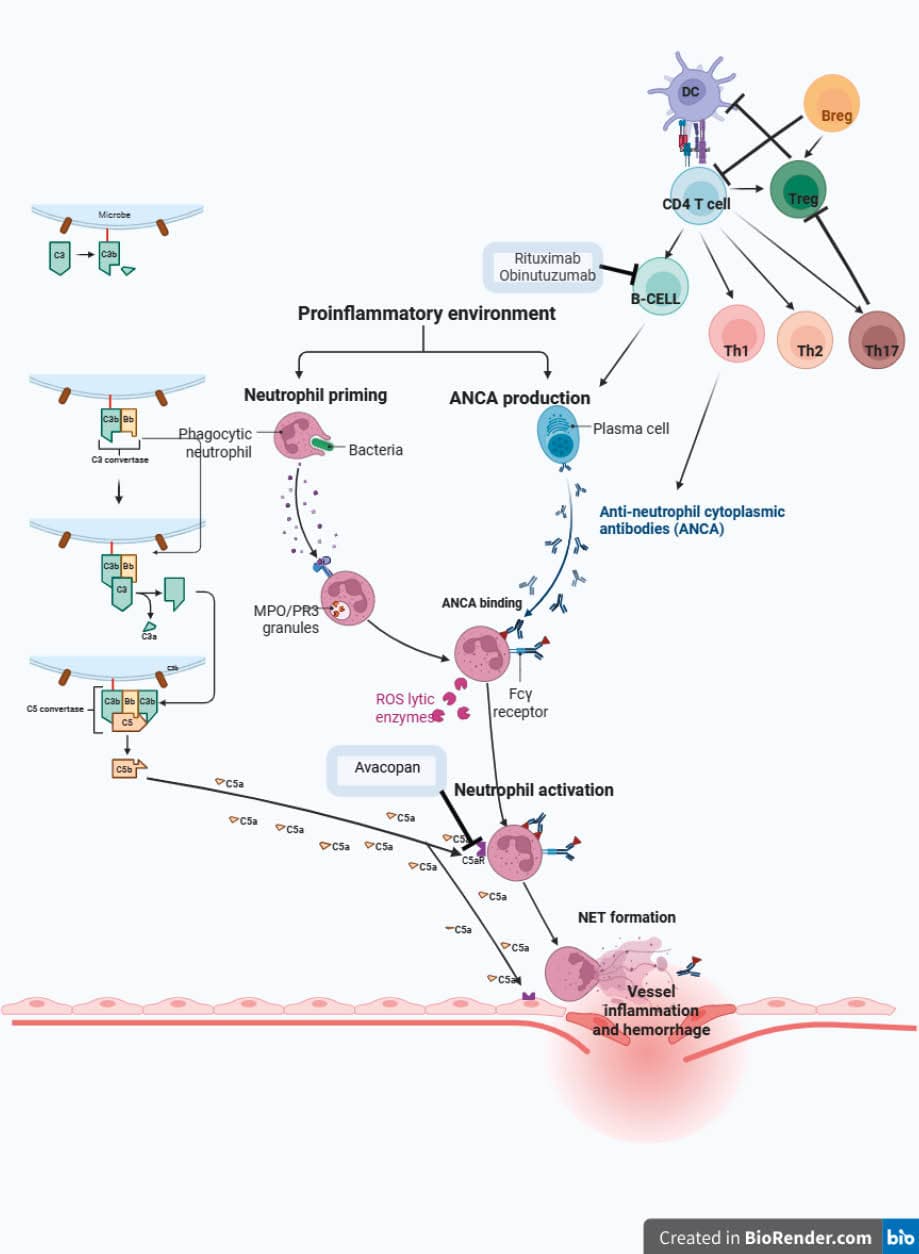
Abbreviations: NET, neutrophil extracellular trap; ROS, reactive oxygen species; others, see Table 1
Definition of remission
The goal of AAV treatment is to induce and maintain remission, thereby preventing irreversible organ damage and preserving quality of life. To standardize the assessment of disease status across both clinical trials and clinical practice, the European League Against Rheumatism (EULAR) has established consensus definitions9 for key disease activity states (Table 2). Remission is formally defined as a complete absence of signs and symptoms of active vasculitis. This state is objectively measured using validated instruments, such as the Birmingham Vasculitis Activity Score (BVAS), where the score of 0 indicates remission. Other defined states include sustained remission, which is the maintenance of remission over a defined period; response, a significant (≥50%) reduction in disease activity; relapse, recurrence of active disease after a period of remission; and refractory disease, which is characterized by unchanged or worsening disease despite standard induction therapy.9
Activity state | EULAR consensus definition |
Abbreviations: AAV, antineutrophil cytoplasmic antibody–associated vasculitis; EULAR, European League Against Rheumatism | |
Active disease | Presence of typical signs, symptoms, or other features (such as glomerulonephritis or pulmonary nodules) of active AAV |
Remission | Absence of typical signs, symptoms, or other features of active AAV with or without immunosuppressive therapy |
Sustained remission | Absence of typical signs, symptoms, or other features of active AAV over a defined time period with or without immunosuppressive therapy |
Response | ≥50% reduction of disease activity score and absence of new manifestations |
Relapse | Recurrence of active AAV after a period of remission |
Refractory disease | Unchanged or increased signs, symptoms, or other features of active AAV after a period of standard induction therapy. Damage, infections, side effects of treatment, or comorbidities as potential causes of the persistent or worsened disease manifestations need to be ruled out. |
The severity of disease presentation guides the intensity of therapy. According to the aforementioned EULAR guidelines,9 a crucial distinction is made between organ- or life‑threatening disease and non–organ- or non–life‑threatening manifestations. Life‑threatening conditions include severe kidney involvement (glomerulonephritis), pulmonary hemorrhage, and central nervous system or cardiac involvement. In contrast, manifestations such as nasal disease without cartilage destruction or skin involvement without ulceration are typically considered non–organ‑threatening, though they can cause significant morbidity. However, the latest recommendations of the British Society of Rheumatology (BSR) emphasize the severity of subglottic stenosis and sinonasal disease, which require expert management and systemic therapy with cyclophosphamide (CYC) or rituximab (RTX) to avoid severe tissue destruction.10
The role of antineutrophil cytoplasmic antibody level monitoring
ANCAs are directed against cytoplasmic antigens present in neutrophils and monocytes. The production of these autoantibodies is associated with a loss of tolerance to self‑antigens. The role of ANCA measurement in the diagnosis of AAV and subtype classification is well established. High‑quality antigen‑specific immunoassays are the preferred methods for ANCA measurement, as recommended by international consensus.11 A meta‑analysis by Guchelaar et al12 showed high pooled sensitivities of 96.8%–98.3% for PR3 antibody immunoassay and 91.4%–95.6% for MPO antibody immunoassay. However, about 10% of patients, especially those with limited kidney or pulmonary involvement, are ANCA‑negative. In the case of renal involvement, kidney biopsy remains the gold standard, providing extensive information on glomerular, interstitial, and vascular damage. The immunosuppressive treatment should not be postponed while waiting for the biopsy to be performed or for the biopsy results. The 2024 KDIGO guideline recommends early initiation of treatment, especially in patients with a rapidly progressive disease course.13
The role of serial ANCA measurements in predicting disease relapse is under study. Evidence suggests that persistent ANCA positivity, a significant rise in ANCA levels, or seroconversion from negative to positive status may be associated with an increased risk of future relapse. However, the therapeutic decision should include a structured clinical assessment of a patient, with consideration of immunosuppressive therapy and ANCA status. The 2024 KDIGO recommendations support this statement.13
In patients treated with RTX, ANCA serology is more significant than in individuals treated with other drugs. RTX is effective in both inducing and maintaining remission, often leading to a more profound serological response (ANCA negativity) than traditional therapies. In this clinical context, the reappearance of ANCAs or increase in their levels after RTX treatment is of particular significance. Studies have shown that in patients treated with RTX, the reappearance of PR3‑ANCA (seroconversion) is a strong predictor of relapse. In a work by van Dam et al,14 96% of relapses in PR3‑ANCA–positive patients occurred with persistent or recurring antibodies. On the other hand, PR3‑ANCA negativity or reduction of ANCA level by at least 50% after RTX therapy was associated with prolonged time to relapse.15
The significance of the increase in MPO‑ANCA level is not well established. However, a recent retrospective analysis16 showed that an increase in MPO‑ANCA levels in patients with GPA/MPA was associated with clinical deterioration, with a positive predictive value of 79% (P = 0.0001). Similar results were reported by Rodríguez et al.17 An increase in MPO or PR3 ANCA levels preceded renal relapse in AAV, with a 100% positive predictive value in PR3 patients.17 Most patients in the whole group (67.3%) received CYC as an induction treatment.
Contrary to RTX, clinical improvement after avacopan therapy may occur without a corresponding decrease in ANCA levels, as the drug targets the downstream inflammatory consequences of ANCA rather than its production.18
In conclusion, although a rise in ANCA levels is significantly associated with an increased risk of relapse, its interpretation must consider the clinical context, particularly the type of therapy being used. In patients treated with RTX, the reappearance of ANCA after a period of negativity, combined with B‑cell reconstitution, is a signal of an impending relapse. Nevertheless, decisions to intensify treatment should still be made primarily based on a comprehensive clinical assessment rather than solely on laboratory results.
B‑cell monitoring (CD19/CD20) during depletion therapy
RTX is a chimeric monoclonal antibody that targets the CD20 antigen expressed on the surface of pre‑B and mature B lymphocytes, leading to their depletion through antibody‑dependent cellular cytotoxicity and complement‑dependent cytotoxicity. This B‑cell depletion is the primary mechanism of its therapeutic effect. A significant reduction in peripheral B cells, often to the levels below 10/µl, is typically observed after the second dose of RTX, with depletion persisting for at least 6 months in most patients. As many as 2.5% of the patients with AAV developed depletion lasting more than 2 years after the last RTX dose.19 Monitoring these counts confirms the drug’s pharmacodynamic effect and can inform redosing strategies in tailored maintenance regimens. In fixed‑dose regimens, CD19/CD20 monitoring is not necessary but can provide information about drug efficacy. Tailored schedules of RTX therapies were used in some clinical trials as maintenance therapy.20,21 However, they are recommended by neither the EULAR nor 2024 KDIGO therapeutic consensuses.9,13
Immunoglobulin G monitoring
B‑cell–targeted therapies (BCTT), such as RTX, are associated with secondary hypogammaglobulinemia. A decreased immunoglobulin (Ig) G level is a more substantial risk factor for infections than reduced IgM or IgA levels. Complete IgA deficiency is relatively common and can be present in healthy individuals.22 It is not a contraindication to Ig replacement, because Ig products contain very low levels of IgA.
Measurement of Ig levels before starting BCTT and during the treatment is recommended. The suggested frequency of this monitoring is every 6–12 months for the duration of BCTT and a minimum of 1 year after stopping the treatment. Pre‑existing low IgG levels and prior immunosuppressive therapies are the strongest risk factors for the development of clinically significant hypogammaglobulinemia during BCTT. Also, autoimmune conditions predisposing to IgG deficiency and AAV are associated with greater incidence of hypogammaglobulinemia than rheumatoid arthritis.23
A significant reduction in IgG level, a risk factor for infectious complications, is defined as below 400 mg/dl.24 Some analyses use a more stringent threshold of 300 mg/dl.25 A significant reduction in Ig levels is more common during RTX induction therapy than during maintenance treatment. In the study by Cortazar et al,26 the mean reduction in Ig level during induction therapy was 6% per month, while during maintenance it was 0.6% per year,26 likely due to concomitant high doses of glucocorticoids (GCs) or CYC during remission induction.
The decision to start Ig supplementation should be based on the degree of hypogammaglobulinemia, infection rate, poor response to antibiotic prophylaxis, and preexisting comorbidities, such as bronchiectasis22 or other structural lung disease. Detailed information about the management of hypogammaglobulinemia secondary to BCTT is included in international recommendations.22
Induction therapy in organ- / life‑threatening manifestations: current standards and innovations
The initial phase of treatment in active AAV, known as remission induction, aims to rapidly control inflammation to prevent or limit organ damage and mortality. The therapeutic landscape for induction has changed in recent years, and international experts’ recommendations now also include patients’ opinions as a new factor in choosing a therapeutic schedule.
In the organ- / life‑threatening presentation, the choice is between CYC, RTX, or their combination as the first part of the schedule, and between GCs, avacopan, or a combination of a short course of GCs and avacopan as the second part of the schedule (Figure 2).
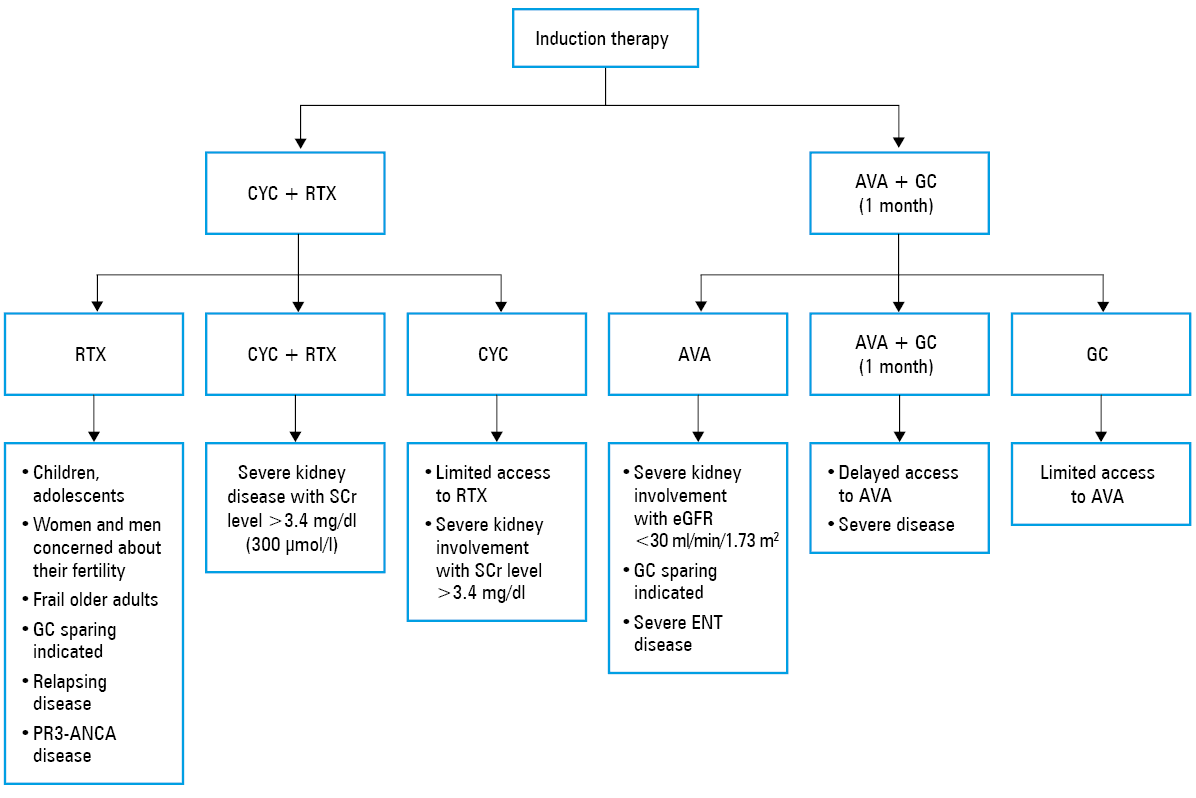
Abbreviations: AVA, avacopan; CYC, cyclophosphamide; eGFR, estimated glomerular filtration rate; ENT, ear, nose, throat; GC, glucocorticoid; GPA, granulomatosis with polyangiitis; KDIGO, Kidney Disease: Improving Global Outcomes; MPA, microscopic polyangiitis; RTX, rituximab; SCr, serum creatinine; others, see Tables 1 and 2
The efficacy of RTX and CYC, as demonstrated in randomized controlled trials (RCTs), is similar and has served as the foundation of induction therapy. The main RCTs comparing RTX and CYC are summarized in Table 3. The RAVE (Rituximab for ANCA‑Associated Vasculitis) trial,27,28 followed by further analysis,29 which included both newly‑diagnosed and relapsing severe disease, found that RTX was more effective than CYC in the subgroup of patients with severe relapses. RTX was also more effective than CYC in PR3‑AAV, with an odds ratio (OR) favoring remission of 2.11 after 6 months of therapy.29 Moreover, in refractory PR3‑AAV cases, RTX was more effective than CYC at 6, 12, and 18 months of therapy. The ORs were 3.57, 4.32, and 3.06, respectively.27,28
Trial acronym | Patient population | Intervention arm | Comparator arm | Primary end point | Key findings |
a Doses are presented in Table 4
| |||||
RAVE2 | New or relapsing GPA/MPA (SCr <4 mg/dl) | Rituximab + GC (no maintenance) | Oral CYC + GC then AZA maintenance | BVAS = 0 at 6 months without GC |
|
RITUXVAS32 | New‑onset AAV with renal involvement | RTX + 2 pulses of IV CYC + GC (no maintenance) | IV CYC + GC, then AZA maintenance | Sustained remission at 12 months | Similar relapse rate at 12 months |
PEXIVAS36 | Severe AAV (eGFR <50 ml/min/1.73 m2 or DAH) | Reduced‑dose oral GC tapera | Standard‑dose oral GC taper | Death or end‑stage kidney disease | Reduced‑dose GC regimen was noninferior for efficacy but resulted in significantly fewer serious infections |
LoVAS37 | New‑onset AAV without severe renal / pulmonary disease | Reduced‑dose oral GC (0.5 mg/kg/d) + RTX | High‑dose oral GC (1 mg/kg/d) + RTX | Remission at 6 months | Reduced‑dose GC regimen was noninferior to high‑dose regimen for remission and caused fewer serious adverse events |
ADVOCATE39 | New or relapsing GPA/MPA (eGFR ≥15 ml/min/1.73 m2) | AVA + (RTX or CYC, 4 weeks of oral steroids permitted) | Tapering prednisone + (RTX or CYC) |
|
|
The decision‑making process should include both the drug’s efficacy and safety. The toxicity of CYC is potentially more serious than that of RTX. The risk of infertility, reduced ovarian reserve, bladder injury, bone marrow failure, myelodysplastic syndrome, and other malignancies are potential adverse events that can occur during and after CYC therapy, and their frequency increases after repeated CYC courses. Therefore, international recommendations, as well as the patient panel, prefer RTX over CYC.9,10,30
However, in the case of severe kidney involvement with rapidly progressive kidney disease and serum creatinine level above 4 mg/dl, there are limited data to recommend only RTX with GCs. In the RAVE trial,4 which showed that RTX was noninferior to CYC, the patients with serum creatinine level above 4 mg/dl were excluded. Therefore, 2024 KDIGO guideline recommends using CYC or RTX with 2 doses of CYC in patients with serum creatinine level above 3.4 mg/dl.13,31,32
Two dosing schedules of RTX are considered equally effective for induction therapy. The RTX therapy schedule of 375 mg/m2 per week for 4 weeks was primarily used to treat non‑Hodgkin lymphoma. The alternative mode of RTX therapy suggests 2 intravenous infusions (1 g) at a 2‑week interval and is used in rheumatoid arthritis. Both schedules cause significant depletion of B cells and are equally efficacious, but the second one entails lower costs and may be more convenient for the patient. However, in the Polish B75 drug program “Treatment of patients with systemic vasculitis,” the schedule of 375 mg/m2 per week for 4 weeks is available as being compatible with the characteristics of the medical product.
Induction of remission of non–organ- or non–life‑threatening granulomatosis with polyangiitis or microscopic polyangiitis
Previously used terms “limited” or “nonsevere” can be deceptive and may lead to undertreatment, with the risk of disease progression. Therefore, current recommendations suggest using terms non–organ- or non–life‑threatening.9 Consequently, the EULAR recommendations9 suggest RTX as first‑line therapy in these cases. Mycophenolate mofetil (MMF) or methotrexate can be used only if RTX or CYC are not tolerated or contraindicated. The MYCYC trial (Clinical Trial of Mycophenolate Versus Cyclophosphamide in ANCA Vasculitis) showed that MMF was noninferior to CYC, but in PR3‑ANCA patients treated with MMF as an induction therapy, a higher relapse rate was observed.33
Optimal glucocorticoid dosage in induction therapy
For many years, high‑dose GCs were the main component of induction therapy. However, their use is associated with a substantial burden of adverse effects, including infections, which remain a leading cause of early mortality in AAV.33,34 During the first year after AAV diagnosis, infections are the predominant cause of death (48%).35 A significant priority in modern AAV management has therefore been minimizing GC exposure without compromising efficacy. Two recent, pivotal trials have provided the high‑level evidence needed to change practice.36,37
The PEXIVAS trial (Plasma Exchange and Glucocorticoids for Treatment of Anti‑Neutrophil Cytoplasm Antibody [ANCA]-Associated Vasculitis)36 was a large, international, randomized trial that compared a reduced‑dose oral GC regimen with a standard‑dose regimen in over 700 patients with severe AAV (defined as estimated glomerular filtration rate [eGFR] <50 ml/min/1.73 m2 and / or diffuse alveolar hemorrhage [DAH]). The reduced‑dose protocol resulted in a 40% reduction in cumulative oral GC exposure during the first 6 months. The trial demonstrated that the reduced‑dose regimen was noninferior to the standard‑dose schedule in terms of efficacy defined as death or end‑stage kidney disease (ESKD). Critically, the patients in the reduced‑dose group experienced significantly fewer serious infections during the first year of follow‑up.36
Complementing these findings, the LoVAS trial (Low‑dose Glucocorticoid Vasculitis Induction Study)37 investigated Japanese patients with new‑onset AAV (predominantly MPO‑ANCA disease) but without severe renal or pulmonary involvement. This trial compared a low‑dose GC regimen (starting at 0.5 mg/kg/day of prednisolone) with a conventional high‑dose regimen (1 mg/kg/day), both in combination with RTX. The study found that the low‑dose GC regimen was noninferior to the standard regimen for inducing remission at 6 months. The predefined 2‑year follow‑up confirmed that frequency of death and relapse did not differ between the groups. However, serious adverse events remained less frequent in the reduced‑dose group, driven by lower rates during the induction phase.37,38
Together, the results from the PEXIVAS and LoVAS trials provide grade 1A/1B evidence supporting the use of reduced‑dose GC tapering regimens as the new standard of care for most patients with GPA and MPA. International guidelines including EULAR, KDIGO, and BSR follow this evidence.9,10,13 To summarize, patients after CYC‑based induction should have their prednisone (or equivalent) dose reduced to 5 mg/day by 6 months, and after RTX‑based induction, it can be discontinued by 6 months. Schedules of prednisolone tapering according to PEXIVAS and LoVAS trials are presented in Table 4.
Week | Prednisolone dosage according to the PEXIVAS trial, mg/day | Prednisolone dosage in the LoVAS trial | ||
Body weight <50 kg | Body weight, 50–75 kg | Body weight >75 kg | ||
1 | 50 | 60 | 75 | 0.5 mg/kg/day |
2 | 25 | 30 | 40 | 0.5 mg/kg/day |
3–4 | 20 | 25 | 30 | 2.5 mg/kg/day |
5–6 | 15 | 20 | 25 | 7.5 mg/day |
7–8 | 12.5 | 15 | 20 | 5 mg/day |
9–10 | 10 | 12.5 | 15 | 4 mg/day |
11–12 | 7.5 | 10 | 12.5 | 3 mg/day |
13–14 | 6 | 7.5 | 10 | 2 mg/day |
15–16 | 5 | 5 | 7.5 | 2 mg/day |
17–18 | 5 | 5 | 7.5 | 1 mg/day |
19–20 | 5 | 5 | 5 | 0 |
21–22 | 5 | 5 | 5 | 0 |
23–52 | 5 | 5 | 5 | 0 |
>52 | According to local practice | 0 | ||
Avacopan
Avacopan is a newer drug recommended by the 2024 KIDIGO, 2022 EULAR, and 2025 BSR guideline as an alternative to GCs for the induction of remission in patients with AAV (Table 5).9,10,13 This drug is an add‑on therapy, being a part of standard induction schedule that includes RTX and / or CYC. A concurrent short‑rapid steroid taper (over 4 weeks) when starting avacopan is optional. The currently recommended duration of the avacopan therapy is 12 months due to the lack of data from the phase III Advocate RCT (A Phase 3 Clinical Trial of CCX168 [Avacopan] in Patients With ANCA‑Associated Vasculitis)39 beyond this time.
Abbreviations: see Figure 2 |
What we know about avacopan from clinical trials39,42-46,48-52 |
|
What we do not know and what are the questions for further investigations |
|
Avacopan is a new complement‑targeting drug that blocks the binding of the C5a molecule to its receptor (C5aR1) on neutrophils, which are involved in the inflammatory process in AAV. It is a selective, competitive C5aR blocker. Avacopan inhibits neutrophil activation and migration. It does not block C5b activity; therefore, the membrane attack complex is produced correctly, and, contrary to eculizumab and ravulizumab, C5‑mediated defense against encapsulated bacteria is preserved.40 Preclinical data showed that inhibition of the C5aR caused neutrophil respiratory burst.8 This mode of action, directed toward neutrophils, differs from the influence of other vasculitis treatments on ANCA production. Avacopan reduces AAV activity but does not affect ANCA levels.17
The drug is administered orally twice a day at a dose of 30 mg. Food retards gut absorption, increasing the area under the plasma concentration curve, and the maximal plasma concentration is reached 6 hours after administration. Therefore, it is recommended to take the capsules with food. Terminal elimination half‑time is 21 days. Steady‑state after beginning the avacopan therapy in patients with vasculitis is reached after 13 weeks. Elimination pathways are primarily hepatic, but also renal. Patients with severely reduced eGFR (15–30 ml/min/1.73 m2) can have diminished drug clearance by 33%–47%.41 However, a dose reduction is not recommended. The drug was not tested in clinical trials in patients with GFR lower than 15 ml/min/1.73 m2. Avacopan is a CYP3A4 inhibitor and a CYP3A4 substrate; therefore, potential drug interactions should be considered before initiation.
The efficacy of avacopan was assessed in the phase 2 CLEAR42 and CLASSIC43 studies and the 3‑phase ADVOCATE study.39,44-46 The ADVOCATE trial found avacopan to be noninferior to prednisolone in terms of remission at weeks 12 and 26, but was more effective in sustaining remission at week 52 (65.7% vs 54.9%; P = 0.007). Renal outcomes were also better in the avacopan arm. In the patients with renal involvement, eGFR increased by 7.3 ml/min/1.73 m2 in the avacopan group and by 4.1 ml/min/1.73 m2 in the prednisone group (P = 0.03) at week 52.39,44-46 The benefit in renal recovery was greatest in the patients with the lowest eGFR. In the subanalysis of the ADVOCATE study in patients with eGFR at 15–20 ml/min/1.73 m2, the improvement of kidney function at week 52 was 16.1 ml/min/1.73 m2 in the patients treated with avacopan and 7.7 ml/min/1.73 m2 (P = 0.003) in those on prednisolone.47 Reduction of albuminuria was also faster in the avacopan group.48
Post hoc analysis of the ADVOCATE study showed that GC‑related side effects, as measured by the Glucocorticoid Toxicity Index, were less pronounced in the avacopan group than in the prednisolone group.49 Also, health‑related quality of life at 26 and 52 weeks, and European Quality of Life‑5D and Short Form 6‑Dimension health utility scores at 52 weeks, were better in the avacopan‑treated patients.50
Among the side effects of avacopan, liver toxicity is recognized, and regular monitoring of liver function is recommended during treatment with this drug. A combined analysis of the CLEAR, CLASSIC, and ADVOCATE clinical trials showed that 4.4% of patients experienced serious adverse events related to liver disorders. In contrast, in the non‑avacopan group, they were observed in 2.8% of the patients.51 In the same analysis, severe infections were observed in 13.3% of the patients in the avacopan group and in 15.2% of those in the non‑avacopan group. Despite these favorable results for avacopan, the risk of infection is still substantial, which is also related to other concomitant treatments, organ damage caused by the disease flare, and comorbidities. The rates of neutropenia and lymphopenia were lower in the avacopan group than in the non‑avacopan group, and it was impossible to distinguish the influence of other drugs, such as RTX or CYC, on these complications. However, the European Union recommends monitoring white blood cell count during avacopan therapy.41
A post hoc analysis of the ADVOCATE trial evaluating the efficacy and safety of avacopan in patients aged over 65 years showed that the rates of adverse events and serious adverse events did not differ among patients aged 65–75, over 75, and under 65 years.52 The efficacy in terms of remission in the individuals over 65 years was also comparable to the whole population, with higher sustained remission rate in the avacopan arm after 52 weeks of therapy. The health‑related quality of life was also better for avacopan‑treated older patients than for those treated with prednisolone. Kidney outcomes and improvement of eGFR in the patients over 65 years treated with avacopan were also better than in those receiving prednisolone. However, improvement in eGFR was greater in the individuals younger than 65 years than in those at 75 years or older. These data are critical because the incidence of AAV increases significantly from the age of 65 years, and kidney involvement is also higher in this group than in the younger individuals.53 These data are reassuring and support the use of avacopan in patients over 65 years of age, showing many advantages of this drug in the elder population.
Access to avacopan varies across countries. The United States Food and Drug Administration approved avacopan for use in October 2021. The European Commission approved the drug for use in the European Union in January 2022. In the United Kingdom, the drug was accepted for the treatment of severe AAV in December 2022. Blueteq form completion for avacopan is mandated in England as part of the National Health Service England approval process for high‑cost drug use. In Poland, avacopan was incorporated into the B75 program “Treatment of patients with systemic vasculitis” by the Ministry of Health’s decision from June 17, 2025 and effective from July 2025. An approval from a coordination team for the treatment of rheumatic diseases is required. Inclusion criteria, such as a severe course of the disease, defined as BVAS for Wegener granulomatosis score of at least 3, and 1 of 3 additional conditions have to be met: inability to reduce the steroid prednisone dose to 5 mg after 5 months of induction treatment, severe renal involvement with eGFR equal to or below 30 ml/min/1.73 m2, or documented contraindications for steroid usage.
Recently, real‑world data on avacopan usage have been reported. The most extensive multicenter retrospective analysis of 92 patients receiving avacopan has been conducted in the United States.54 Clinical remission was achieved in 90% and 84% of the patients after 26 and 52 weeks of avacopan therapy, respectively. As many as 20% of the patients discontinued therapy due to side effects. In the patients with kidney involvement, mean (SD) increase in eGFR was 12.2 (25.4) and 19.8 (23.1) ml/min/1.73 m2 at weeks 26 and 52, respectively. Contrary to the ADVOCATE study, in this real‑world avacopan application, almost all patients (97%) received steroids in combination with avacopan, and the mean (SD) withdrawal time was 97 (81) days (13.8 [11.5] weeks) from induction therapy and 62 (71) days (8.8 [10.1] weeks) from avacopan initiation. Mean prednisone dose at week 26 was 1.8 (3.7) mg and at week 52 it was 0.6 (2.5) mg. A majority of patients (72%) were off steroids at the last follow‑up. Clinical trials on avacopan excluded patients with eGFR below 15 ml/min/1.73 m2.39,44-46 In this United States analysis,54 23% of the patients had eGFR below 15 ml/min/1.73 m2 at the start of induction therapy. In this group, mean increase in eGFR was 19.4 (22.7) ml/min/1.73 m2 at week 26 and 25.1 (15.6) ml/min/1.73 m2 at week 52. However, in this group, 43% of the patients received plasma exchange (PLEX), and the median delay to the introduction of avacopan was 47 days. There are also smaller retrospective analyses from Japan, Germany, and France.55-57
In the Japanese study of 21 patients, a high prevalence of avacopan discontinuation was observed (42.9%). In most cases (33.3%), the reason was an elevated activity of liver enzymes despite the dose adjustment to body weight.54 The patients weighing above 55 kg received a standard dose of 30 mg twice a day; those weighing 40–55 kg received 20 mg twice a day; and those weighing below 40 kg received 10 mg twice a day. This effect may be associated with increased avacopan exposure in the Japanese population, as previously described by Miao et al58 in white individuals.
In the German study, 39 patients were included, of whom 20% discontinued avacopan due to adverse events. Fifteen patients had eGFR below 15 ml/min/1.73 m2, and the increase in eGFR in this group ranged from 8 to 35 ml/min/1.73 m2. The authors also included patients with DAH, and the remission rates at 6 and 12 months were high. However, due to the small sample size (n = 7), the results should be interpreted with caution. Similarly to other real‑world data, 34.5% of the patients were on steroids after 12 months of avacopan therapy.56
The problem with these real‑world trials is that comparison of their results is difficult due to the different methodologies used.
These data establish avacopan as a highly effective agent that can replace or reduce exposure to GCs in induction regimens, offering dual benefits of limiting GC‑related side effects and potentially improving long‑term renal function. Following postmarketing surveillance, the Food and Drug Administration (FDA) recently issued a Drug Safety Communication regarding cases of serious liver injury associated with avacopan. These reports led to updated labelling and increased clinical vigilance. The manufacturer asserted that evidence supports avacopan’s effectiveness and that it is collaborating with the FDA to determine next steps, prioritizing patient safety and support. On the other hand, the European Medicines Agency (EMA) Committee for Medicinal Products for Human Use has initiated a review of avacopan in response to the same concerns about the integrity of data from the ADVOCATE trial, the primary study supporting its marketing authorization in the European Union. Up till now, avacopan maintains its regulatory approval from both the FDA and EMA. These safety updates reinforce the necessity of rigorous liver function monitoring—specifically alanine aminotransferase, aspartate aminotransferase, and bilirubin—before and during the treatment course to ensure the safe delivery of this steroid‑sparing therapy. In a recent update from April 27, 2026, FDA proposed to withdraw approval for avacopan on the basis on new information regarding its insufficient effectiveness.
The role of therapeutic plasma exchange in severe renal and pulmonary disease
Therapeutic PLEX is an adjunctive therapy intended to rapidly remove circulating pathogenic ANCAs and other inflammatory mediators. Its role in AAV has been widely discussed since the first publication of the PEXIVAS trial results.36 In this trial, the patients with severe AAV were randomized to receive PLEX or no PLEX. The study found no significant difference in the primary composite outcome of death or ESKD between the 2 groups.59
However, subsequent analyses painted a more nuanced picture. A meta‑analysis that included the PEXIVAS data suggested that PLEX may reduce the risk of developing ESKD at 12 months, with the most significant absolute benefit observed in the patients with the highest baseline serum creatinine levels (>300–500 µmol/l). This potential benefit in preserving renal function must be carefully weighed against a concurrently increased risk of serious infections associated with the procedure.60 A post hoc analysis of the PEXIVAS trial revealed that in the PLEX group, eGFR increased at weeks 2, 4, and 8, as compared with the non‑PLEX group. Improvement in eGFR or recovery of kidney function at week 4 was significantly associated with a lower risk of ESKD at week 52.61
Regarding pulmonary hemorrhage, the PEXIVAS trial did not demonstrate a treatment benefit of PLEX in the patients with this manifestation. This has led to divergent international guidelines. The BSR and EULAR guidelines9,10 now recommend considering PLEX for patients with severe kidney involvement (serum creatinine level >300 µmol/l) but do not routinely recommend its use for pulmonary hemorrhage in the absence of severe kidney disease. In contrast, the KDIGO guidelines13 suggest that PLEX may be considered for patients with serum creatinine level above 3.4 mg/dl (>300 µmol/l) or for those with DAH accompanied by hypoxemia. This difference shows that even with high‑quality evidence, interpretation and application can vary, reflecting different expert panel judgment on the risk‑benefit balance in these critical clinical scenarios.9,10,13
Maintenance therapy
In the patients with severe AAV who achieved remission after induction treatment with CYC or RTX, we recommend RTX as maintenance treatment over azathioprine (AZA) or methotrexate. This recommendation is strongly supported by high‑level evidence from RCTs. The MAINRITSAN trial (Comparison Between a Long Term and a Conventional Maintenance Treatment with Rituximab) demonstrated superiority of a fixed‑schedule RTX regimen (500 mg intravenously every 6 months) over daily oral AZA for preventing major relapses at 28 months in the patients who had achieved remission with CYC (relapse rate of 5% in the RTX group vs 29% in the AZA group).62,63 Long‑term follow‑up of this cohort confirmed the sustained benefit of RTX. More recently, the RITAZAREM trial (Rituximab Vasculitis Maintenance Study) corroborated these findings in patients with relapsing AAV who were reinduced with RTX, demonstrating that RTX was superior to AZA for maintaining remission.64 In this study, the patients received 1 g of RTX every 4 months through month 20. Some centers also use schedules consisting of 1 g RTX infusions every 6 months for 2 years, with excellent remission rates. The KDIGO and BSR guidelines allow for both schedules.10,13 The EULAR guidelines recommend the RITAZAREM schedule in the patients who relapse on a 500 mg every 6 months schedule.9
Alternative dosing strategies for RTX have been explored. There are also maintenance treatment schedules using RTX at individually tailored doses. In the MAINRITSAN 2 study, the patients received 500 mg of RTX at randomization, and RTX was redosed when the B‑cell CD19+ lymphocyte count or ANCA level rose significantly. However, trimestral monitoring of B lymphocytes (CD19+) and ANCA was necessary.65 The relapse rate did not differ between the aforementioned individually tailored schedule and the fixed‑dose schedule presented in the MAINRITSAN 1 study. However, the cumulative dose of received RTX was lower in the individually tailored arm. Despite the appeal of a biomarker‑driven approach, a pooled analysis of the MAINRITSAN trials found that the rate of major relapse was significantly higher in the individually tailored group than in the fixed‑dosing group.66 Consequently, most international guidelines now recommend a fixed‑dosing schedule of 500–1000 mg every 4–6 months.9,10,13
AZA and methotrexate remain important alternative options for maintenance therapy, particularly when RTX is contraindicated or not accessible. The WEGENT trial (Comparison of Methotrexate or Azathioprine as Maintenance Therapy for ANCA‑Associated Vasculitides) showed these 2 agents to have equivalent efficacy in maintaining remission. MMF is generally considered a third‑line option, reserved for patients with intolerance to other agents, as it was associated with a significantly higher risk of relapse than AZA in a head‑to‑head randomized trial.67
Optimal duration of maintenance therapy: balancing relapse risk and treatment toxicity
The duration of maintenance treatment should not be shorter than 2 years, and the cessation of immunosuppressive treatment, including RTX maintenance therapy, should be undertaken with caution. There is no consensus for the optimal duration of maintenance immunosuppression therapy in AAV. The recommendations and expert opinions suggest that 2 years of maintenance therapy are necessary. However, the duration of optimal maintenance therapy is not precisely established. The results of some clinical trials proposing the extension of maintenance therapy with RTX were encouraging. Evidence from several trials suggests that extending therapy beyond the standard 24 months can reduce the risk of relapse. The REMAIN trial (Randomised Trial of Prolonged Remission‑Maintenance Therapy in Systemic Vasculitis) found that continuing AZA for 48 months, as compared with 24 months, lowered the relapse rate and improved renal survival.68 Similarly, the MAINRISTAN 3 clinical trial extended maintenance RTX treatment to 36 months with infusions of 500 mg every 6 months.69 This mode of treatment was associated with fewer relapses than placebo (4% vs 27%).68,69
New therapeutic perspectives
The therapeutic landscape for AAV is undergoing a significant paradigm shift, moving beyond nonspecific immunosuppression toward targeted biologic interventions. Current research focuses on the complement system, modulation of B cells and T cells, and novel tissue‑specific targets to improve remission rates and reduce GC overuse.
Recent investigations have expanded our understanding of the role of the complement cascade in AAV pathogenesis, leading to the introduction of avacopan into clinical practice. Other complement inhibitors are under evaluation. Vilobelimab, a monoclonal antibody, neutralizes the C5a ligand directly, preventing it from engaging the C5aR.70 Phase 2 clinical trials, including IXCHANGE (Study of IFX‑1 to Replace Steroids in Patients With Granulomatosis With Polyangiitis and Microscopic Polyangiitis)71 and IXPLORE (Safety and Efficacy of Two Different Dose Regimens of IFX‑1 as Add‑On to Standard of Care in Subjects with GPA and MPA),72 suggest that vilobelimab is well tolerated and facilitates significant steroid sparing while maintaining remission rates comparable to those of standard care. A theoretical benefit of ligand neutralization is the avoidance of potential agonist effects at the receptor,73 though complete neutralization during explosive complement activation may prove challenging.70
Broader inhibition is achieved via eculizumab, which targets C5 to prevent the generation of both C5a and the membrane attack complex (C5b‑9).74 While primarily used for paroxysmal nocturnal hemoglobinuria and atypical hemolytic uremic syndrome, eculizumab has been utilized off‑label for some refractory AAV cases involving rapidly progressive vasculitis.75 However, due to a high risk of infectious side effects, its use in AAV should be limited to specific situations, such as when AAV is concurrent with thrombotic microangiopathy.
Therapy targeting B lymphocytes with RTX as the mainstay remains a cornerstone of current therapy. However, incomplete tissue B‑cell depletion during RTX‑based therapy may contribute to disease relapse. Obinutuzumab, a type II glycoengineered antibody, is currently being evaluated in the ObiVas trial (Randomised, Phase II, Double Blind, Controlled Trial Designed to Evaluate the Mechanistic Effect of Obinutuzumab Versus Rituximab in Active AAV) for its superior affinity and ability to achieve more profound B‑cell depletion.76
Research into B lymphocyte stimulator (BlyS) blockade has yielded mixed results. The BREVAS trial (Belimumab in Remission of Vasculitis) demonstrated that adding belimumab to standard maintenance therapy did not significantly reduce relapse risks.77 However, the COMBIVAS trial (Rituximab and Belimumab Combination Therapy in PR3 Vasculitis; NCT03967925) is investigating the dual action of RTX and belimumab, hypothesizing that blocking the postrituximab rise in BLyS may prevent the emergence of autoreactive B cells.78
Conversely, T‑cell costimulation blockade with abatacept failed to demonstrate efficacy in reducing relapses during the ABROGATE trial (Abatacept for the Treatment of Relapsing, Non‑Severe, Granulomatosis with Polyangiitis [Wegener’s]; NCT02108860).79 Novel approaches are now targeting structural proteins and fibrosis. Lixudebart, an antibody against claudin‑1 (CLDN1), is being investigated in the RENAL‑F02 trial (Rescue of Nephrons With ALE.F02) to determine if inhibiting nonjunctional CLDN1 overexpression can halt the fibrotic evolution of crescentic glomerulonephritis.80 Other experimental agents under review include sparsentan, hydroxychloroquine, and the dual B‑cell activating factor and a proliferation‑inducing ligand inhibitor telitacicept.
In conclusion, while the diversification of the AAV pipeline is promising, further research is needed to determine the optimal integration of these novel agents into existing treatment protocols and their efficacy beyond strictly controlled clinical trial populations.
Conclusions
The current standard of care, synthesized from the world’s leading clinical guidelines, is now centered on achieving rapid and sustained remission through RTX‑based or CYC‑based induction, coupled with strategies to minimize or avoid GCs.81 Long‑term disease control is best achieved with RTX maintenance, with the duration of therapy individualized based on a careful assessment of relapse risk vs the hazards of prolonged immunosuppression. Several controversies remain, including whether to use combination RTX/CYC for induction, how to use avacopan and accompanying steroid dosing, and when to use PLEX. We can anticipate further development of B‑cell and complement targeting therapies in this disease. Recent reports on hepatotoxicity of avacopan and decisions of both the FDA and EMA regarding this agent indicate high vigilance while deciding on initation and contiunuation of such a therapy.
- Jennette JC, Falk RJ, Bacon PA, et al. 2012 Revised International Chapel Hill consensus conference nomenclature of vasculitides. Arthritis Rheum. 2013; 65: 1‑11. | Crossref
- Watts RA, Mahr A, Mohammad AJ, et al. Classification, epidemiology and clinical subgrouping of antineutrophil cytoplasmic antibody (ANCA)-associated vasculitis. Nephrol Dial Transplant. 2015; 30 (Suppl 1): i14‑i22. | Crossref
- Robson JC, Grayson PC, Ponte C, et al. 2022 American College of Rheumatology / European Alliance of Associations for Rheumatology classification criteria for granulomatosis with polyangiitis. Ann Rheum Dis. 2022; 81: 315‑320. | Crossref
- Suppiah R, Robson JC, Grayson PC, et al. 2022 American College of Rheumatology / European Alliance of Associations for Rheumatology classification criteria for microscopic polyangiitis. Ann Rheum Dis. 2022; 81: 321‑326. | Crossref
- Grayson PC, Ponte C, Suppiah R, et al. 2022 American College of Rheumatology / European Alliance of Associations for rheumatology classification criteria for eosinophilic granulomatosis with polyangiitis. Ann Rheum Dis. 2022; 81: 309‑314. | Crossref
ARTICLE INFORMATION