
Giant aneurysm of the right coronary artery with a fistula to the coronary sinus and right atrium: long-term observation ended with a successful unconventional operation

 CC BY 4.0
Giant aneurysm of the right coronary artery with a fistula to the coronary sinus and right atrium: long-term observation ended with a successful unconventional operation
CC BY 4.0
We present a case of a 60‑year‑old man with a history of hypertension, dyslipidemia, and chronic atrial fibrillation. The patient’s clinical condition and imaging findings were followed for 18 years, during which the patient exhibited clinical symptoms consistent with grade II chronic coronary syndrome and New York Heart Association (NYHA) class III chronic heart failure (HF). The patient suffered from obesity, had no overt pulmonary congestion, and presented with moderate peripheral edema.
Electrocardiography showed atrial fibrillation with an irregularly irregular rhythm, right axis deviation, and features of right ventricular (RV) and right atrial (RA) hypertrophy. Transthoracic echocardiography (TTE) demonstrated enlargement of the cardiac chambers, predominantly on the right side, with preserved left ventricular systolic function (ejection fraction, 60%). Hypertrophy of the interventricular septum and the RV free wall was observed, along with mild mitral and moderate tricuspid regurgitation. Modified parasternal long‑axis, 4‑chamber, and subcostal views showed a dilated vessel with increased turbulent flow on color Doppler imaging, corresponding to a dilated right coronary artery (RCA; Figure 1A). Although the most recent TTE suggested elevated pulmonary pressures, right‑heart catheterization was not performed.
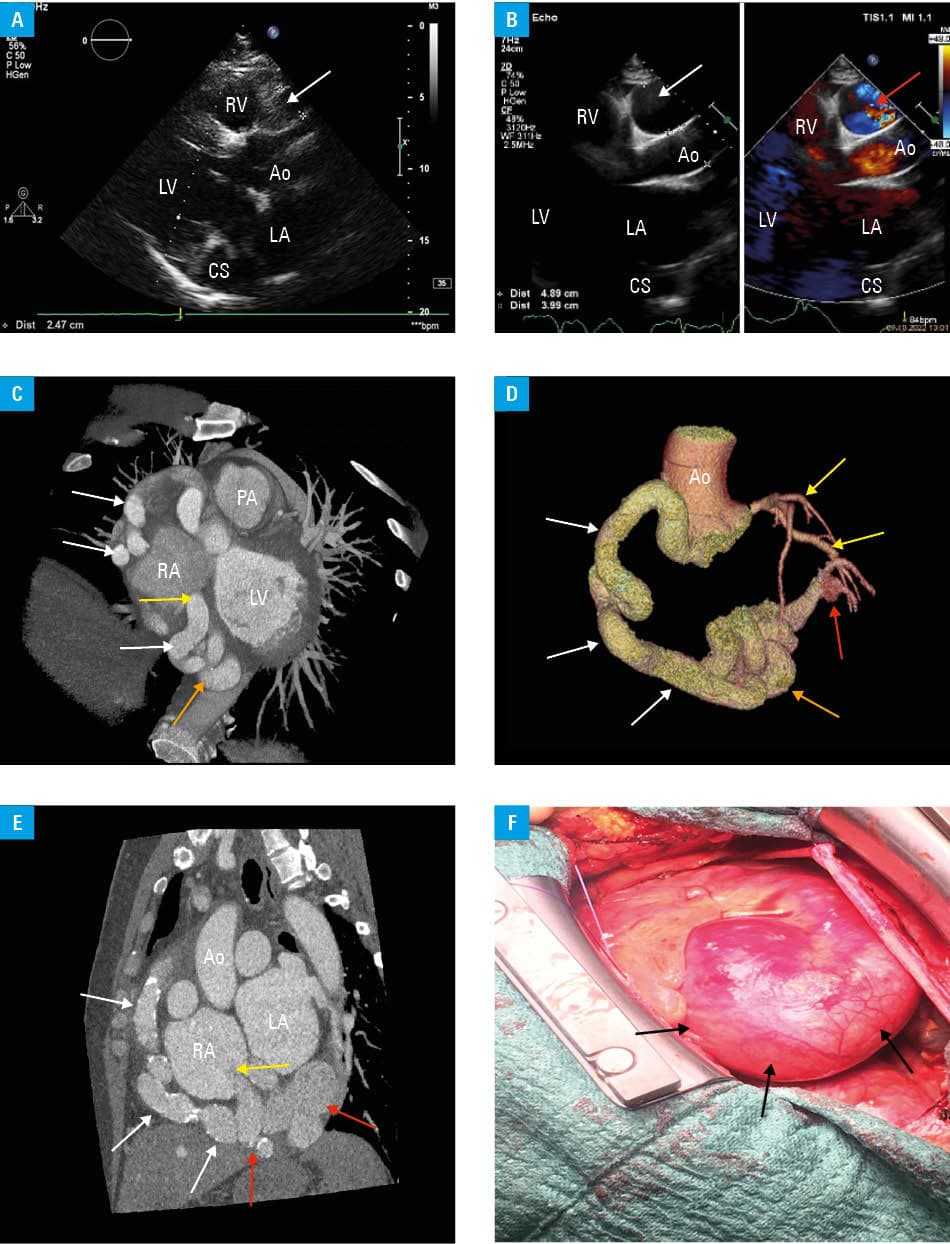
Abbreviations: Ao, aorta; CS, coronary sinus; LA, left atrium; LV, left ventricle; PA, pulmonary artery; RA, right atrium; RV, right ventricle
Comparison of the RCA diameter on TTE examinations performed in 2007 and 2021 demonstrated progressive enlargement from 2.47 to 4.89 cm (Figure 1B), accompanied by progression of the right‑sided chamber size. Further diagnostic evaluation was performed with multidetector computed tomography (MDCT), which identified a vascular anomaly in the form of a fistula between the RCA, coronary sinus, and RA (Figure 1C). On MDCT performed in 2021, marked elongation and widening of the entire RCA were observed, including aneurysmal dilatation of the proximal segment, with the outer diameter increasing from 11 to 53 mm. The diameter of the lumen in distal segments ranged from 16 to 36 mm, forming a conglomeration of tortuous vessels at the posterior‑inferior outline of the heart (Figure 1D). As compared with the 2007 examination, a significant progression of the RCA dilatation was evident (Figure 1E). Furthermore, the most recent MDCT showed significant stenosis in the mid‑segment of the left anterior descending (LAD) artery. The patient was initially evaluated for surgical closure of the fistula; however, he declined the proposed interventional treatment. After several years of follow‑up, the patient consented to surgical management. Intraoperatively, massive RCA aneurysm was identified, extending beyond the crux of the heart (Figure 1F).
The patient underwent surgical treatment involving closure of the RCA fistula, closure of the RCA aneurysm, and creation of the left internal mammary artery‑LAD graft, as the treatment of concomitant coronary artery disease. At present, he remains in a good clinical condition, and is under outpatient observation, with symptoms of HF classified as NYHA class II.
Congenital or acquired (usually iatrogenic) coronary fistulas represent abnormal communications between a coronary artery and the heart cavity or another vessel, including the coronary sinus, systemic or pulmonary vein, or the pulmonary artery.1 The most frequent sites of fistula drainage are the pulmonary trunk, RV, and RA. A coronary artery with a significant fistula undergoes gradual proximal dilatation from the site of the fistula, which, over time, may lead to coronary artery aneurysm.2 Larger, hemodynamically significant fistulas may lead to the occurrence of steal syndrome, angina, myocardial infarction, as well as arrhythmias, endocarditis, and HF due to volume overload. In the presence of a significant left‑right shunt, pulmonary hypertension may develop. Rupture or thrombosis of a fistula or concomitant aneurysm is also possible.3 Depending on the size of the leak and the presence of symptoms, it is feasible to close the fistula by transcatheter techniques or surgical intervention.4,5
- Baumgartner H, De Backer J, Babu‑Narayan SV, et al; ESC Scientific Document Group. 2020 ESC Guidelines for the management of adult congenital heart disease. Eur Heart J. 2021; 42: 563‑645. | Crossref
- Frommelt P, Lopez L, Dimas VV, et al. Recommendations for multimodality assessment of congenital coronary anomalies: a guide from the American Society of Echocardiography: developed in collaboration with the Society for Cardiovascular Angiography and Interventions, Japanese Society of Echocardiography, and Society for Cardiovascular Magnetic Resonance. J Am Soc Echocardiogr. 2020; 33: 259‑294. | Crossref
- Al‑Hijji M, El Sabbagh A, El Hajj S, et al. Coronary artery fistulas: indications, techniques, outcomes, and complications of transcatheter fistula closure. JACC Cardiovasc Interv. 2021; 14: 1393‑1406. | Crossref
- An X, Guo S, Dong H, et al. Congenital coronary artery‑to‑pulmonary fistula with giant aneurysmal dilatation and thrombus formation: a case report and review of literature. BMC Cardiovasc Disord. 2021; 21: 273. | Crossref
- Glaveckaitė S, Mindaugas M, Nomeda V, et al. Successful surgical treatment of coronary cameral fistula. Kardiol Pol. 2023; 81: 403‑404. | Crossref
ARTICLE INFORMATION