
When ventricular tachycardia meets left ventricular thrombus: catheter ablation guided by intracardiac echocardiography with cerebral protection
1 , 2, 2, 2

 CC BY 4.0
When ventricular tachycardia meets left ventricular thrombus: catheter ablation guided by intracardiac echocardiography with cerebral protection
, 2, 2, 2 CC BY 4.0
A 67‑year‑old man with ischemic cardiomyopathy (left ventricular [LV] ejection fraction, 30%), recurrent sustained monomorphic ventricular tachycardia (VT), prior implantation of a left bundle branch–optimized cardiac resynchronization therapy defibrillator, and a chronic laminated LV apical thrombus (12 mm × 4 mm) visible on transthoracic echocardiography (Figure 1A) was referred for repeat VT ablation. Due to drug‑refractory arrhythmia, contraindications to mechanical cardiac support and heart transplant, repeat catheter ablation was considered the only viable strategy. Prior to thrombus formation, the patient had undergone endocardial ablation followed by epicardial substrate modification, and remained on chronic anticoagulation with apixaban.
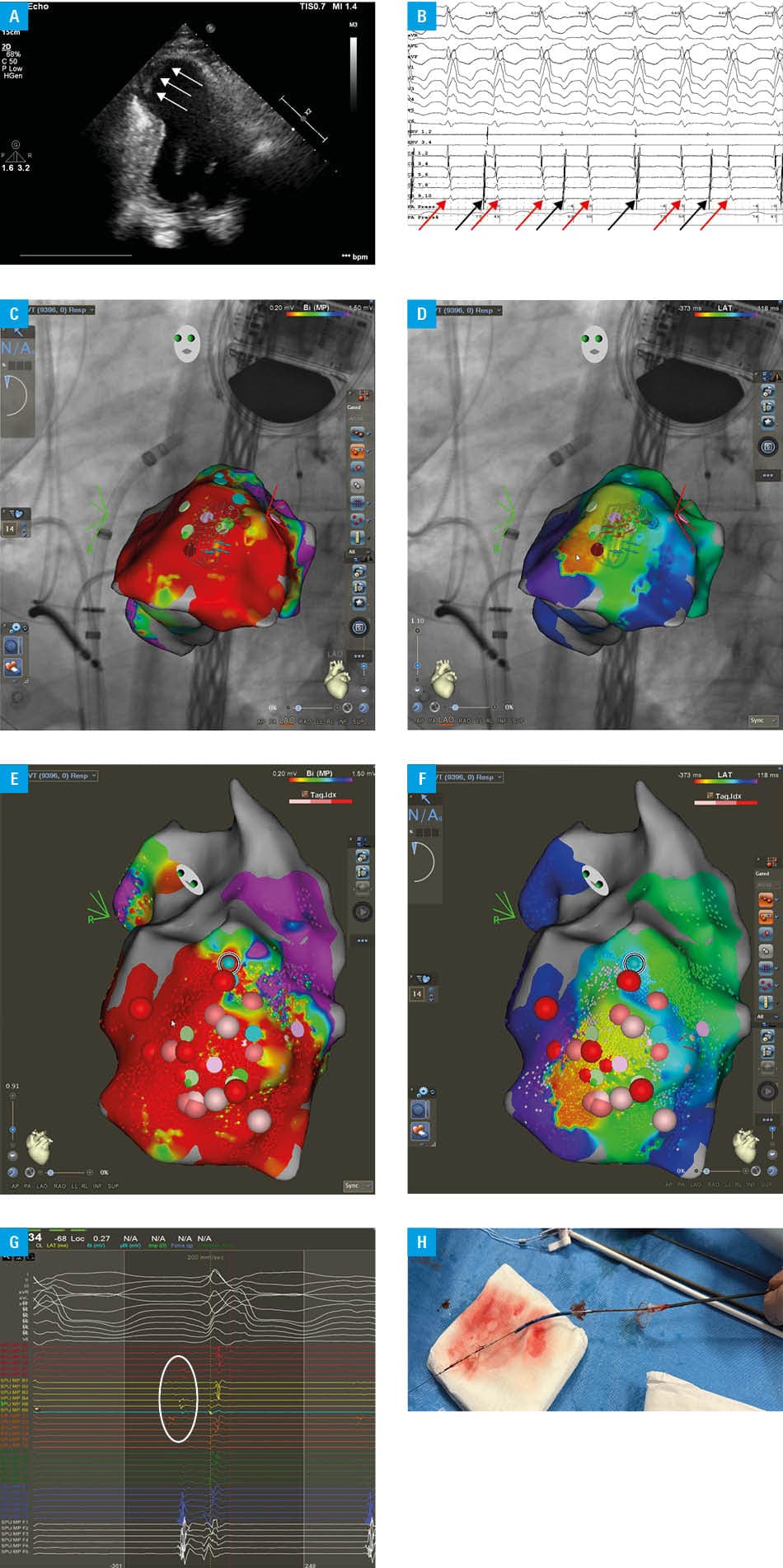
Given the presence of LV thrombus and the need for extensive substrate mapping, a cerebral protection system (SENTINEL, Boston Scientific, Marlborough, Massachusetts, United States) was introduced via the right radial artery and subsequently deployed in the brachiocephalic trunk and left common carotid artery as an additional procedural safeguard. Venous access was obtained through the right femoral vein. A decapolar catheter was positioned in the coronary sinus and a quadripolar catheter in the right ventricle. Electrophysiological study confirmed clinical VT (Figure 1B). After a single transseptal puncture, a steerable sheath was advanced to the LV, while an intracardiac echocardiography (ICE) catheter was positioned in the right ventricle to guide catheter ablation. Intravenous heparin was administered with target activated clotting time of 350 ms. Activation and voltage maps of the LV were performed using an OPTRELL mapping catheter and CARTO 3‑dimensional electroanatomical mapping system (Biosense Webster, Diamond Bar, California, United States; Figure 1C–1F), visualizing a heterogeneous scar in the midanterior and midlateral walls. Radiofrequency ablation with a QDOT MICRO catheter (40 W; ablation index >600) at the sites demonstrating VT isthmus and diastolic potentials resulted in VT termination and restoration of biventricular pacing (Figure 1G). Programmed stimulation induced a nonclinical unstable VT, which was not further mapped. After the procedure, all catheters and the cerebral protection system were removed without complications. No macroscopic thrombotic material was identified in the filters (Figure 1H). The procedure was uneventful. No neurological deficits or VT recurrence were observed at 6‑month follow‑up.
Catheter ablation of ischemic VT carries a risk of systemic embolization, particularly in patients with LV thrombus.1,2 Previous studies have shown that cerebral ischemic lesions may occur despite adequate anticoagulation.3 ICE enables real‑time visualization of intracardiac structures and may improve procedural safety in this setting.4 The SENTINEL cerebral protection system captures embolic debris during transcatheter aortic valve implantation, although its impact on stroke reduction remains uncertain, and its use in other left‑sided procedures is still exploratory.5 In our case, no macroscopic debris was identified; however, this neither excludes microembolization nor confirms device efficacy.
Although ICE‑guided VT ablation or cerebral protection during left‑sided procedures has been previously reported, to our knowledge, data illustrating the combined use of both techniques in this setting have not yet been presented. This case shows the feasibility of such an approach, albeit its impact on thromboembolic risk requires further investigation.
- Margolis G, Nov C, Kazatsker M, et al. In‐hospital outcomes of ventricular tachycardia catheter ablation in the presence of intra‐cardiac thrombus. Pacing Clin Electrophysiol. 2024; 47: 1433‑1440. | Crossref
- Heeger C‑H, Metzner A, Schlüter M, et al. Cerebral protection during catheter ablation of ventricular tachycardia in patients with ischemic heart disease. J Am Heart Assoc. 2018; 7: e009005. | Crossref
- Hasegawa K, Yoneda ZT, Powers EM, et al. Stroke and bleeding risks of endocardial ablation for ventricular arrhythmias. JACC Clin Electrophysiol. 2024; 10: 193‑202. | Crossref
- Sanhueza E, Hanson M, Neira V, et al. Pushing the limits: successful zero fluoroscopy ventricular tachycardia ablation with intraventricular thrombus guided by intracardiac echocardiography. JACC Case Rep. 2025; 30: 104439. | Crossref
- Goel S, Khera S, Krishnamoorthy P, et al. Sentinel cerebral embolic protection during transcatheter aortic valve replacement. JACC Cardiovasc Interv. 2025; 18: 1948‑1950. | Crossref
ARTICLE INFORMATION