
Pulmonary embolism complicated by systemic arterial embolism due to high-risk patent foramen ovale

 CC BY 4.0
Pulmonary embolism complicated by systemic arterial embolism due to high-risk patent foramen ovale
CC BY 4.0
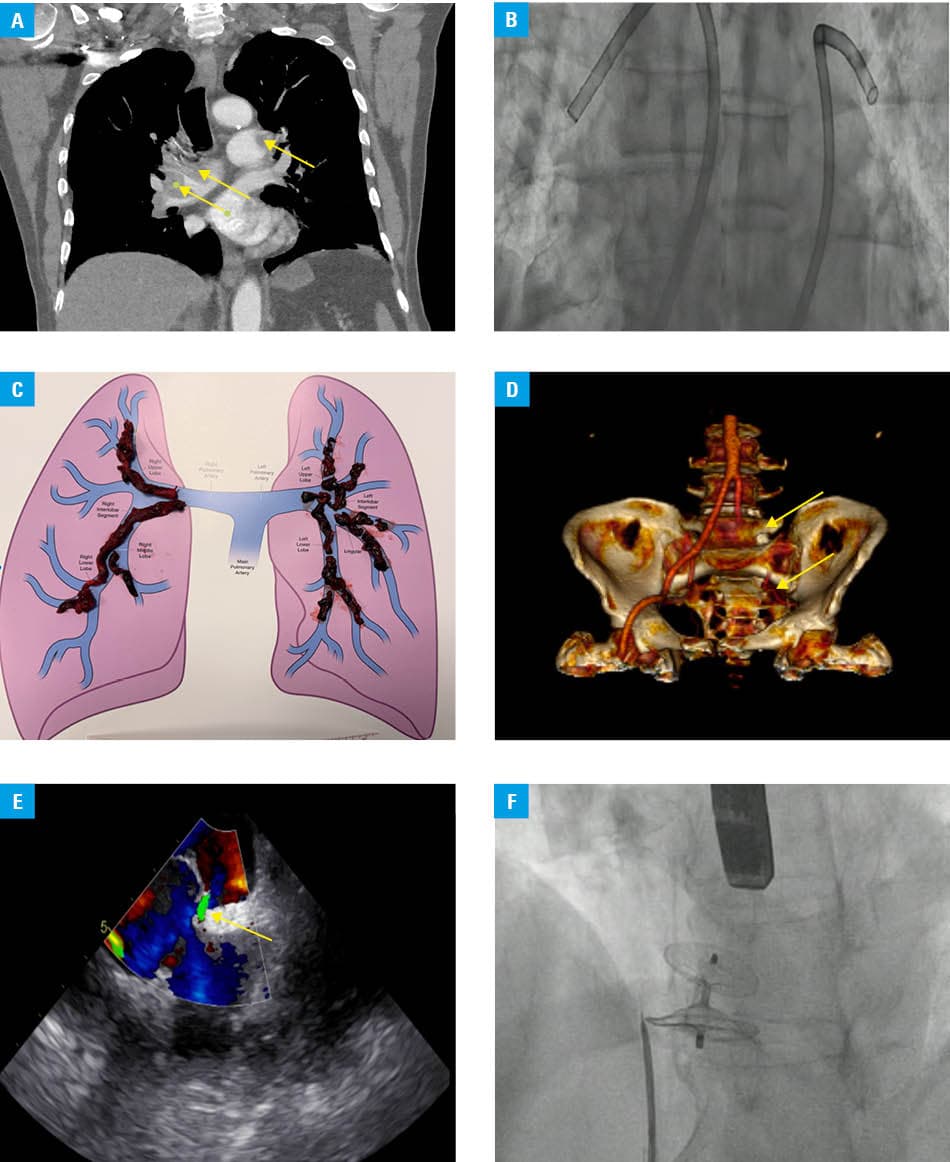
We present a case of a 77‑year‑old man with intermediate‑high‑risk pulmonary embolism (PE) with bilateral thrombi in the main pulmonary arteries and their lobar branches (Figure 1A). The patient had been treated with low‑molecular‑weight heparin for 24 hours at a remote hospital without clinical improvement. His medical history was irrelevant. Upon arrival, he had tachycardia at 111 bpm, normal blood pressure (133/85 mm Hg), tachypnea with a respiratory rate of 28 bpm, and profound hypoxia (SaO2, 85%; pO2, 33.5 mm Hg; and pCO2, 29.4 mm Hg) despite oxygen supplementation at 15 l/min via a mask with a reservoir bag. Switching to a high‑flow nasal cannula at 60 l/min with 100% O2 was required to achieve SaO2 above 90%.
Workup showed enlarged right heart with decreased function, a shift of the interatrial and interventricular septa toward the left side, no visible right‑to‑left shunt, a right ventricular / left ventricular diameter ratio of 1.4 on echocardiography, and an elevated level of troponin I (829 ng/l; reference range <34.2 ng/l).
Due to ongoing respiratory and right ventricular failure, a high thrombus burden, elevated bleeding risk, and no net benefit from systemic thrombolysis, the local PE response team qualified the patient for urgent (within 1 h of admission) transcatheter reperfusion. He underwent catheter‑directed vacuum aspiration thrombectomy using the Lightning Flash 2.0 system (Penumbra Inc., Alameda, California, United States), with satisfactory thrombus debulking (Figure 1B and 1C). The procedure resulted in normalization of pulmonary pressures, immediate relief of dyspnea, SaO2 increase to 99%, and reduced supplemental oxygen requirements (to 3 l/min via a nasal cannula 6 h after the procedure). Twelve hours later, the patient developed pain and weakness in his left lower limb, with low skin temperature, decreased muscle strength, and weak peripheral arterial pulsation. Computed tomography angiography demonstrated occlusions of the left common iliac artery, internal and external iliac arteries, common femoral artery, deep femoral artery, and external femoral artery (Figure 1D). The patient underwent urgent, successful surgical embolectomy with a Fogarty catheter (Edwards Lifesciences, Irvine, California, United States). Transesophageal echocardiography was performed due to a strong suspicion of an intracardiac shunt, and identified a very flaccid aneurysmal interatrial septum with a patent foramen ovale (PFO; Figure 1E). Due to the high‑risk anatomy, urgent percutaneous closure of the PFO was carried out using a 30‑mm Amplatzer Talisman occluder (Abbott, Abbott Park, Illinois, United States; Figure 1F). The procedure resulted in improved oxygen saturation levels—SaO2 reached 99% on room air, and mixed venous saturation increased from 55% to 67%. Arrhythmic, rheumatic, hematologic, and neoplastic screenings were negative. The patient was discharged home in good general condition after 6 days of hospitalization. Apixaban 10 mg twice daily for the first week, followed by 5 mg twice daily was administered for 6 months, along with clopidogrel 75 mg daily for 3 months. Three‑month follow‑up was uneventful.
Paradoxical embolism involves an intracardiac pressure shift from left‑to‑right to right‑to‑left caused by PE, allowing thrombi to pass through the PFO.1,2 Closing the PFO during PE treatment is not a routine approach because the PFO compensates for the increased right heart pressure.3,4 However, in this case, the paradoxical embolism occurred after PE treatment and pressure normalization, due to a high‑risk anatomy and tissue mobility within the interatrial septum, which failed to seal properly.
- Dabaliz AM, Arain FD. Impending paradoxical embolism: perioperative management and role of transesophageal echocardiography. Semin Cardiothorac Vasc Anesth. 2020; 24: 328‑336. | Crossref
- Kopeć G, Araszkiewicz A, Kurzyna M, et al. Role of catheter‑directed therapies in the treatment of acute pulmonary embolism. Expert opinion of the Polish PERT Initiative, Working Group on Pulmonary Circulation, Association of Cardiovascular Interventions, and Association of Intensive Cardiac Care of the Polish Cardiac Society. Kardiol Pol. 2023; 81: 423‑440. | Crossref
- Pristipino C, Germonpré P, Toni D, et al. European position paper on the management of patients with patent foramen ovale. Part II – decompression sickness, migraine, arterial deoxygenation syndromes and select high‑risk clinical conditions. Eur Heart J. 2021; 42: 1545‑1553. | Crossref
- Waligóra M, Stępniewski J, Kopeć G. Severe refractory arterial blood desaturation in the course of acute pulmonary embolism successfully reversed with catheter‑directed therapy. Pol Arch Intern Med. 2023; 133: 16537. | Crossref
ARTICLE INFORMATION