
NETosis and venous thromboembolism: from mechanisms to practical implications
1,2 ,
Key words: citrullinated histone H3, coagulation, neutrophil extracellular traps, post-thrombotic syndrome, venous thromboembolism
,
Key words: citrullinated histone H3, coagulation, neutrophil extracellular traps, post-thrombotic syndrome, venous thromboembolism

 CC BY 4.0
NETosis and venous thromboembolism: from mechanisms to practical implications
, CC BY 4.0
Neutrophil extracellular traps (NETs) are increasingly recognized as key mediators in the development of venous thromboembolism (VTE). Animal models and in vitro studies showed that NETs form a prothrombotic scaffold that supports platelet adhesion and aggregation, promotes activation of blood coagulation, and accelerates thrombin generation, leading to the formation of compact fibrin networks that exhibit increased resistance to fibrinolysis. Although clinical data remain limited, available studies support the translational relevance of these mechanisms in VTE. Elevated levels of circulating markers related to NETs formation (NETosis), such as citrullinated histone H3 (citH3), cell‑free DNA, and neutrophil protein–DNA complexes, have been detected in patients with acute deep vein thrombosis and correlated with disease severity and unfavorable outcomes. In acute pulmonary embolism (PE), elevated citH3 level on admission predicted PE‑related death. Higher concentrations of NET‑related proteins have also been linked to post‑thrombotic syndrome and chronic thromboembolic pulmonary hypertension. Recent data suggest an association between enhanced NETosis and elevated levels of factor XI. From a clinical perspective, enhanced NETosis can be implicated in suboptimal effects of anticoagulant therapy in VTE, especially in cancer or septic patients. Despite the fact that attenuation of NETosis is an attractive goal in VTE, at present, no therapeutic strategies targeting NETosis, NETs degradation, or inhibition of NETosis‑associated pathways are available. This review summarizes the current knowledge on the mechanisms linking NETs with thrombosis. It also discusses the utility of available methods for the quantification of NET‑related markers in patients and clinical implications of NET‑mediated venous thrombosis and its sequelae.
Introduction
Venous thromboembolism (VTE), encompassing deep vein thrombosis (DVT) and pulmonary embolism (PE), is a major contributor to global illness and death. Its incidence is influenced by age, comorbidities, and risk exposure. DVT occurs frequently, with an annual rate of about 1 per 1000 people.1,2 Multiple VTE risk factors include older age, obesity, major surgery or trauma, hospitalization, cancer, immobility, estrogen therapy, pregnancy / puerperium, sepsis, chronic inflammatory diseases, and genetic predisposition.1,2 Owing to VTE prevention strongly advocated within the last 20 years, the thrombotic risk following hospitalization, injury, or pregnancy has been markedly reduced.3 In Western populations, roughly 1 in 12 individuals will develop DVT during their lifetime. Notably, 25%–30% of first‑time DVT cases occur without identifiable risk factors. VTE recurrence affects 20%–36% of patients within 10 years.1,2 Long‑term anticoagulation is highly effective in preventing VTE recurrence, but at the cost of an elevated bleeding risk. Post‑thrombotic syndrome (PTS), a chronic complication, develops in up to half of DVT patients, typically 3–6 months after the initial event. PE is less common than DVT, with 60–120 cases per 100 000 individuals annually, and approximately 370 000 cases per year in the United States.1,2,4 However, in many countries, PE is still associated with high prevalence and a 30‑day mortality rate of up to 14%–20%,4 particularly in elderly patients and those with a high comorbidity burden. Chronic thromboembolic pulmonary hypertension (CTEPH) is a serious long‑term complication affecting 1%–4% of PE patients, with substantial mortality.1,5
Accumulating evidence indicates that immune cells, particularly neutrophils, are implicated in VTE.6-17 Neutrophils that serve as frontline effectors of innate immunity can generate neutrophil extracellular traps (NETs) in the process of NETs formation (NETosis), which represents a specialized antimicrobial defense mechanism, discovered by Brinkmann and co‑workers in 2004.18 It is also well known that NETosis contributes to venous thrombus formation and stabilization, giving rise to the concept of immunothrombosis. Understanding the role of NETosis in VTE not only provides mechanistic insights into disease pathogenesis but also opens new avenues for biomarker development and targeted therapy. In this review, we present available data on the associations between NETosis and venous thrombosis, in particular the mechanisms through which NETs contribute to thrombus formation. We also discuss potential therapeutic strategies targeting NETosis, and critically evaluate methods for the quantification of NET‑associated proteins. Finally, we address practical implications of NETosis in the management of VTE patients.
Role of neutrophil extracellular traps in thrombus formation
The release of NETs in response to strong proinflammatory stimuli, such as infections and damage‑associated molecular patterns (DAMPs), represents a key mechanism of innate immunity. NETosis can be triggered by autoantigens, urate crystals, oxidized low‑density lipoprotein, cholesterol, high‑mobility group bo × 1 protein (HMGB1), and proinflammatory cytokines (eg, interleukin [IL]-1β, IL‑8, and tumor necrosis factor α).19 Phorbol‑12‑myristate‑13‑acetate (PMA), lipopolysaccharides (LPS), calcium ionophores, and bacteria can induce NETosis both in vitro and in vivo.19 NETs are 3‑dimensional structures composed of decondensed chromatin decorated with neutrophil granule proteins, including neutrophil elastase (NE), myeloperoxidase (MPO), and proteinase 3.18 NETosis is a complex, tightly regulated process involving activation of nicotinamide adenine dinucleotide phosphate oxidase regulated by protein kinase signaling cascade Raf‑MEK‑ERK pathway. This pathway plays an important role in the initiation of NETosis, particularly its classical, reactive oxygen species (ROS)-dependent form.20 Subsequent post‑translational histone modifications, such as citrullination, and progressive disintegration of intracellular membranes ultimately result in the extrusion of DNA into the extracellular space.21 Peptidyl arginine deiminase 4 (PAD4), localized primarily in the cytoplasm and translocated to the nucleus following calcium influx, catalyzes citrullination of histones (conversion of arginine to citrulline), promoting chromatin decondensation essential for NETosis. Owing to their spatial architecture, NETs act as sticky, protein‑rich scaffolds that immobilize microorganisms, including bacteria, fungi, and certain viruses.22 NETs locally concentrate potent antimicrobial factors, such as proteolytic enzymes, ROS, and cytotoxic histones.18
The negatively charged DNA backbone binds positively charged coagulation factors, platelets, and red blood cells. The key mechanism of coagulation activation via tissue factor (TF) exposure following vessel injury is closely associated with recognition of pathogens by leukocytes and cellular damage. Pathogen‑associated molecular patterns (eg, LPS) and DAMPs stimulate monocyte receptors, such as toll‑like receptors (TLRs) and CD14, leading to increased TF gene transcription and protein expression.19 NETs can bind TF derived from activated monocytes, endothelial cells, or microparticles.23 They also activate the contact pathway via factor XII (FXII), as the negatively charged surfaces of extracellular DNA and histones promote FXII autoactivation, leading to activation of FXI, FIX, and ultimately FX.24,25 The dual engagement of intrinsic and extrinsic pathways underscores the potent procoagulant capacity of NETs.
NET‑associated enzymes, namely, NE and MPO, also oxidize natural anticoagulants, including thrombomodulin and TF pathway inhibitor, promoting endothelial dysfunction and a prothrombotic state.26,27 Moreover, NET‑rich thrombi exhibit increased resistance to fibrinolysis.28,29 This contributes to thrombus persistence and may impair the resolution of venous clots. Experimental degradation of NETs with DNase I enhances thrombolysis, supporting the mechanistic role of chromatin in fibrinolytic resistance.30
Platelets cooperate closely with neutrophils, linking inflammation with thrombosis, mainly through interactions between platelet P‑selectin and neutrophil P‑selectin glycoprotein ligand‑1, resulting in the formation of platelet–neutrophil aggregates.31,32 These aggregates enhance further neutrophil recruitment, promote leukocyte adhesion to the endothelium, and stimulate NETs release.33 Also, histones bind to platelet TLR2 and TLR4, inducing calcium influx, granule secretion, and activation of integrin αIIbβ3.34 Platelets, in turn, stimulate NETosis via P‑selectin and HMGB1, creating a self‑amplifying loop.23,35
Neutrophil extracellular trap formation testing
To our knowledge, no widely adopted, diagnostically approved in vitro diagnostic and fully standardized method for NETs quantification is currently available for routine clinical use. Although several commercial kits and laboratory‑developed assays have been proposed,36-38 their clinical implementation remains limited due to substantial analytical and preanalytical variability (Table 1).36,39 Theoretically, the most specific circulating NET markers are MPO‑DNA and NE‑DNA complexes. MPO‑DNA complexes were used in multiple clinical studies,37,40,41 and were shown to correlate with disease severity in sepsis.42 However, their association with cardiovascular risk factors in the general population37 or with acute VTE43 has not been clearly established due to several limitations of the results obtained (Table 1).39 In addition, MPO‑DNA levels are highly sensitive to preanalytical factors, which significantly affects reproducibility (Table 1).44 The lack of standardized calibrators and reference materials further limits interstudy comparability. Plasma contains cell‑free DNA (cfDNA) that originates from multiple sources, including apoptosis and necrosis, which may interfere with assays; therefore, citH3 is frequently used as a surrogate marker of NETosis.45,46 However, histone citrullination is not specific to NETs formation and may occur in other inflammatory conditions or autoimmune diseases.46-48 Consequently, current evidence suggests that multimarker approaches combining NET‑related proteins and coagulation parameters may better reflect the NETs burden than single biomarkers. Notably, citH3 and NE did not correlate with MPO‑DNA complexes in plasma.37,39 These problems render NETosis assessment in VTE patients (and in other populations) quite challenging, and contribute to inconsistent results reported by various research groups.
Marker | Principle / method | Advantages | Limitations | Clinical utility |
Abbreviations: citH3, citrullinated histone H3; ELISA, enzyme‑linked immunosorbent assay; MPO, myeloperoxidase; NE, neutrophil elastase; NET, neutrophil extracellular trap; VTE, venous thromboembolism | ||||
MPO‑DNA complexes39-42 | Detection of MPO bound to extracellular DNA (noncommercial ELISAs developed in specific laboratories) | Conceptually specific for NETs; widely used in research; correlate with disease severity in sepsis but not in VTE | Poor specificity in plasma / serum; inconsistent correlation with other NET markers; strong sensitivity to preanalytical factors (sample type, anticoagulant, processing time, storage, freeze–thaw); lack of standardized calibrators | Research use only; not adopted in routine diagnostics |
NE‑DNA complexes38,45,49 | Detection of NE bound to extracellular DNA (noncommercial ELISA) | Conceptual specificity similar to MPO‑DNA | Same analytical and preanalytical limitations as MPO‑DNA; poor standardization | Research use only |
citH345,49 | Detection of citH3 associated with chromatin decondensation during NETosis (commercial ELISA) | Most commonly used surrogate NET marker; technically feasible; widely used in experimental and clinical studies | Not NET‑specific; histone citrullination occurs also in other inflammatory conditions, necrosis, and autoimmune diseases | Widely used research marker; interpretation requires clinical context |
Cell‑free DNA45 | Quantification of extracellular circulating DNA (commercial fluorescent assay) | Easy to measure; reflects extracellular chromatin release | High sensitivity but low specificity; DNA originates from apoptosis, necrosis, and other sources | Limited diagnostic value if assessed alone |
Multimarker approaches37,39 | Combination of NET markers (eg, MPO/NE, DNA, citH3) with coagulation markers | Better correlation with NETosis burden and disease severity | Lack of standardized panels; inconsistent correlations between markers (eg, citH3 and NE vs MPO‑DNA) | Promising research strategy |
Neutrophil extracellular trap formation and immunothrombosis
Increasing evidence highlights the central role of NETosis in immunothrombosis.27,35,49
Immunothrombosis refers to the formation of thrombi as part of the innate immune response, aimed at trapping and neutralizing pathogens within microthrombi and limiting their systemic dissemination.50 However, excessive or dysregulated NETosis promotes thrombosis.34 NETs structures have been detected in fresh thrombi, where their abundance correlated with thrombus burden and disease severity.51-53
Of note, serum obtained from patients with eosinophilic granulomatosis with polyangiitis enhanced the capacity of neutrophils isolated from healthy controls to generate NETs.54 Peripheral blood eosinophil counts correlated with the percentage of neutrophils undergoing NETs formation, suggesting a potential modulatory effect of eosinophils or eosinophilic inflammation on neutrophil activation and NETosis, which may contribute to disease pathogenesis.54
Neutrophil extracellular traps in experimental deep vein thrombosis
Animal models have provided compelling mechanistic insights into the role of NETs in DVT.55-69 Using immunofluorescence, extracellular DNA structures colocalizing with neutrophil markers (lymphocyte antigen 6 complex locus G6D [Ly6G], MPO, NE) have been observed within developing thrombi, strongly suggesting NETs presence at the sites of thrombogenesis.56 In mice, NETs contribute to thrombosis via inflammasome activation.57 Neutrophil stimulation induces NETs release and activates caspase‑1. Histones further enhance caspase‑1 activation in platelets. Pharmacologic inhibition of caspase‑1 significantly reduced DVT, supporting a functional link between NETs and inflammasomes.57 Platelets were also shown to amplify leukocyte recruitment, fibrin formation, and NETs release.58 In murine models of inferior vena cava stenosis or ligation, NETs were abundant within thrombi, colocalizing with fibrin and platelets, and genetic depletion of neutrophils or degradation of NETs using DNase I resulted in reduced thrombus size, weight, and stability.55,59,60 The same effect was observed with relation to PAD4 deficiency.55,61 Interestingly, PAD4‑deficient mice were protected from VTE without incidences of major bleeding.61 Moreover, Hisada et al62 showed colocalization of citH3 and DNA with fibrin within murine venous thrombi.
In animal studies, negatively charged histones exerted direct cytotoxic and procoagulant effects.55,59,60 NET‑associated proteases can degrade endogenous anticoagulants and modify fibrin structure, contributing to impaired clot lysis.32,55,59,60,63 Moreover, NETs were shown to amplify thrombin generation,63 while FXI inhibition attenuated thrombin generation on isolated NETs.64 In vitro studies demonstrated that NETs components accelerated thrombin generation and enhanced fibrin formation.24,65 Additionally, in vitro addition of histones and DNA to plasma resulted in formation of denser fibrin clots more resistant to fibrinolysis.66 DNA and histones also reduced plasmin generation and activity29,67 through limited accessibility of plasmin and tissue plasminogen activator to their sites of action, leading to impaired clot dissolution.68,69
Neutrophil extracellular trap formation in patients with venous thromboembolism
Available studies on NETosis and its association with the risk of VTE or its complications6-17 are summarized in Table 2. In 2013, van Montfoort et al6 analyzed 150 adult patients with acute symptomatic DVT and 195 individuals with a clinical suspicion of DVT, and observed that higher (>80th percentile) levels of circulating nucleosomes and elastase-α1‑antitrypsin complexes were associated with a 2–3‑fold greater risk of thrombosis (adjusted odds ratio [OR], 3; 95% CI, 1.7–5 and adjusted OR, 2.3; 95% CI, 1.4–3.9, respectively). The Michigan Research Venous Group reported about 220% higher levels of circulating DNA in 47 symptomatic DVT patients, as compared with those free of DVT.7 Moreover, elevated plasma cfDNA levels correlated positively with the DVT Wells score, D‑dimer, MPO, and von Willebrand factor levels in patients with DVT.7
Study population | Main findings | References |
Abbreviations: cfDNA, cell‑free DNA; CTEPH, chronic thromboembolic pulmonary hypertension; dsDNA, double‑stranded DNA; DVT, deep vein thrombosis; FXI, factor XI; IQR, interquartile range; OR, odds ratio; PAD4, peptidylarginine deiminase 4; PE, pulmonary embolism; PTS, post‑thrombotic syndrome; Q, quartile; others, see Table 1 | ||
Patients with acute symptomatic DVT (n = 150) vs patients with suspected DVT (n = 195) | Circulating nucleosomes and elastase–α1‑antitrypsin complexes >80th percentile associated with a 2–3‑fold higher DVT risk | van Montfoort et al6 |
Patients with symptomatic DVT (n = 47) vs patients with excluded DVT (n = 28) | Circulating DNA higher in the DVT than the non‑DVT group (mean [SD], 57.7 [6.3] vs 17.9 [3.5] ng/ml; P <0.01) | Diaz et al7 |
Patients with VTE (n = 11) | Extracellular DNA, MPO, citH3, and PAD4 visualized within venous thrombi | Savchenko et al8 |
Patients with acute PE (n = 126) vs healthy controls (n = 25) | Three‑fold higher citH3 levels in PE associated with hypofibrinolysis and higher simplified PE severity index; citH3 >4.11 ng/ml positively associated with 1‑year PE‑related death | Ząbczyk et al9 |
Patients with CTEPH (n = 141) vs controls (n = 60) | citH3 expression within fresh red thrombi; about 2‑fold higher MPO and dsDNA levels in CTEPH | Sharma et al10 |
Patients with VTE (n = 37) vs patients with no VTE history (n = 37) | Median (IQR) MPO‑DNA fold increase, 1.05 (0.96–1.13) vs 1 (0.94–1.05); P = 0.04 | Zapponi et al11 |
Patients with DVT (n = 52) vs healthy volunteers (n = 51) | Three to 5‑fold higher plasma levels of MPO‑DNA, NE‑DNA, and citH3 in DVT | Li et al12 |
Patients with trauma‑related VTE (n = 10) vs trauma patients without VTE (n = 29) | Four‑fold higher citH3 levels in the patients who developed VTE as compared with those without VTE (median [IQR], 12.8 [7.1–30.8] vs 3 [1.8–6.8] ng/ml; P = 0.02) | Navarro et al13 |
Patients with hyperhomocysteinemia‑related DVT (n = 71) vs non‑DVT patients (n = 323) | Higher levels of MPO‑DNA (by 44%), citH3 (by 65%), and cfDNA (by 67%) in DVT patients (all P <0.001) | Shao et al14 |
Patients with prior DVT followed for 53 months (n = 179) |
| Krupa‑Zabiegała et al15 |
Patients with acute VTE (n = 611) |
| Jiménez‑Alcázar et al16 |
Patients with DVT/DVT+PE (n = 172) |
| Michel et al17 |
The first evidence of NETs involvement in VTE was provided by Savchenko et al,8 who detected cfDNA, MPO, citH3, and PAD4 within venous thrombi obtained from 11 patients with VTE. Importantly, NETs were localized mainly within organizing rather than organized thrombi, though venous thrombi contained considerably less NET‑related components than coronary thrombi.30
Regarding acute PE, 370% higher baseline citH3 concentrations were associated with simplified PE severity index and correlated with reduced plasma clot susceptibility to fibrinolysis.9 Of note, citH3 levels greater than 4.11 ng/ml (sensitivity, 67% and specificity, 83%) were associated with a greater risk of 1‑year PE‑related death.9
Jiménez‑Alcázar et al16 showed that among patients with acute VTE, those with PE, as compared with those with proximal or distal DVT, had about 25%–50% higher nucleosome and cfDNA levels, without any differences in DNA‑histones‑MPO complexes. Moreover, cfDNA levels, in contrast to DNA‑histones‑MPO complexes, predicted VTE‑related death (hazard ratio [HR], 2.57; 95% CI, 1.59–4.15) but not VTE recurrence during 3‑year follow‑up. Sharma et al10 provided evidence on NETs involvement in CTEPH by showing abundant citH3 expression within fresh red thrombi excised during pulmonary endarterectomy, along with elevated concentrations of cfDNA and MPO (both P <0.001). Interestingly, enhanced neutrophil adhesion and chemotactic activity, together with 5% increased circulating MPO‑DNA levels, were detected even 2 years after an acute VTE episode, suggesting that activated neutrophils and endothelium mutually stimulate each other via endothelial injury and NET release, likely promoting thrombosis.11
In 2024, Li et al12 compared 52 DVT patients with healthy individuals and showed about 3–5‑fold higher plasma levels of MPO‑DNA, NE‑DNA, and citH3, along with a substantial platelet contribution to NETs generation and their procoagulant activity. Control neutrophils stimulated using plasma of DVT patients showed enhanced expression of TF and MPO, while NETs presented increased binding of coagulation factors, including fibrinogen, prothrombin, and FX. Moreover, it has been observed that NETosis is mediated by platelet factor 4, whose genetic inhibition reduced thrombosis in the inferior vena cava ligation model by modulating NETs formation.12
About 4‑fold higher baseline citH3 levels were also observed in trauma patients who developed VTE during 90‑day follow‑up, as compared with non‑VTE trauma patients.13 Similarly, levels of NET‑related proteins, namely, MPO‑DNA, citH3, and cfDNA were approximately 40%–60% higher in 71 individuals with hyperhomocysteinemia‑associated DVT than in non‑DVT patients.14
Recently, our group showed NETs as a contributor to PTS in a long‑term follow‑up study conducted in 179 individuals with prior DVT. The patients who developed PTS, as compared with the non‑PTS cohort, had nearly 70% higher citH3 levels, which correlated with the Villalta score.15 Baseline citH3 levels were associated with PTS (by 1‑ng/ml increase, OR, 5.5; 95% CI, 2.52–12.01). Moreover, recurrent VTE was found to correspond to almost 38% higher citH3 concentrations, as compared with no recurrence.15 This study suggests that NET‑related markers are predictive of serious VTE complications. Intriguingly, increased FXI activity was also shown to be associated with enhanced NETosis in DVT patients, which suggests an interaction between FXI and inflammation.17 This finding might be relevant for clinical practice given the studies on FXI/FXIa inhibitors.70
Collectively, experimental data from animal models, in vitro systems, and translational studies strongly implicate NETs as structural and functional mediators of VTE. These findings have opened new perspectives on the immunothrombotic mechanisms underlying VTE and suggest that targeting NETosis or promoting NETs degradation may represent a promising therapeutic strategy. The mechanisms linking NETosis and VTE are summarized in Figure 1.
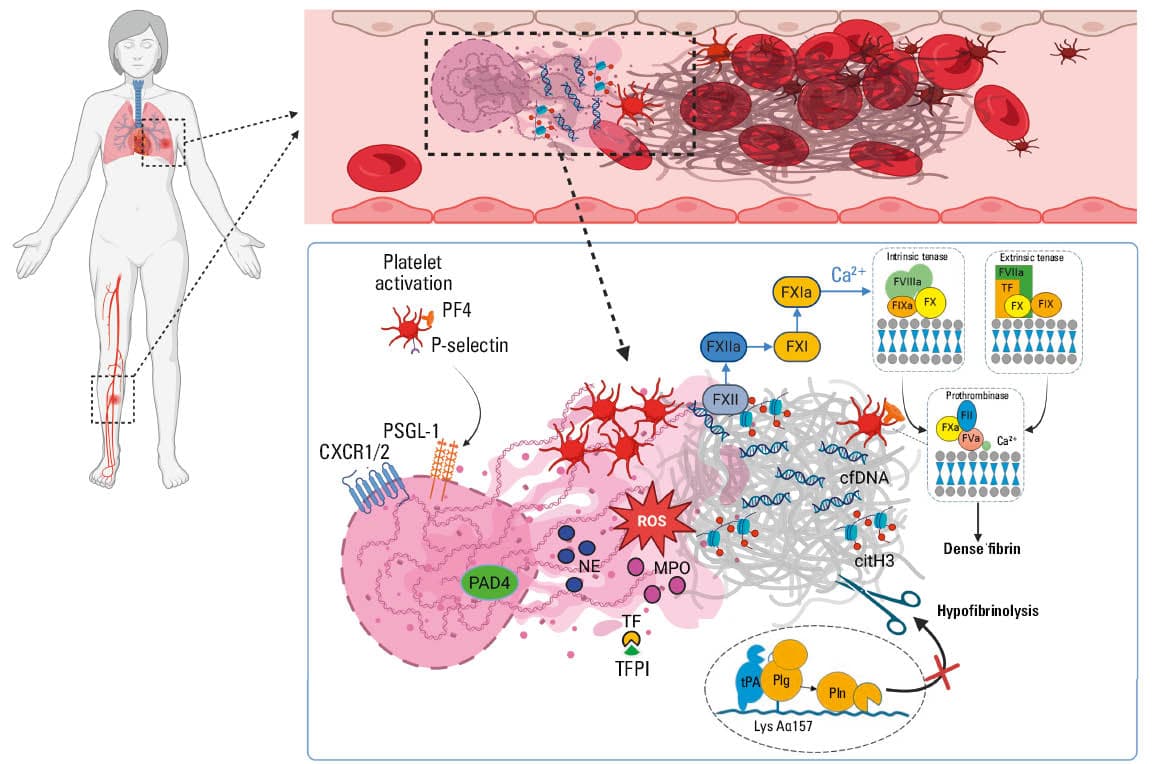
Abbreviations: CXCR1/2, C‑X‑C motif chemokine receptor 1/2; Lys Aα157, Lysine‑157 on the fibrinogen α chain; PF4, platelet factor 4; Plg, plasminogen; Pln, plasmin; ROS, reactive oxygen species; PSGL‑1, P‑selectin glycoprotein ligand‑1; TF, tissue factor; TFPI, tissue factor pathway inhibitor; tPA, tissue plasminogen activator; others, see Tables 1 and 2
Cancer‑associated thrombosis
Malignancy is a major factor predisposing to VTE, increasing its incidence by approximately 5‑fold through different mechanisms.71 Multiple studies using neutrophils and plasma from cancer patients indicate that cancer increases the tendency for NETosis in vitro, though in vivo role of NETs in cancer‑associated thrombosis is less defined.72-77 NET‑related markers, namely citH3 and cfDNA, have been identified within thrombi obtained from cancer patients, including cerebral, coronary, and pulmonary microthrombi.72 In an observational study by Mauracher et al,73 increased circulating citH3 levels have been associated with VTE in lung and pancreatic cancer, but not in breast, brain, or colorectal cancer, suggesting that NET markers may help assess thrombotic risk in selected malignancies. NET‑related markers also correlated with thrombin‑antithrombin complexes and D‑dimer, while DNase I effectively reduced NET‑related thrombin generation and subsequent fibrin formation in healthy control plasma, stimulated with neutrophils isolated from gastric cancer patients.74 It has also been shown that tumor‑derived growth factors stimulate NETs release, and the interaction between NETs and platelets represents a potential target for the prevention and treatment of tumor‑related thrombosis.75 Interestingly, in patients with a history of VTE, increasing levels of circulating citH3‑DNA independently predicted occult cancer during 1‑year follow‑up (per 500‑ng/ml increase; HR, 2.1; 95% CI, 1.23–3.61).74 Recently, Li et al77 found that cancer cell–derived extracellular vesicles induced NETosis and histone H3 citrullination, augmenting the risk of VTE in cancer patients independently of TF‑mediated blood coagulation activation.
Although NETs have been shown to promote tumor progression, under specific conditions they may also exert tumor‑suppressive effects and mechanically restrict the hematogenous spread of malignant cells.78-80 Cools‑Lartigue et al78 demonstrated that NETs can bind tumor cells within the microcirculation. However, in their experimental model, this interaction facilitated metastasis; the authors emphasized that NET‑mediated sequestration of tumor cells could, in alternative biological contexts, promote their elimination by immune effector cells. Enhanced antitumor properties of NETs through tumor antigen exposure and activation of antigen‑presenting cells have also been proposed by Papayannopoulos.79 Additionally, Mousset et al80 showed that NET‑associated proteases may induce tumor cell damage and inhibit proliferation in vitro, indicating a potential direct cytotoxic effect of NETs against malignant cells.
In summary, although the predominant body of evidence supports a prothrombotic and prometastatic role of NETs in cancer‑associated thrombosis, there is also evidence that NETs may exert tumor‑suppressive activity through physical sequestration of tumor cells within the vasculature, direct cytotoxic effects mediated by NET‑associated enzymes, and augmentation of antitumor immune responses.
Future directions and challenges
The future of research on NETosis appears quite promising, yet it also demands a cautious assessment that would allow clinical translation. At present, several parallel research directions are developing intensively, including the standardization of NETs measurements, deeper elucidation of the molecular mechanisms underlying NETs formation, and development and testing of therapeutic strategies targeting NETs or promoting their degradation.81 There has been a marked increase in the number of studies developing enzymatic or immunological approaches to NETs degradation, such as DNase‑based therapies or antihistone antibodies. In parallel, growing attention is being directed toward mapping the heterogeneity of NETosis, as it is becoming increasingly evident that no single, universal pattern of NETs formation exists.48,82 Instead, this process appears to be highly dependent on the nature of the stimulus, tissue microenvironment, and activation state of neutrophils.82
Targeting neutrophil extracellular trap formation in venous thromboembolism prevention and treatment
Potential therapeutic strategies that directly target neutrophils/NETs include: 1) DNase I—to degrade extracellular DNA; 2) histone‑neutralizing agents; 3) PAD4—to prevent NETosis; and 4) inhibition of platelet–neutrophil interactions.19,83 These approaches aim to attenuate thrombosis without impairing hemostasis.83 Therapeutic strategies that do not directly deplete target cells, such as inhibiting their recruitment (eg, C‑X‑C motif chemokine receptor 1/2 antagonists) or modulating their functional activation (eg, ROS generation), may nonetheless perturb immune homeostasis. Such interference can result in multifaceted adverse effects, including hepatotoxicity and fatigue.83
DNase therapy
DNase I, a nucleic acid endonuclease that digests single- and double‑stranded DNA, reduced thrombosis in multiple murine models of DVT.55,59 By degrading cfDNA and NETs, DNase I decreases thrombus size more effectively than neutrophil depletion alone.62 cfDNA‑rich thrombi resist fibrinolysis, and cfDNA fragments enhance the intrinsic coagulation pathway, promoting tissue hypoxia and endothelial injury.84 DNase I hydrolyzed cfDNA, limited thrombin generation, reduced immune cell infiltration, and prevented venous thrombosis in aging and tumor‑bearing mice without significant bleeding.85,86 Moreover, DNase I–like 3, secreted by macrophages, was also shown to degrade NETs and nucleosome‑bound DNA, and was postulated to prevent disseminated intravascular coagulation.87,88
Histone inhibition
Small polyanions were shown to inhibit histone- and platelet‑mediated activation and exhibit protective effects in NET‑associated diseases, such as sepsis and DVT, with some candidates advancing toward clinical development.89
Heparin, beyond its antithrombin‑mediated anticoagulant function, binds histones via electrostatic interactions, forms noncytotoxic complexes, disrupts NETs, and reduces platelet aggregation. Since NETs are positively charged, unfractionated heparin (UFH) may be particularly effective in acute PE.90 Heparin can also destabilize NETs by displacing histones from their chromatin backbone.90 However, in vitro studies showed that heparin may paradoxically stimulate NETs formation.90 Low‑molecular‑weight heparin induced less NETs production, while fondaparinux did not promote NET formation.90 Although UFH shows potential advantages in PE through NET‑related mechanisms, its overall clinical benefit requires further confirmation based on real‑world data. So far, the precise immunological mechanisms by which histones drive endothelial injury and thrombosis remain incompletely understood, and their targeted inhibition in DVT requires further investigation.
Peptidyl arginine deiminase 4 inhibition
Although inhibitors of PAD4 are being thoroughly studied in preclinical models, large phase II/III clinical trials evaluating PAD4 inhibitors in humans are currently lacking. In a DVT murine model, PAD4‑deficient mice formed thrombi without NETs.61 However, when neutrophils from wild‑type mice were infused, NET‑containing thrombi developed again, demonstrating that neutrophil PAD4 may be implicated in VTE and identifying PAD4 as a potential therapeutic target in DVT.61 Several PAD4 inhibitors have been developed, including reversible, nonspecific agents (paclitaxel, minocycline, streptomycin) and irreversible PAD4 inhibitors (F- and Cl‑amidine) with unclear effects on DVT.91 To date, no PAD4 inhibitors have been approved for DVT management, highlighting the need for highly specific, high‑affinity agents.
Other indirect or combination approaches
Other potential approaches include modulation of autophagy, complement pathways, caspase‑1 inhibition, IL‑17A and IL‑1β inhibition or ROS scavengers,19 and phytochemicals, such as hesperidin, baicalin, and imperatorin,92 which were identified as effective NETosis inhibitors. In an antiphospholipid syndrome murine model, NETs contributed significantly to thrombosis, and defibrotide, a mixture of polyanionic oligonucleotides, reduced NET‑driven thromboinflammation.93
Interestingly, in preclinical models and retrospective clinical studies, aspirin, metformin, nonsteroidal anti‑inflammatory drugs, and statins have demonstrated NETosis‑reducing effects via diverse, largely unclear mechanisms.46,94 Overall, therapies effective in other NET‑related disorders may offer promising new directions for DVT management. To overcome limitations, such as the short half‑life and poor tissue penetration of NET‑targeting agents, future studies should prioritize the development of reversible NETosis inhibitors and the use of nanocarrier‑based systems to enhance drug delivery to target tissues while minimizing systemic toxicity.
Practical aspects
Certain patient groups and clinical scenarios may justify measuring the levels of NET‑associated proteins in diagnostic contexts. This is especially relevant for conditions where NETs are well‑documented contributors to thrombotic complications or tissue damage, including sepsis, severe COVID‑19, disseminated intravascular coagulation, antiphospholipid syndrome, vasculitides (particularly antineutrophil cytoplasmic antibody–associated vasculitis), and unusual or unexplained thrombotic events in young patients.82 Moreover, NETs testing could be considered in autoimmune and autoinflammatory diseases, such as systemic lupus erythematosus, rheumatoid arthritis, juvenile idiopathic arthritis, and inflammatory myopathies, in which NETs serve as sources of autoantigens and inflammation promoters. However, due to a lack of standardized assays and specific markers, NETs measurement should remain an adjunctive tool in selected cases rather than routine practice. Development of validated, specific tests is required before broader clinical application can be considered. To our best knowledge, the only diagnostic test designed to assess NETs formation in NET‑related pathologies (eg, sepsis, COVID‑19, and autoimmune diseases) is a chemiluminescent Nu.Q H3.1 test (Volition Diagnostics UK Ltd, London, United Kingdom) quantifying H3.1‑nucleosome complexes in plasma.95
Conclusions
Accumulating experimental and clinical evidence indicates that NETs play an important role in the pathogenesis of VTE, particularly in the development and progression of DVT. Animal and in vitro studies consistently demonstrate that NETs provide a structural scaffold that promotes platelet adhesion and activates blood coagulation, leading to enhanced thrombin generation and the formation of dense fibrin networks resistant to fibrinolysis. Through interactions with platelets, endothelial cells, and components of the complement and coagulation systems, NETs integrate inflammatory and hemostatic pathways, thereby reinforcing the concept of immunothrombosis in venous disease. Clinical studies, although still limited, support the translational relevance of these findings by demonstrating elevated circulating NET‑related protein levels in acute VTE and long‑term complications, especially PTS and CTEPH. Despite these promising insights, several important challenges need to be addressed before NET‑related biomarkers can be incorporated into routine clinical practice. Current assays for NETs quantification suffer from substantial preanalytical and analytical variability, a lack of standardized calibration, and limited specificity. Furthermore, many commonly used surrogate markers, such as citH3 or cfDNA, are not exclusive to NETosis and may reflect other forms of cell death or inflammation. Future research should focus on large, prospective studies to clarify the prognostic value of NET‑related biomarkers in VTE and to determine whether therapeutic strategies targeting NETosis and promoting NETs degradation or inhibition of factors associated with NETosis can improve clinical outcomes.
- Marschang P, Gerotziafas G, Kozak M, et al. Epidemiology of venous thromboembolism: implications for clinical practice. Pol Arch Intern Med. 2025; 135: 17105. | Crossref
- Pathak A, Roberts L, Agrawal DK. Immunomodulation and thrombolytic approaches in the management of deep vein thrombosis and pulmonary embolism. Cardiol Cardiovasc Med. 2025; 9: 322‑333. | Crossref
- Krasiński Z, Undas A, Podolak‑Dawidziak M, et al. Thromboprophylaxis in medical patients: a 2025 update of Polish recommendations. Pol Arch Intern Med. 2025; 135: 17047. | Crossref
- Pruszczyk P, Araszkiewicz A, Chrzanowski Ł, et al. Trends in the incidence and treatment of pulmonary embolism in Poland (2018‑2023): insights from public healthcare data. Pol Heart J. 2025; 83: 1296‑1306. | Crossref
- Wilczek Ł, Stępniewski J, Waligóra M, et al. Unmet needs in diagnostics of acute pulmonary embolism and their determinants in Polish hospitals. Pol Heart J. 2024; 82: 874‑881. | Crossref
ARTICLE INFORMATION