
A rare case of craniopharyngioma in the pituitary stalk region mimicking lymphocytic hypophysitis

 CC BY 4.0
A rare case of craniopharyngioma in the pituitary stalk region mimicking lymphocytic hypophysitis
CC BY 4.0
Pituitary stalk lesions are rare entities of neoplastic, inflammatory, or congenital origin, with inflammatory and infectious causes predominating.1,2 Craniopharyngioma is an uncommon dysembryogenetic tumor arising from epithelial remnants of the craniopharyngeal duct or metaplastic anterior pituitary cells. Lesions confined to the pituitary stalk are exceptionally rare, representing approximately 2% of all suprasellar craniopharyngiomas, since they are seldom identified prior to their extension into adjacent regions.3
A 50‑year‑old man presented with a 6‑day history of progressively worsening headache, accompanied by vertigo, tinnitus, fatigue, chills, low‑grade fever (37.1 °C), and a 4‑day history of polydipsia. Initial investigations demonstrated cerebrospinal fluid pleocytosis and an elevated C‑reactive protein level, with negative microbiological studies, leading to a diagnosis of aseptic meningitis. Concurrently, reduced thyroid‑stimulating hormone and free thyroxine levels prompted comprehensive endocrine evaluation.
Hormonal assessment showed reduced levels of luteinizing hormone, follicle‑stimulating hormone, testosterone, and morning cortisol, with adrenocorticotropic hormone in the low‑normal range. Additionally, low urine osmolality, elevated serum osmolality, and low urine specific gravity were observed. Based on these findings, a diagnosis of panhypopituitarism with concomitant diabetes insipidus was made. Detailed laboratory test results are provided in Supplementary material, Tables S1 and S2.
Magnetic resonance imaging (MRI) demonstrated pituitary stalk thickening (Figure 1A and 1B) with T2 hyperintensity and heterogeneous contrast enhancement (Figure 1C). The lesion caused compression and narrowing of the anterior pituitary, displacement of the posterior lobe, and deviation of the pituitary stalk toward the optic chiasm without evidence of compression (Figure 1A and 1B). Ophthalmologic examination identified no visual field defects.
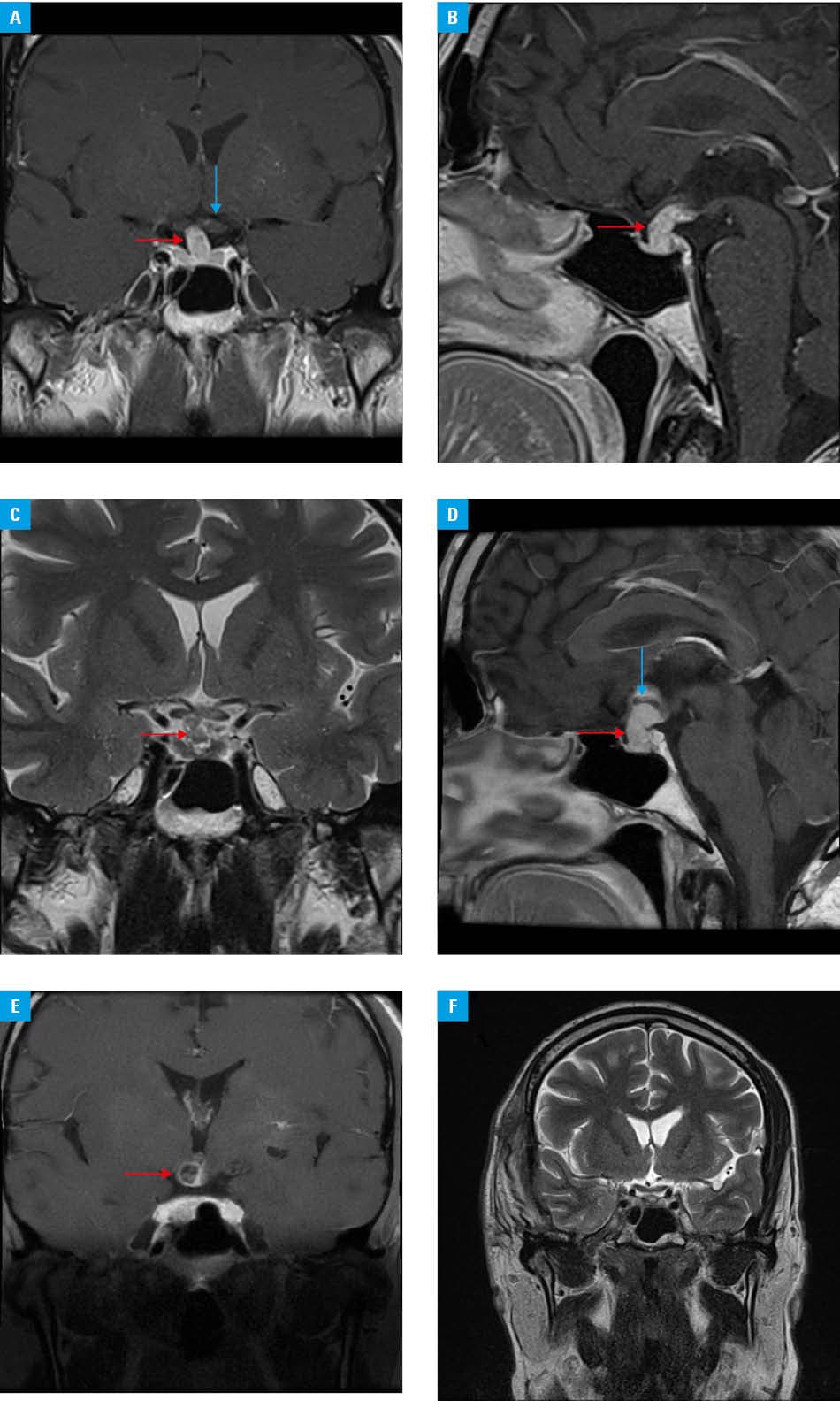
Lymphocytic hypophysitis was initially considered the most likely diagnosis. However, atypical radiologic features, including heterogeneous enhancement and cystic T2‑hyperintense areas, were noted. Follow‑up imaging at 9 weeks showed rapid lesion progression, with an 8‑mm increase in maximal diameter and the development of a rim‑enhancing cystic component, favoring a diagnosis of craniopharyngioma (Figure 1D and 1E).
Given the transinfundibular location and superior extension into the third ventricle, the patient underwent right temporal craniotomy with gross total resection. Histologic examination confirmed papillary craniopharyngioma, with immunohistochemical positivity for the BRAF V600E mutation. Postoperatively, persistent panhypopituitarism was managed with hormone replacement therapy, including administration of hydrocortisone, levothyroxine, testosterone, and desmopressin.
The postoperative course was complicated by diplopia, most pronounced on the left gaze, and significant weight gain attributed to hypothalamic dysfunction. At 12‑month follow‑up, no radiologic evidence of recurrence was observed (Figure 1F).
Differentiation between craniopharyngioma and lymphocytic hypophysitis remains challenging due to overlapping clinical and imaging features. Accurate diagnosis is critical, as therapeutic approaches differ substantially. Aseptic meningitis has been described in both entities, likely reflecting immune‑mediated inflammatory mechanisms common to both, with additional chemical meningeal irritation in craniopharyngioma.4 Antipituitary antibodies demonstrate limited diagnostic specificity and may represent a secondary autoimmune response to pituitary injury.5 Serial neuroimaging (MRI/computed tomography) is essential in the diagnostic workup; features favoring craniopharyngioma include heterogeneous enhancement, cystic components with rim enhancement, calcifications, local invasion, and progressive growth. In the cases of diagnostic uncertainty, histologic verification is indicated. A comparison of these 2 entities is provided in Supplementary material, Table S3.
- Kluczyński Ł, Gilis‑Januszewska A, Godlewska M, et al. Diversity of pathological conditions affecting pituitary stalk. J Clin Med. 2021; 10: 1692. | Crossref
- Catford S, Wang YY, Wong R. Pituitary stalk lesions: systematic review and clinical guidance. Clin Endocrinol (Oxf). 2016; 85: 507‑521. | Crossref
- Tang B, Xie S, Huang G, et al. Clinical features and operative technique of transinfundibular craniopharyngioma. J Neurosurg. 2019; 133: 119‑128. | Crossref
- Suzuki K, Izawa N, Nakamura T, et al. Lymphocytic hypophysitis accompanied by aseptic meningitis mimics subacute meningoencephalitis. Intern Med. 2011; 50: 2025‑2030. | Crossref
- Patti G, Calandra E, De Bellis A, et al. Antibodies against hypothalamus and pituitary gland in childhood‑onset brain tumors and pituitary dysfunction. Front Endocrinol. 2020; 11: 16. | Crossref
SUPPLEMENTARY MATERIAL
ARTICLE INFORMATION