
Interstitial lung abnormalities progression upon treatment with cabazitaxel for metastatic prostate cancer


 CC BY-NC-SA 4.0
Interstitial lung abnormalities progression upon treatment with cabazitaxel for metastatic prostate cancer
CC BY-NC-SA 4.0
A 75‑year‑old patient, a never‑smoker, received treatment for metastatic prostate cancer. Since 2018, he has subsequently undergone therapy with docetaxel, abiraterone, and olaparib. Due to bone metastasis, radiotherapy with radium 223 (223Ra) was introduced. Since June 2025, 6 cycles of palliative cabazitaxel therapy have been administered at a dose of 20 mg/m2. Chest computed tomography (C‑CT) performed prior to cabazitaxel initiation showed mild subpleural fibrotic interstitial lung abnormalities (ILAs; Figure 1A and 1B). On C‑CT from September 2025, a significant progression of pulmonary changes was noted, and interstitial lung disease (ILD) was diagnosed (Figure 1C and 1D).
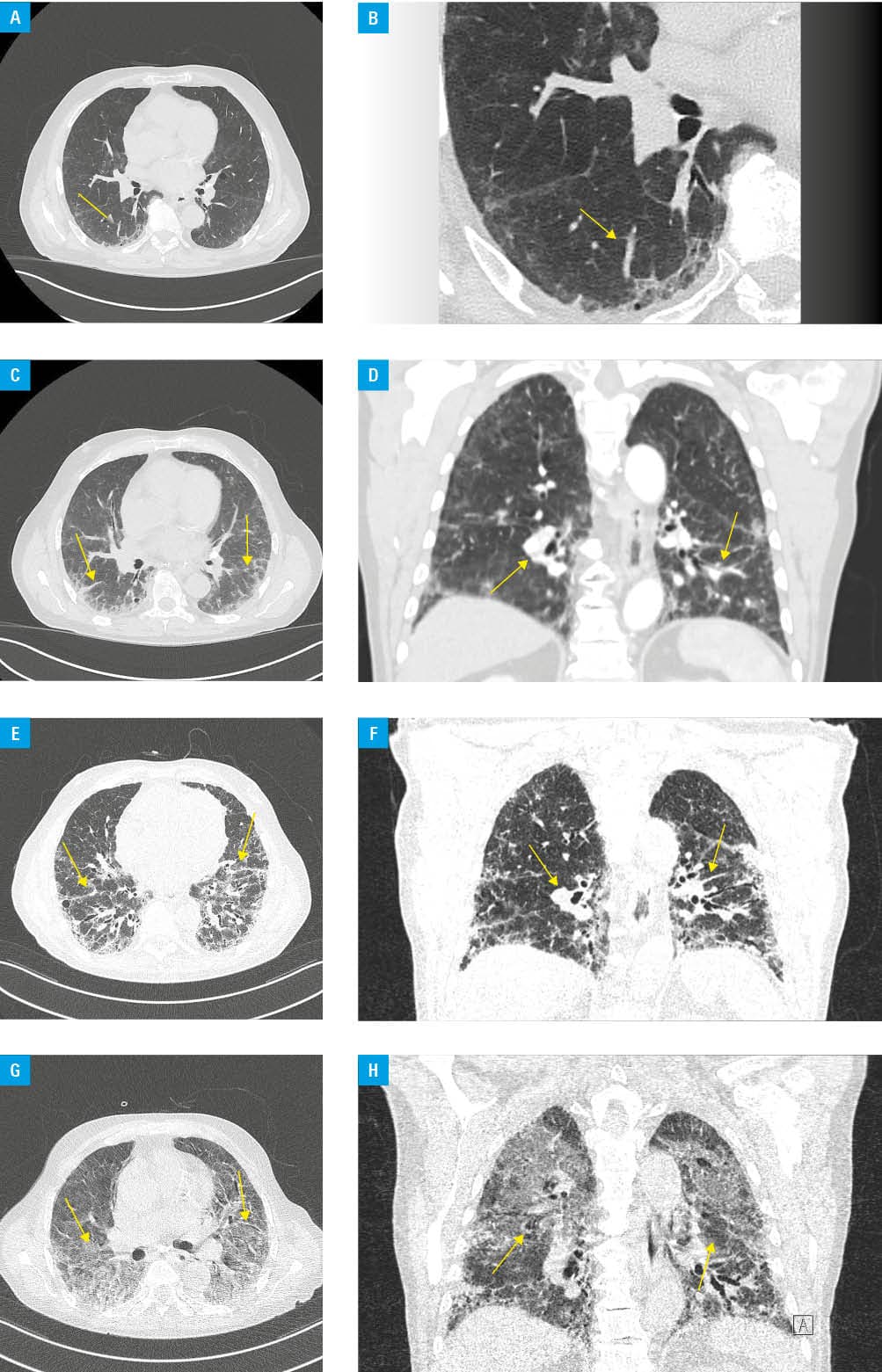
In October 2025, the patient presented to an emergency department with respiratory failure. Bilateral Velcro crackles were heard over both lung fields. Given a high suspicion of concomitant pulmonary embolism (PE; Wells Criteria for Pulmonary Embolism, 5.5 points; D‑dimer, 9.01 mg/l [reference range <0.584 mg/l]), C‑CT angiography was performed. Compared with previous CT scans, a marked progression of ILD was observed, and PE was diagnosed (Figure 1E and 1F).
The patient was admitted to our pulmonary department. The results of autoimmune testing (ia, rheumatoid factor, anticitrullinated protein antibodies, antineutrophil cytoplasmic antibodies, antinuclear antibodies, and autoantibody panels) were negative. A bronchoalveolar lavage (BAL) fluid sample was obtained for microbiological and cytological examination. Microbiological test results were negative. Cytological examination demonstrated lymphocytosis of 23%. Immunophenotyping of the lymphocyte population showed 13.8% of lymphoid cells, of which 13.3% were polyclonal T lymphocytes (CD4/CD8 ratio, 4.6), and 0.5% were natural killer cells. Furthermore, monocyte‑lineage cells accounted for 58% and granulocytes for 28.2% of the lymphocyte population. The BAL lymphocytosis and lymphocyte immunophenotype suggested cell‑mediated lung injury attributable to drug hypersensitivity, and the progression of lung changes correlating with cabazitaxel intake further supported the diagnosis of drug‑induced ILD (DI‑ILD). Treatment included methylprednisolone at a dose of 1 mg/kg of body weight with a gradual ambulatory taper. A good response was achieved. The patient required supplemental oxygen only with exertion and was discharged. Due to his poor general condition and concomitant PE, pulmonary function tests were not performed.
Three weeks later, the patient presented to the emergency department with superinfection in DI‑ILD involving the middle and upper lung regions (Figure 1G and 1H). He died 3 days later from rapidly progressive respiratory failure.
DI‑ILD is a heterogeneous group of diseases that occur after exposure to certain drugs. Taxane treatment can lead to DI‑ILD, possibly through a type IV hypersensitivity reaction. The registration trials of cabazitaxel (eg, TROPIC [Treatment of Hormone‑Refractory Metastatic Prostate Cancer Previously Treated with a Taxotere‑Containing Regimen]1) reported no cases of ILD, which may reflect the rarity of this adverse event; however, patients with pre‑existing ILA or ILD may have been excluded from these studies. Pharmacovigilance studies of adverse events of cabazitaxel showed that they are mainly nonrespiratory. The United States Food and Drug Administration drug label reports cases of ILD/interstitial pneumonitis related to treatment as a postmarketing experience, with no frequency estimates due to the scarcity of data, and includes a warning for respiratory disorders.2 Accumulation of pulmonary toxicity must be considered—previous exposure to docetaxel and olaparib may have contributed to ILD development. In the phase II trial of olaparib / abiraterone, 2 cases (3%) of pneumonitis were reported in the olaparib arm, and none in the placebo / abiraterone arm.3 Due to pneumonitis, a single death was reported and considered a serious adverse event related to study treatment.3 To the best of our knowledge, only 1 case of cabazitaxel‑induced hypersensitivity pneumonitis in metastatic prostate cancer has been reported in a patient who had previously received chemotherapy and radiotherapy with 223Ra.4
ILAs are a risk factor for developing ILD and constitute an independent predictor of mortality.5 Approximately 10% of ILA cases progress to ILD within a year, and in about 50% of patients ILD develops within 5 years.6 Recent studies report an increased risk of ILA progression to ILD during treatment with cytotoxic agents.7
This case highlights the importance of screening for ILA prior to taxane therapy initiation. Obtaining a baseline C‑CT scan with the Fleischner classification of ILA is essential, as treatment modification and close monitoring may be warranted. Patients with ILA should be monitored extensively and have C‑CT performed between chemotherapy cycles, with respiratory symptom assessment and pulmonary function tests, including diffusing capacity, obtained at baseline and at follow‑up. Immediate discontinuation of cabazitaxel is required if pulmonary symptoms emerge or exacerbate. Sequential use of agents with documented pulmonary toxicity should be considered, as harmful effects may be cumulative, as should be concomitant 223Ra therapy. Immunosuppression with corticosteroids increases infection risk; antimicrobial prophylaxis should be considered for higher doses (ie, antifungal and Pneumocystis jirovecii pneumonia prophylaxis). Collaborative efforts of pulmonologists and oncologists are essential for satisfactory management of patients with ILA receiving anticancer therapy.
- de Bono JS, Oudard S, Ozguroglu M, et al. Prednisone plus cabazitaxel or mitoxantrone for metastatic castration‑resistant prostate cancer progressed on or after docetaxel‑based chemotherapy (TROPIC): a phase 3 randomised trial. Lancet. 2010; 376: 1147‑1154. | Crossref
- Sanofi‑Aventis U.S. LLC. Jevtana (cabazitaxel) [prescribing information]. Bridgewater, NJ: Sanofi‑Aventis U.S. LLC; 2025. https://daillymed.nlm.nih.gov/dailymed/drugInfo.cfm?setid=de3d9c26‑527b‑4ea4‑9b2d‑dd58a2b3e8fa. Accessed March 2026.
- Clarke N, Wiechno P, Alekseev B, et al. Olaparib combined with abiraterone in metastatic castration‑resistant prostate cancer. Lancet Oncol. 2018; 19: 975‑986. | Crossref
- Yanai Y, Kosaka T, Hongo H, Oya M. Interstitial pneumonitis in a castration‑resistant prostate cancer patient receiving cabazitaxel after thoracic radiation therapy: a case report. BMC Cancer. 2019; 19: 720. | Crossref
- Hatabu H, Hunninghake GM, Richeldi L, et al. Interstitial lung abnormalities detected incidentally on CT: a position paper from the Fleischner Society. Lancet Respir Med. 2020; 8: 726‑737. | Crossref
ARTICLE INFORMATION