
Cladribine treatment of a young patient with isolated progressive pulmonary Langerhans histiocytosis complicated by invasive aspergillosis

 CC BY 4.0
Cladribine treatment of a young patient with isolated progressive pulmonary Langerhans histiocytosis complicated by invasive aspergillosis
CC BY 4.0
A 19‑year‑old male cigarette smoker (3 pack‑years) with progressive isolated pulmonary Langerhans cell histiocytosis (IPLCH) and recurrent pneumothoraces was admitted with a prolonged air leak.
Following pneumonia at the age of 15 years, the patient’s clinical status deteriorated; he developed cough and lost more than 20% of body weight. Two years later, he was hospitalized. Chest computed tomography (C‑CT) showed thin‑walled, bizarre‑shaped, air‑filled spaces, predominantly in the upper and middle lung zones, with sparing of the diaphragmatic regions, consistent with PLCH (Figure 1A; Supplementary material, Figure S1A). Bronchoscopy with bronchoalveolar lavage showed 3.2% of CD1a‑positive cells (diagnostic value >5% is considered significant). Pneumocystis jirovecii culture and polymerase chain reaction (PCR) results for tuberculosis‑causing Mycobacteria were negative. Magnetic resonance imaging (MRI) of the abdomen showed no abnormalities. Based on multidisciplinary team decision, probable IPLCH was diagnosed and smoking cessation was recommended.
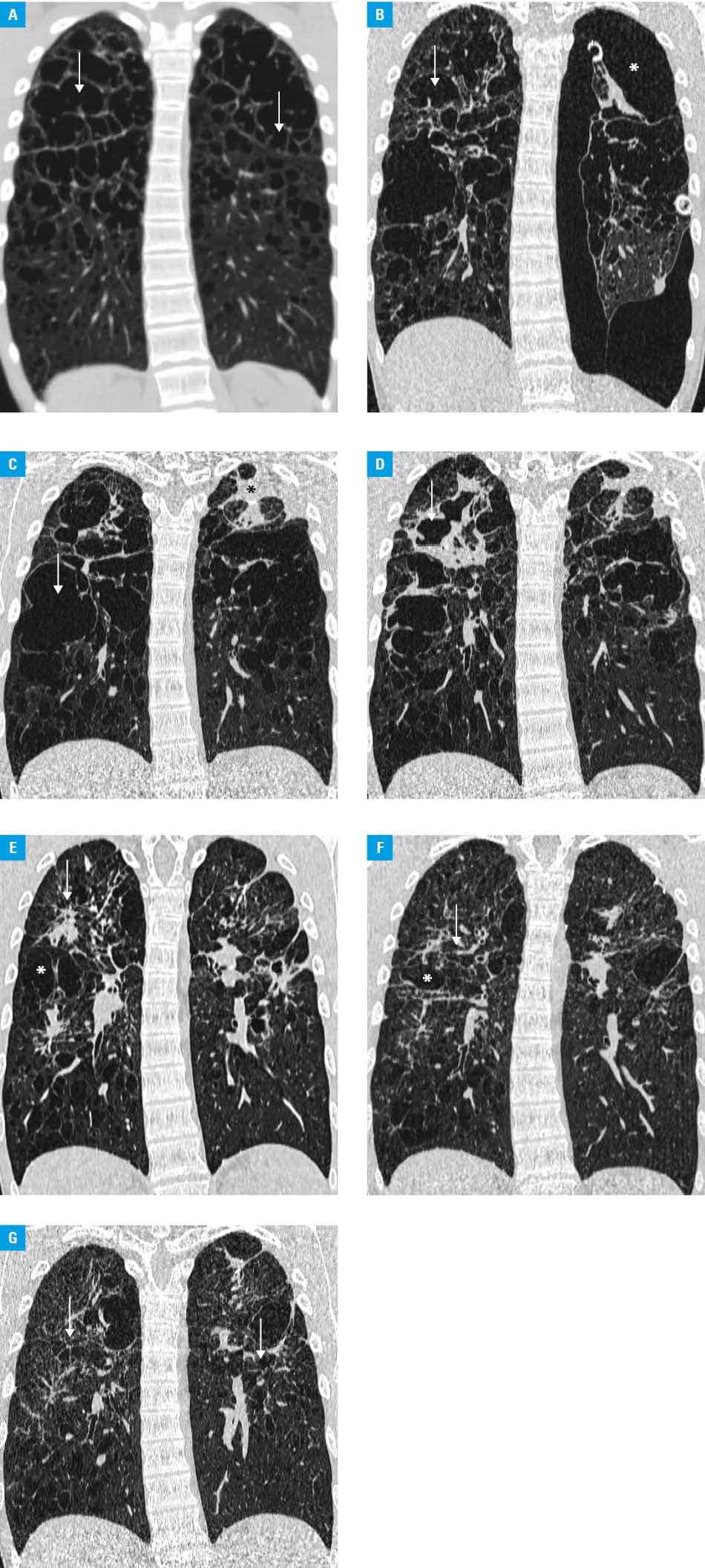
Since then, the patient has had 4 episodes of recurrent bilateral pneumothoraces. At the age of 19, he was hospitalized in a district hospital, where an open biopsy of the left lung with pleurodesis and pleurectomy was performed. Despite surgical intervention, a persistent air leak has been observed for 3 months. Later, the patient was referred to our thoracic surgery department. C‑CT showed left‑sided pneumothorax with a chest drain (Figure 1B; Supplementary material, Figure S1B). Resection of the left lung apex was performed. Histopathological examination showed characteristic changes with the presence of CD1a- and langerin‑positive cells, confirming the diagnosis of LCH. It was only at this time that the patient quit smoking. Pulmonary function parameters were decreased (Supplementary material, Table S1). Craniofacial CT, brain and pituitary gland MRI, abdominal ultrasound, echocardiography, and positron emission tomography showed no abnormalities. C‑CT showed bizarre‑shaped, air‑filled spaces, coalescing into larger cystic areas, more extensive than on the examination performed 2 years earlier (Figure 1C; Supplementary material, Figure S1C). Progressive IPLCH was diagnosed. Cladribine treatment at a dose of 0.14 mg/kg body weight for 5 consecutive days with P. jirovecii prophylaxis was initiated. At the time of the second course, the patient developed a respiratory tract infection with high values of inflammatory parameters and new consolidations on chest X‑ray. Antibiotics provided limited benefit. C‑CT showed new lesions: parenchymal consolidations in the right upper lobe, superimposed on thin‑walled, air‑filled spaces, as well as air–fluid levels indicating infectious involvement (Figure 1D; Supplementary material, Figure S1D). Bronchoscopy showed purulent discharge. Cultures of bronchial wash for bacteria and mycobacteria were negative, as well as PCR results for Mycobacterium tuberculosis, cytomegalovirus, and P. jirovecii. However, Aspergillus fumigatus was cultured and a high concentration of immunoglobulin G Aspergillus antibodies was detected (Supplementary material, Table S2). The patient was diagnosed with probable invasive aspergillosis and voriconazole treatment was introduced. Due to the occurrence of a severe adverse event (grade 3 according to Common Terminology Criteria for Adverse Events), cladribine therapy was permanently discontinued. After 6 months of antifungal treatment, the patient showed improvement in his clinical status, pulmonary function tests (Supplementary material, Table S2), and CT lesions, with visible partial regression of inflammatory parenchymal consolidations, along with reduced size of the thin‑walled, air‑filled cysts (Figure 1E; Supplementary material, Figure S1E). Follow‑up C‑CT examinations after 1 and 2 years showed continued regression of inflammatory and cystic lesions (Figure 1F and 1G; Supplementary material, Figure S1F and S1G).
PLCH is a neoplastic disease caused by gene mutations in the mitogen‑activated protein kinase pathway with a strong inflammatory component. It is diagnosed on the basis of histopathological examination of lesions; however, presumptive diagnosis can be made with characteristic clinical and radiological features. A bronchoalveolar lavage fluid sample with more than 5% of CD1a‑positive cells confirms the IPLCH diagnosis (with distinct radiological lesions), but such a finding is rarely observed in practice. Management of patients with PLCH should be individualized based on the extent of the disease, respiratory symptoms, and functional pulmonary impairment. Smoking cessation is the most important intervention in IPLCH, resulting in remission in almost 50% of cases. In progressive IPLCH, cladribine is the first choice of treatment.1 Usually, 6 courses are recommended, but it depends on the type of adverse events, mostly myelosuppression and infections, with fewer cycles also being effective.1,2 In addition, patients with cystic lung destruction and prolonged air leak are more prone to opportunistic infections.3-5
Our patient developed severe progressive IPLCH as an adolescent; however, a single dose of cladribine brought long‑lasting benefit with stabilization of the disease.
- Goyal G, Tazi A, Go RS, et al. International expert consensus recommendations for the diagnosis and treatment of Langerhans cell histiocytosis in adults. Blood. 2022; 139: 2601‑2621. | Crossref
- Radzikowska E, Wakuliński J, Langfort R, et al. Cladribine treatment in patients with pulmonary Langerhans cell histiocytosis. Pol Arch Intern Med. 2023; 133: 16586. | Crossref
- Lamoth F, Calandra T. Pulmonary aspergillosis: diagnosis and treatment. Eur Respir Rev. 2022; 31: 220114. | Crossref
- Ma Q, Tarabrin EA, Berikkhanov ZG, Ivanova MY. Risk factors and clinical impact of prolonged air leak following video‑assisted thoracoscopic surgery: a retrospective cohort study. Front Med (Lausanne). 2025; 12: 1549765. | Crossref
- Vassallo R, Harari S, Tazi A. Current understanding and management of pulmonary Langerhans cell histiocytosis. Thorax. 2017; 72: 937‑945. | Crossref
SUPPLEMENTARY MATERIAL
ARTICLE INFORMATION