
Rasmussen aneurysm: minimally-invasive management of a rare complication of recurrent pulmonary tuberculosis

 CC BY 4.0
Rasmussen aneurysm: minimally-invasive management of a rare complication of recurrent pulmonary tuberculosis
CC BY 4.0
Rasmussen aneurysm is a rare (approximately 5%) and life‑threatening complication of cavitary tuberculosis characterized by inflammatory pseudoaneurysmal dilatation of the pulmonary artery adjacent to the tuberculous cavity.1 Although hemoptysis caused by Rasmussen aneurysm is uncommon, when present, it represents a critical clinical manifestation requiring urgent evaluation due to associated high mortality.2 Treatment options include surgical and endovascular approaches. Surgical procedures, such as lobectomy or pneumonectomy, are typically reserved for cases where localized bleeding cannot be controlled by less invasive methods. Endovascular techniques, specifically embolization, are increasingly favored due to their minimally‑invasive nature, shorter recovery time, and lower procedural risk, as compared with thoracotomy.1
We present a case of a 38‑year‑old woman admitted to a hospital in July 2023 with anemia, liver cirrhosis, and jaundice. The patient denied smoking but reported chronic alcohol abuse. Chest radiography showed a round opacity in the middle zone of the right lung and patchy, confluent opacities in the upper zone of the right lung. Interferon γ release assay and molecular examination of the sputum confirmed infection with Mycobacterium tuberculosis. Drug susceptibility testing demonstrated sensitivity to first‑line antituberculous agents. To limit the hepatotoxicity, the initial recommended treatment comprised 300 mg of isoniazid daily, 1000 mg of ethambutol daily, and 700 mg of streptomycin daily for 2 months, followed by isoniazid and ethambutol for 10 months. Seven months after the initial diagnosis, the patient was readmitted with massive hemoptysis (approximately 250 ml of blood), anemia, and cough. Laboratory test results showed a hemoglobin level of 8 g/dl and an elevated C‑reactive protein level of 15.154 mg/l. The patient received 1 unit of packed blood cells and 1 unit of fresh frozen plasma. Computed tomography angiography (CTA) demonstrated progression of pulmonary lesions and Rasmussen aneurysm arising from the posterior segmental artery (A2) of the right pulmonary artery, measuring approximately 10 mm × 8 mm × 8 mm (Figure 1A–1E). Direct microscopic examination of the sputum confirmed recurrent M. tuberculosis infection. After consultations with thoracic and vascular surgeons, endovascular treatment was performed. Under local anesthesia, via the right femoral vein and using the Seldinger technique, the aneurysmal A2 segmental branch of the right pulmonary artery was selectively catheterized with a Progreat microcatheter (Terumo Corporation, Tokyo, Japan), and successfully embolized using Nester pushable coils (COOK, Bloomington, Indiana, United States; Figure 1F). Follow‑up angiography confirmed complete embolization with no further contrast filling of the aneurysm (Figure 1G). Hemoptysis resolved after the procedure, antimicrobial treatment was continued, and no complications were observed. The patient was referred to a tuberculosis sanatorium to continue the antituberculous treatment.
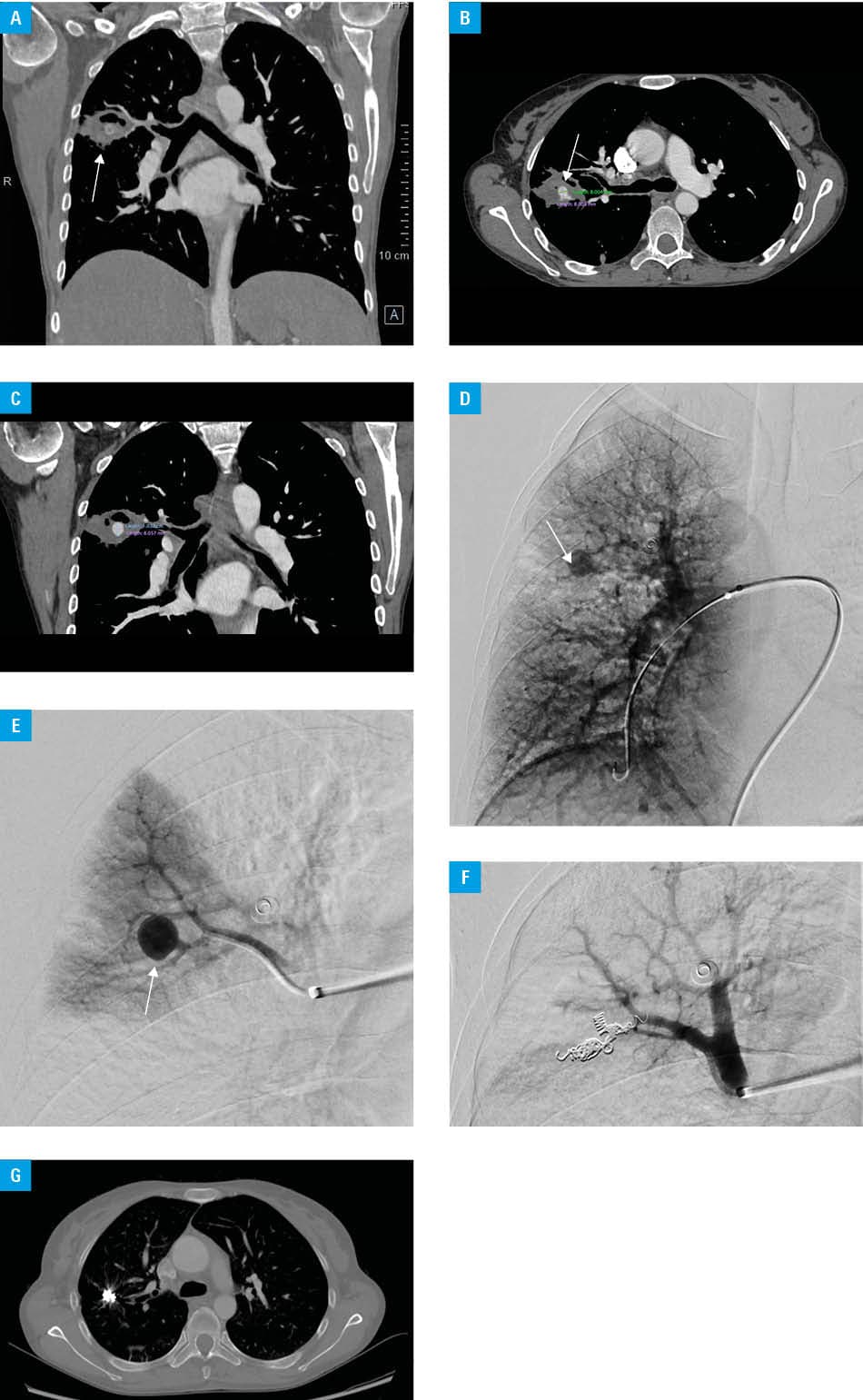
This case highlights the importance of rapid CTA diagnosis and prompt minimally‑invasive treatment of Rasmussen aneurysm in a clinically compromised patient presenting with massive hemoptysis. The recurrence may have been associated with impaired immunity related to alcohol dependence syndrome, malnutrition, low body mass index (16.46 kg/m2), or poor adherence to medical recommendations and irregular intake of antituberculous medications. Selective endovascular embolization provides immediate control of bleeding and represents a safe and effective therapeutic option, particularly in high‑risk patients. Early radiological diagnosis combined with timely endovascular management may significantly reduce mortality in this rare but potentially fatal complication of pulmonary tuberculosis.3
- Malik SA, Khan A, Siddique H, et al. Rasmussen aneurysm in a patient with pulmonary tuberculosis. Respirol Case Rep. 2024; 12: e70088. | Crossref
- Kushwaha DS, Sharma P. Endovascular coil embolization of Rasmussen aneurysm: a rare cause of massive asphyxiating haemoptysis. NMO Journal. 2024; 18: 22‑25. | Crossref
- Marak JR, Kumar T, Gara H, Dwivedi S. Rasmussen aneurysm: case series of a rare complication of pulmonary tuberculosis. Respir Med Case Rep. 2023; 45: 101897. | Crossref
ARTICLE INFORMATION