
Unilateral multicystic kidney associated with 17q12 duplication, presenting with mass effect symptoms in a young patient

 CC BY 4.0
Unilateral multicystic kidney associated with 17q12 duplication, presenting with mass effect symptoms in a young patient
CC BY 4.0
Cystic renal diseases are a complex group of conditions that range in severity from mild to life‑threatening.1 We report a case of a 25‑year‑old woman who was admitted to a nephrology department for assessment of polycystic kidneys. Prior to admission, the patient had undergone computed tomography that showed polycystic remodeling and enlargement of the left kidney, which was pressing on the stomach, spleen, and tail of the pancreas, as well as numerous small, dense cysts in the right kidney (Figure 1A).
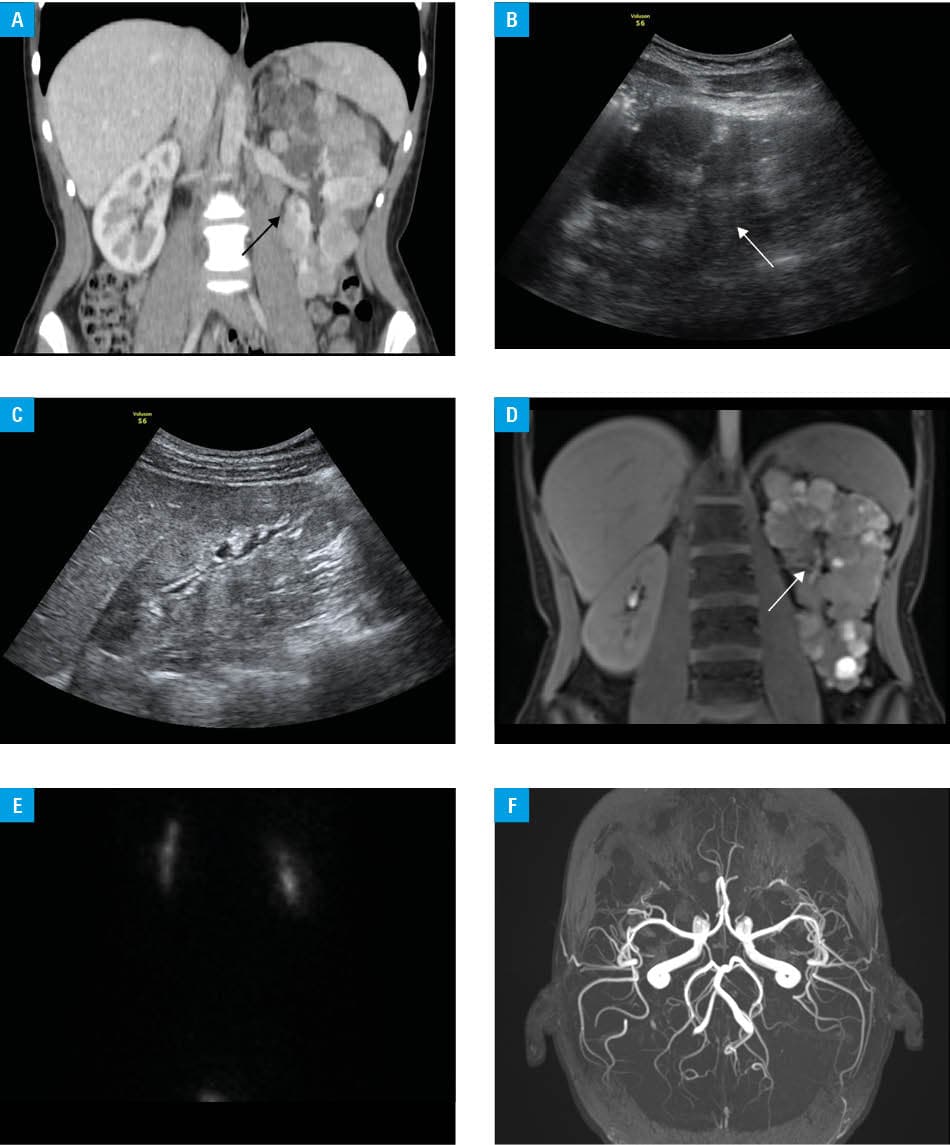
On admission, the patient complained of intermittent, nonradiating colicky pain localized to the left lumbar region, accompanied by nausea. She denied hematuria, urinary tract infections, or hypertension, and reported no other symptoms, medical conditions, or family history of renal diseases. On physical examination, a palpable mass was found in the left upper abdominal quadrant. Laboratory test results showed normal renal function without urinalysis abnormalities. Ultrasound examination confirmed polycystic remodeling of the left kidney (Figure 1B), without previously described cysts in the right kidney (Figure 1C). Due to the asymmetric kidney cysts, clinical presentation, and inconsistencies in diagnostic imaging results, further evaluation was undertaken. Abdominal magnetic resonance imaging (MRI) showed an enlarged left kidney with numerous cysts of varying sizes and a moderate amount of preserved normal kidney parenchyma, without signs of neoplasia. MRI confirmed absence of cysts in the right kidney and other abdominal organs (Figure 1D). Renal dynamic scintigraphy showed delayed renographic curve of the left kidney with urinary outflow disturbance, excluding signs of obstruction, and 30% extraction rate. Right kidney scintigraphy was within normal limits (Figure 1E). Due to the atypical clinical presentation, autosomal dominant polycystic kidney disease was considered as a possible differential diagnosis. Brain arterial malformations can be observed in patients with autosomal dominant polycystic kidney disease, which is why we performed head MRI angiography without contrast enhancement, which excluded vascular malformations (Figure 1F).1,2 We further carried out panel genetic testing using next‑generation sequencing, which was negative for diagnostic variants in the genes commonly causing cystic kidney diseases, including the COL4A3, COL4A4, COL4A5, HNF1B, NOTCH2, PKD1, PKD2, PKHD1, TSC1, TSC2, and VHL genes. However, follow‑up genetic testing with array comparative genomic hybridization showed interstitial duplication of the 17q12 region. In consultation with a clinical geneticist, the patient was diagnosed with unilateral multicystic kidney caused by duplication of the 17q12 region. Due to the manifesting symptoms, we consulted a urologist who recommended nephrectomy if the mass‑effect symptoms deteriorated. The patient’s parents underwent abdominal ultrasound examination which indicated no abnormalities.
The 17q12 region consists of multiple genes, including the HNF1B gene that can be linked to a variety of renal abnormalities, including unilateral or bilateral kidney cysts. In this case, panel sequencing was negative, as the duplicated 17q12 region encompassing the HNF1B gene had no abnormalities in a single nucleotide sequence, and the extra copy of the gene can be missed by next‑generation sequencing. In our case, the 17q12 duplication led to a unilateral multicystic kidney. Literature suggests that 17q12 duplication can also be associated with electrolyte abnormalities, infertility, neuropsychiatric disorders, epilepsy, and diabetes.3,4 In our patient, these abnormalities were not present, but further monitoring will be required.
- Sekine A, Hidaka S, Miriyama T, et al. Cystic kidney diseases that require a differential diagnosis from autosomal dominant polycystic kidney disease (ADPKD). J Clin Med. 2022; 11: 6528. | Crossref
- Devuyst O, Ahn C, Barten T, et al. KDIGO 2025 Clinical Practice Guideline for the Evaluation, Management, and Treatment of Autosomal Dominant Polycystic Kidney Disease (ADPKD). Kidney Int. 2025; 107: S1‑S239. | Crossref
- Cannon S, Clissold R, Sukcharoen K, et al. Recurrent 17q12 microduplications contribute to renal disease but not diabetes. J Med Genet. 2023: 60: 491‑497. | Crossref
- Milone R, Tancredi R, Cosenza A, et al. 17q12 recurrent deletions and duplications: description of a case series with neuropsychiatric phenotype. Genes (Basel). 2021; 12: 1660. | Crossref
ARTICLE INFORMATION