
Predicted value of indices describing adipose distribution and function in women with metabolic syndrome

 CC BY 4.0
Predicted value of indices describing adipose distribution and function in women with metabolic syndrome
CC BY 4.0
Introduction
Metabolic syndrome (MetS) gradually develops with age and is strongly influenced by an unhealthy lifestyle.1 It is recognized as a major cause of cardiovascular disease (CVD), and represents a classic example of multimorbidity requiring a holistic approach. Notably, alongside the effectiveness of surgical treatment for obesity, recent advances in the use of glucagon‑like peptide‑1 receptor agonists and multireceptor agonists have revolutionized medical treatment of this disease.2 Recent approaches to MetS treatment place abdominal obesity at the center, as, when properly managed, it represents a reversible contributor to type 2 diabetes mellitus (T2DM), chronic inflammation, and fatty liver disease.3 Several anthropometric indices have been developed to assess fat distribution and metabolic risk. In addition to widely used measures, such as body mass index (BMI) and waist‑to‑height ratio (WHtR), novel indices have been proposed, including body roundness index (BRI), a body shape index (ABSI), visceral adiposity index (VAI), lipid accumulation product (LAP), and dysfunctional adiposity index (DAI). These indicators extend and improve upon BMI for evaluating obesity.4-6 The WHtR of 0.5 or higher indicates abdominal obesity and an increased risk of CVD and T2DM.7 The BRI reflects the roundness of body shape based on height, waist circumference (WC), and hip circumference, with values above 10 suggesting an elevated risk of disease in women.8 A higher ABSI indicates an increased CVD risk when WC is disproportionately large relative to height and weight, reflecting greater abdominal fat accumulation.9 Finally, elevated LAP values are associated with higher visceral fat accumulation, and a higher DAI score suggests greater adipose tissue dysfunction, which correlates with adverse health outcomes.10 Early identification of individuals at a risk of MetS is crucial, as it allows for targeted preventive interventions against CVD development, particularly in women with obesity. Poland currently ranks among the countries with the highest cardiovascular risk, with a notable increase in obesity prevalence among women.7
The aim of this study was to assess the usefulness of selected novel indices in predicting MetS in women with obesity.
Patients and methods
This retrospective study included 219 women with obesity (120 with MetS and 99 controls) selected from among the patients of an outpatient clinic. The study protocol was approved by the Bioethical Committee at the Poznan University of Medical Sciences (KB‑652/23). The study was carried out in accordance with the Declaration of Helsinki.
Only women aged over 18 years with complete clinical and selected biochemical data (total cholesterol [TC], high‑density lipoprotein cholesterol [HDL‑C], low‑density lipoprotein cholesterol [LDL‑C], and triglyceride [TG]) were included in the study. The inclusion criteria for the MetS group were based on the 2022 diagnostic consensus of several Polish societies3 and comprised the presence of central obesity (WC ≥88 cm for women or BMI ≥30 kg/m2) and at least 2 of the following: 1) blood pressure equal to or greater than 130/85 mm Hg or treatment for hypertension; 2) non–HDL‑C level equal to or greater than 130 mg/dl or hyperlipidemic treatment; 3) fasting plasma glucose level equal to or greater than 100 mg/dl (5.6 mmol/l) or equal to or greater than 140 mg/dl after a glucose tolerance test, or glycated hemoglobin concentration equal to or greater than 5.7%, or hypoglycemic treatment. Inclusion criteria for the control group comprised WC equal to or greater than 88 cm or BMI equal to or greater than 30 kg/m2 and not meeting the criteria for MetS. Exclusion criteria for the whole study population were cancer diagnosis, autoimmune or chronic inflammatory diseases affecting metabolic parameters, use of drugs affecting lipid or glucose metabolism, pregnancy or lactation, and alcohol or drug use disorder.
Parameters and indices used in the assessment of adipose distribution and function
Lipid profile was determined using an enzymatic‑colorimetric method (Roche / Hitachi Cobas C system, Basel, Switzerland) in accordance with good laboratory practices. Anthropometric measurements, including body weight and height, were obtained using a standardized medical scale (In Body 770, model BPM040S12FXX, Seul, South Korea). Waist and hip circumferences were measured with a flexible tape to the nearest 0.1 cm. The following indices were calculated:
Based on BMI, the patients were categorized as underweight (<18.5 kg/m2), normal weight (18.5–24.9 kg/m2), overweight (25–29.9 kg/m2), or obese (≥30 kg/m2).
Statistical analysis
Data were tested for normality using the Shapiro–Wilk test. As all null hypotheses were rejected, descriptive statistics are presented using median with interquartile range (IQR). Differences between the groups were assessed using the Mann–Whitney test. Spearman rank correlation coefficients were calculated to examine the associations between age, height, weight, WC, percentage of fat mass (%FM), TC, HDL‑C, LDL‑C, and TG levels, and the selected indices: VAI, ABSI, DAI, LAP, BRI, BMI, and WHtR. Logistic regression analysis was performed to assess the relationship between MetS presence and the selected indices. Predictive capacity of the indices for MetS was evaluated using receiver operating characteristic (ROC) curve analysis. For each ROC curve, the area under the curve (AUC), 95% CIs, P value, and the optimal cutoff point (determined by maximizing the Youden index) were calculated. Statistical analyses were performed using Statistica package, version 13 (TIBCO Software Inc., Palo Alto, California, United States). Additionally, the pROC package in R (v. 4.3.1; R Foundation for Statistical Computing, Vienna, Austria) was used to assess differences between the ROC curves. AUCs were compared using the DeLong test, and the obtained P values were corrected using the Benjamini–Hochberg method to eliminate biases resulting from multiple hypothesis testing. Predictive performance was further assessed by the Youden index, sensitivity, specificity, positive predictive value, negative predictive value, and accuracy. P values below 0.05 were condsidered significant.
Results
The women with MetS were younger than the controls (median [IQR] age, 52 [38–63] vs 57 [54–62] y; P <0.001). The MetS group exhibited significantly higher values of BMI, TG, VAI, DAI, and LAP, as compared with the control group. Conversely, significantly lower values were observed in the MetS group for %FM, TC, HDL‑C, LDL‑C, ABSI, BRI, and WHtR (Supplementary material, Table S1).
Most of the selected parameters were significantly associated with the studied indices; however, the clinically relevant correlations included: body weight and LAP (R = 0.523), WC and BRI (R = 0.926), WC and ABSI (R = 0.653), WC and LAP (R = 0.666), TC and ABSI (R = 0.418), HDL‑C and VAI (R = –0.758), HDL‑C and DAI (R = –0.759), TG and VAI (R = 0.761), TG and DAI (R = 0.759), and TG and LAP (R = 0.695; all P <0.05). Notably, most of these associations are expected, as the formulas of these indices typically integrate parameters related to lipid metabolism and insulin sensitivity. However, the correlations between body weight and LAP and between TC and ABSI are a novel finding.
Univariate logistic regression analysis demonstrated that, as compared with the control group, the odds of having MetS increased approximately 3‑fold for each 1‑unit increase in DAI (odds ratio [OR], 3.021; 95% CI, 1.872–4.876), nearly 2‑fold for VAI (OR, 1.888; 95% CI, 1.444–2.467), and by 14% for BMI (OR, 1.142; 95% CI, 1.077–1.212). For LAP, a 1‑unit increase was associated with a 1.9% higher risk (OR, 1.019; 95% CI, 1.011–1.027), whereas a 1‑unit increase in BRI was associated with an 11% lower risk (OR, 0.89; 95% CI, 0.779–1.017), and a 0.1‑unit increase in WHtR and ABSI corresponded to a 31% (OR, 0.688; 95% CI, 0.494–0.957) and 29% lower risk of MetS (OR, 0.29; 95% CI, 0.183–0.46), respectively. In ROC analysis, selected indices (VAI, ABSI, DAI, and LAP) were identified as valuable predictors of MetS, showing high sensitivity and specificity. Overall, ABSI, BRI, and WHtR were identified as desimulating predictors, in contrast to VAI, DAI, LAP, and BMI, which were simulating predictors (Supplementary material, Table S2). Graphical interpretation of the ROC curve analysis is shown in Figure 1.
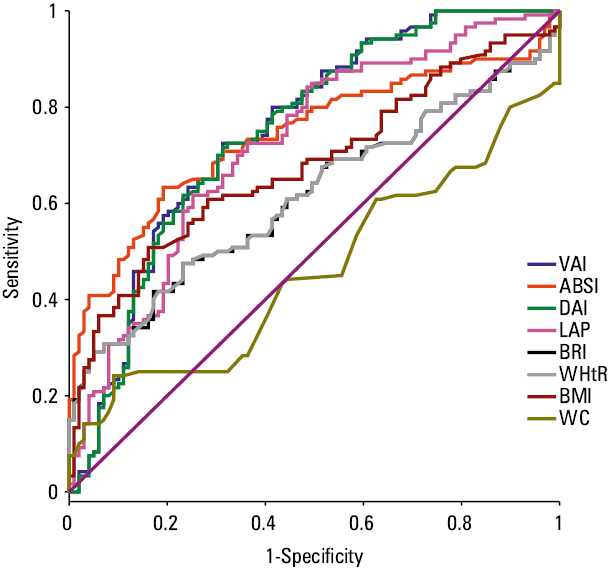
Abbreviations: ABSI, a body shape index; BMI, body mass index; BRI, body roundness index; DAI, dysfunctional adiposity index; LAP, lipid accumulation product; WC, waist circumference; WHtR, waist‑to‑height ratio; VAI, visceral adiposity index
Among the analyzed parameters, VAI demostrated the highest diagnostic utility in the assessment of MetS, with an AUC of 0.75 (95% CI, 0.684–0.816; P <0.001). VAI was shown to have higher predictive power than the classic anthropometric parameters, such as WC (P = 0.31), BRI (P = 0.002), and WHtR (P = 0.002). This confirms the advantage of models integrating metabolic data (TG, HDL‑C) over isolated WC measurements. Although VAI had a greater AUC than BMI (0.75 vs 0.679), no differences were found between these parameters in terms of diagnostic performance (P = 0.3). However, it should be emphasized that VAI at the optimal cutoff point (2.215) was characterized by significantly higher sensitivity than BMI (72.5% vs 50.8%), making it a more effective tool for identifying women at a risk of MetS. Logistic regression analysis confirmed that VAI was a strong, independent predictor of the MetS risk (OR, 1.89; 95% CI, 1.44–2.47). Although ABSI and DAI had similar AUC values (0.741 and 0.747, respectively) and did not differ significantly from VAI in terms of diagnostic performance, VAI offered the most balanced diagnostic profile, combining high sensitivity with a satisfactory positive predictive value (73.7%; Supplementary material, Tables S2 and S3).
Discussion
In this study, novel indices associated with abdominal fat accumulation (VAI, ABSI, DAI, LAP) were evaluated, and their potential as reliable predictors of MetS in a female population was proven. VAI was shown to have significantly higher predictive power than classic anthropometric parameters, such as WC, BRI, and WHtR. In clinical practice, these indices may serve as useful tools or, in some cases, alternatives to conventional measures, such as BMI and WC.
Recent studies have evaluated these novel indices across different populations. VAI and LAP were identified as practical tools for metabolic risk stratification, with LAP showing diagnostic advantage. In our study, which involved a homogeneous cohort of women, both indices demonstrated strong predictive performance. In particular, a 1‑unit increase in VAI was associated with 2‑fold increased odds of MetS relative to the control group. VAI was originally derived from studies involving white populations, making it particularly suitable for our study cohort.11 LAP was one of the most effective tools for discriminating MetS, showing high Youden index values, with a cutoff value of 49.8 (sensitivity 68.5%, specificity 82.4%) in Saudi women.12 MetS has significant implications for the early metabolic dysfunction in young women. Parsaei et al13 reported elevated LAP and VAI values in patients with polyendocrine metabolic ovarian syndrome (PMOS), underscoring the utility of these simple indices for screening women of reproductive age. This observation was supported by Ulloque‑Badaracco et al,14 who confirmed that both these indices were strongly associated with metabolic alterations and visceral adiposity, highlighting their clinical relevance in women. In the present study, the discriminative power of LAP was moderate, though its sensitivity and specificity remained satisfactory. An analysis of NHANES (National Health and Nutrition Examination Survey) data indicated that higher LAP values were associated with increased all‑cause (22%) and CVD‑specific (14%) mortality, suggesting the potential of this indicator as a mortality predictor.15
ABSI and BRI may also provide insight into vascular and renal risk. In the Nord‑Trøndelag Health Study 2, ABSI and WHtR were more strongly associated with cardiovascular mortality than BMI, WC, or WHR over a mean 17.7‑year follow‑up.16 Among women with PMOS, ABSI had lower discriminatory ability for MetS (AUC, 0.762) than BRI (AUC, 0.714).17 DAI has shown promise as a predictor of metabolic disturbances in women with PMOS, with sensitivity and specificity of 74% and 80%, respectively. For insulin resistance, its sensitivity was 82% and specificity 55%.18
The key role of obesity in the development of disorders that increase cardiovascular risk was also emphasized in the position statement of Polish scientific societies regarding MetS.3 MetS is not considered a separate disease entity, but a condition in which attention should be paid to the numerous complications that develop due to excess body weight. It requires effective treatment of both obesity and its accompanying diseases in order to reduce cardiometabolic risk. For this reason, new, simple indicators are being sought that could help general practitioners make a diagnosis or facilitate patient assessment by a dietitian. In recent years, there has been a systematic increase in the incidence of obesity worldwide among all age groups. According to World Health Organization data, 21% of adults in Poland are obese, and 38% are overweight. The percentage of people with obesity in Poland is projected to increase to 33% by 2035.19 There are a number of factors that influence dietary habits, such as season and sleep pattern / quality, which have a direct impact on the energy content of the diet. In winter, an inverse relationship was observed between seasonal fluctuations in food energy density and sleep quality, which translated into an association between consumption of foods with higher energy density and the poorer sleep quality.20
Strengths of this study include the homogeneous female cohort and adequate sample size. Expanding the study to additional centers could further enhance generalizability. Evaluating sensitivity and specificity across 8 indices provided a comprehensive perspective on their clinical utility. Analysis of the nutritional status of women would enable the objective measurement and reference to the obtained indicator values.
Conclusions
In conclusion, novel indices, such as VAI, ABSI, DAI, and LAP, appear to be effective predictors of MetS in women, with VAI showing the highest predictive power reflecting increased abdominal fat accumulation. Incorporation of these indices into routine clinical practice could facilitate early detection and prevention of MetS in women. Simple, cost‑effective, and easily applicable indices remain valuable tools for screening and risk assessment, and further studies are warranted to explore their full potential in diverse patient populations.
- Meng X, Fang Y, Zhang S, et al. Interpretable machine learning identification of dietary and metabolic factors for metabolic syndrome in Southern China: a cross‑sectional study. Nutrients. 2025; 27: 3368. | Crossref
- Gajos G. Breaking the weight loss paradox: from weight reduction to cardiovascular benefit in obesity treatment. Pol Arch Intern Med. 2025; 24: 16983. | Crossref
- Dobrowolski P, Prejbisz A, Kuryłowicz A, et al. Metabolic syndrome: a new definition and clinical management guideline [in Polish]. Nadciśnienie Tętnicze w Praktyce. 2022; 8: 1‑26. | Crossref
- Amato MC, Giordano C. Visceral adiposity index: an indicator of adipose tissue dysfunction. Int J Endocrinol. 2014; 2014: 730827. | Crossref
- He Z, Zeng J, Ding W, et al. Association of lipid accumulation product with the prevalence and incidence of sarcopenia: a nationwide study in Chinese. Nutr Metab (Lond). 2025; 7: 115. | Crossref
SUPPLEMENTARY MATERIAL
ARTICLE INFORMATION