
Ring-like diffusion restriction in pyogenic liver abscess on diffusion-weighted imaging in a nonagenarian: a diagnostic pitfall

 CC BY 4.0
Ring-like diffusion restriction in pyogenic liver abscess on diffusion-weighted imaging in a nonagenarian: a diagnostic pitfall
CC BY 4.0
We present a case of a 93‑year‑old woman admitted with a 10‑day history of worsening paroxysmal upper abdominal pain. The patient remained afebrile throughout the clinical course. Physical examination showed localized tenderness in the epigastrium and right upper quadrant. Laboratory workup indicated leukocytosis (leukocyte count, 14.27 × 10⁹/l; reference range [RR], 3.5–9.5 × 10⁹/l) and a mildly elevated level of high‑sensitivity C‑reactive protein (hs‑CRP; 10 mg/l; RR <3 mg/l). Serum tumor markers, including α-fetoprotein, carcinoembryonic antigen, and carbohydrate antigen 19–9, were within normal limits.
Magnetic resonance imaging (MRI) showed a focal lesion within the left lateral segment of the liver, measuring approximately 4.2 cm × 3.8 cm. On axial T2‑weighted sequences, the lesion exhibited heterogeneous hyperintensity (Figure 1A), with corresponding hypointensity observed on T1‑weighted imaging (Figure 1B). Of particular note, diffusion‑weighted imaging (DWI) demonstrated an atypical pattern of continuous ring‑like hyperintensity confined to the inner wall of the abscess cavity, rather than a homogeneous high signal commonly encountered in pyogenic abscesses (Figure 1C). The corresponding apparent diffusion coefficient (ADC) map showed a circumferential reduction in peripheral diffusion (minimum ADC value, approximately 0.8 × 10⁻³ mm2/s), with heterogeneous signal intensity noted centrally (Figure 1D). Magnetic resonance cholangiopancreatography confirmed an absence of any fistulous communication between the dilated biliary radicles and the abscess cavity (Figure 1E). Contrast‑enhanced MRI was recommended by the referring clinician but could not be completed because the nonagenarian patient was unable to tolerate the prolonged scan time required for the full dynamic protocol. MRI of the upper abdomen performed 2 years prior to the current admission had documented chronic structural alterations of the left hepatic lobe, comprising parenchymal atrophy, intrahepatic lithiasis, and marked ductal ectasia (Figure 1F). Based on these radiologic features, a diagnosis of pyogenic liver abscess in the setting of chronic hepatolithiasis was established. The patient subsequently underwent computed tomography–guided percutaneous drainage, yielding approximately 30 ml of foul‑smelling purulent material. Symptomatic relief of abdominal pain occurred immediately after the procedure, and a marked reduction in laboratory parameter levels was observed within 48 hours (leukocyte count, 5.85 × 10⁹/l; hs‑CRP, 5 mg/l).
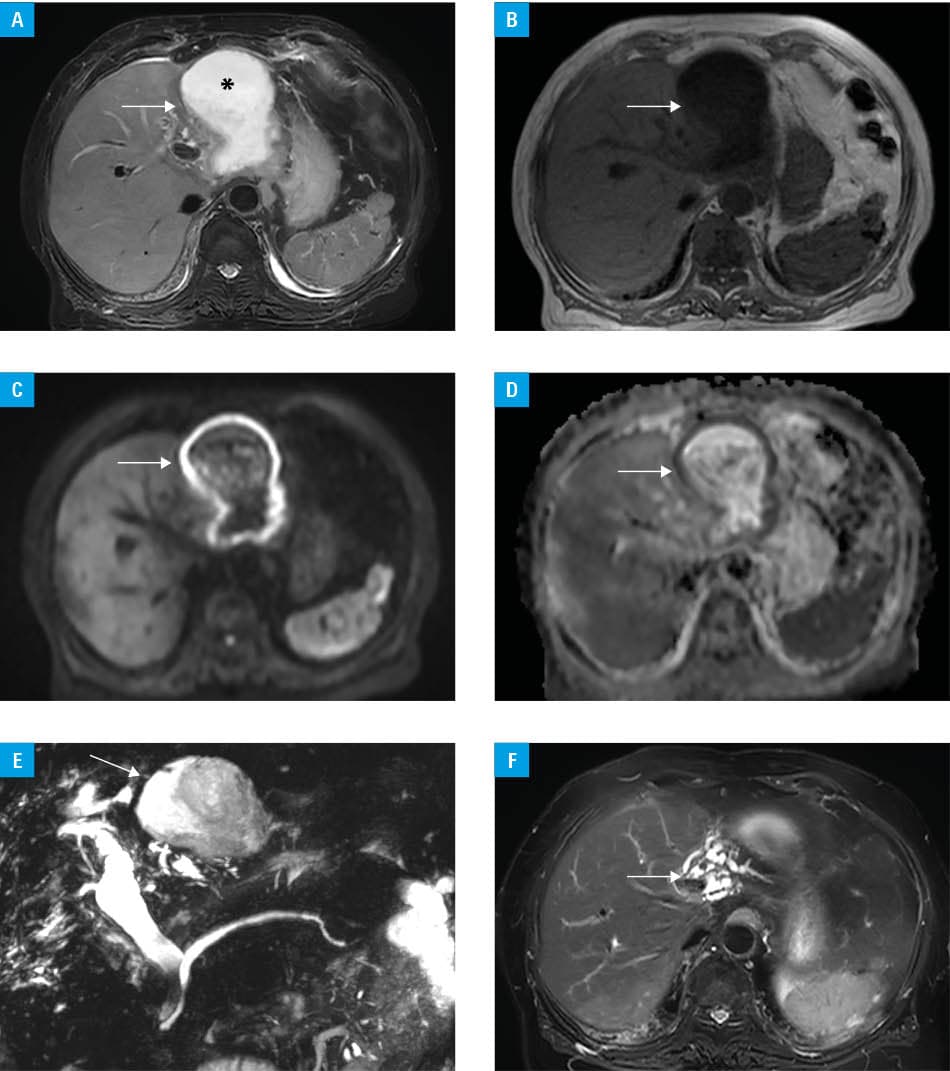
On DWI, the central cavity of a typical pyogenic liver abscess generally manifests as homogeneous, markedly increased signal intensity, a phenomenon attributable to restricted water diffusion within the inspissated purulent fluid. This feature helps distinguish an abscess from a necrotic neoplasm.1,2 In the present case, however, the observed pattern of peripheral ring‑like diffusion restriction constitutes a rare and diagnostically challenging variant; such an appearance has been rarely documented in the context of hepatic abscesses. The lesion described herein was sizable and developed against a background of bile stasis and chronic inflammation. A plausible explanation is that, under these conditions, the viscosity of the central contents was comparatively low, resulting in less impeded water mobility within the cavity, whereas the tenacious material deposited along the inner margin was visible as a rim of restricted diffusion. Of note, the patient’s afebrile course and only mildly elevated CRP level, though atypical of a pyogenic abscess, are consistent with the often blunted inflammatory response in the very elderly. In older patients with intrahepatic lithiasis and biliary dilatation, a newly developed focal liver lesion exhibiting ring‑like diffusion restriction may be readily mistaken for intrahepatic cholangiocarcinoma.3 Recognition of this atypical DWI finding as indicative of an abscess is therefore essential to avoid undue delay in drainage and prevent an unwarranted surgical intervention. Following evacuation of the purulent collection and source control, the prognosis in such patients remains excellent, even at an advanced age.4
- Khim G, Em S, Mo S, Townell N. Liver abscess: diagnostic and management issues found in the low resource setting. Br Med Bull. 2019; 132: 45‑52. | Crossref
- Khot R, Ganeshan D, Sundaram KM, et al. Cystic lesions and their mimics involving the intrahepatic bile ducts and peribiliary space: diagnosis, complications, and management. Abdom Radiol (NY). 2025; 50: 2969‑2988. | Crossref
- Liu M, Chen J, Huang R, et al. Imaging features of intrahepatic cholangiocarcinoma mimicking a liver abscess: an analysis of 8 cases. BMC Gastroenterol. 2021; 21: 427. | Crossref
- Roediger R, Lisker‑Melman M. Pyogenic and amebic infections of the liver. Gastroenterol Clin North Am. 2020; 49: 361‑377. | Crossref
ARTICLE INFORMATION