
A dozen decades in the service of internal medicine: Polish Society of Internal Medicine 1906–2026


 CC BY-NC-SA 4.0
A dozen decades in the service of internal medicine: Polish Society of Internal Medicine 1906–2026
CC BY-NC-SA 4.0
The Polish Society of Internal Medicine (Towarzystwo Internistów Polskich) was established during the period when Poland was split between Prussia, the Habsburg monarchy, and Russia, and there was no independent Polish state, and this year marks the 120th anniversary of its foundation. A resolution to establish the Society was passed in 1900, during the 9th Congress of Polish Physicians and Naturalists, held in Krakow (July 21–24, 1900). Unfortunately, the occupying authorities hindered the organization of meetings of Polish physicians, and the next congress took place after 7 years, in 1907. In 1906, the organizing committee of the newly established society of internists began its work, and this year is officially recognized as the year it was founded. The Austrian authorities did not allow for the Society to be officially registered, as they objected to calling it the Polish Society of Internal Medicine. Therefore, the first congress of the unofficial Society was organized as the Internal Medicine Session of the Congress of Polish Physicians and Naturalists, which took place in Lvov (now Lviv in Ukraine) on July 22–25, 1907. Finally, the Austrian authorities agreed to the name Society of Internists of the Polish Lands (Towarzystwo Internistów Ziem Polskich), without any reference to a Polish nation or nonexisting state. The newly formed Society organized its first de nomo and de jure but the second de facto congress in Krakow in 1911.
Following Poland’s regaining of independence as a free nation, the 5th Congress of the Society was held in Vilnus in 1923. At that time, its name was changed to the Polish Society of Internal Medicine, and its journal, Polish Archives of Internal Medicine (Polskie Archiwum Medycyny Wewnętrznej), was launched. In 2023, Władysław Antoni Gluziński was re‑elected president of the Society and appointed editor‑in‑chief of the journal. Until 1939, the presidents of the Society were Witold Eugeniusz Orłowski (1925–1929 and 1930–1931), Edward Żebrowski (1929–1930), Mściwój Semerau‑Siemianowski (1931–1936), and Włodzimierz Filiński (1937–1949). The World War II caused significant losses among Polish internists, including members of the executive board of the Society, and the entire archives of the Society were destroyed in the Warsaw Uprising in 1944.
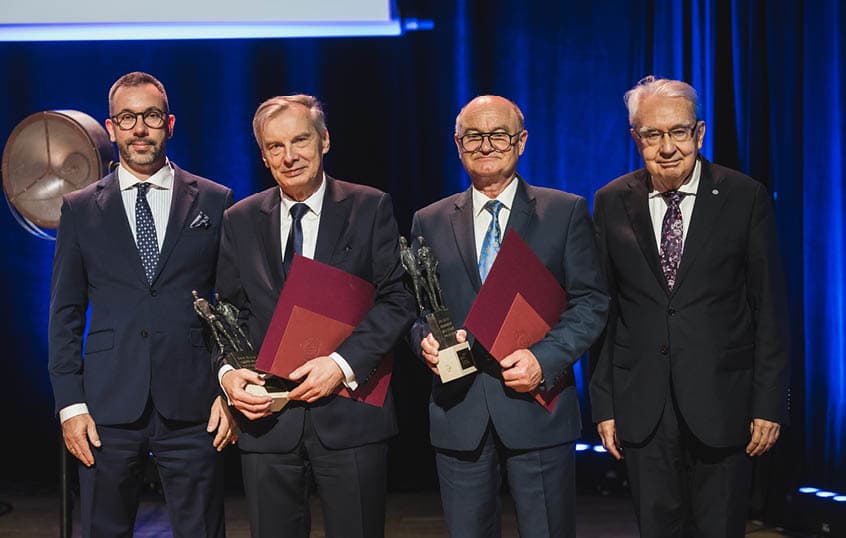
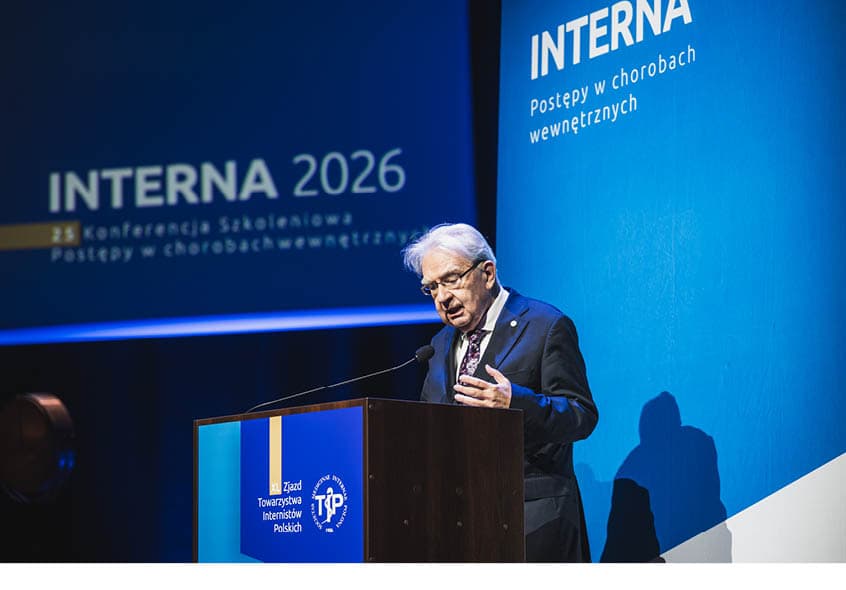
Since 1956, the Polish Society of Internal Medicine has been a member of the International Society of Internal Medicine, and since 1996, it has also been a member of the European Federation of Internal Medicine. During the celebrations marking the Society’s centennial, an open address was published, which included the following statement: The aim of medicine is always the patient. Therefore, while an internist may be referred to by other names, such as a generalist or hospitalist, or positioned differently within health care structures, they cannot be replaced, because the need for a holistic approach to patient care stems from the very essence of medicine. Photographs from the celebration held in Krakow on May 22–23, 2026 are shown in Figures 1 and 2; other photographs relevant to the history of the Society are presented in Supplementary material.
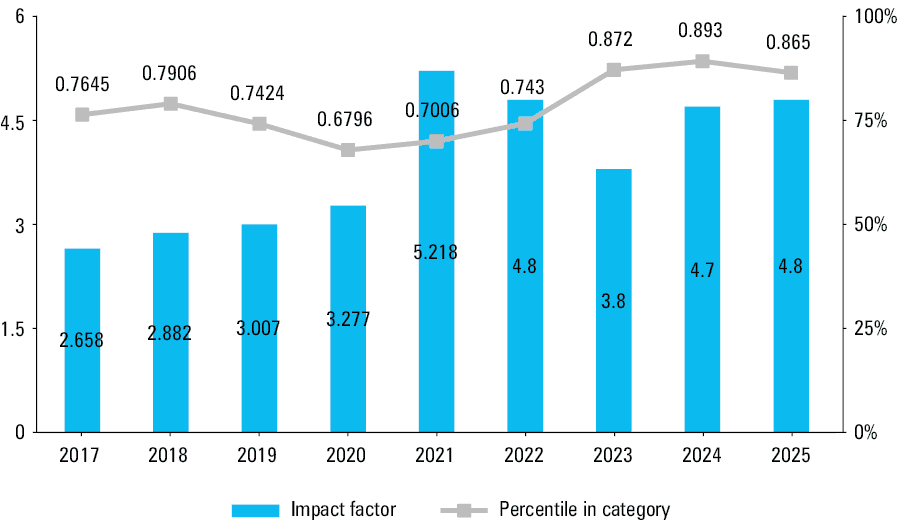
In 2026, the flagship periodical of the Society achieved a 2‑year impact factor of 4.8, with an increase by 0.1 as compared with the previous year (Figure 3), which is a meaningful achievement in a challenging market of scientific publishing. We are proud that the journal maintains its high standing also from a local perspective (Table 1). New initiatives started in June 2026 aim to promote the Society and encourage its members to submit their work, enhancing its visibility. The new website, launched on June 1, matches the current trends and hopefully will attract new readers and authors. A marked increase in the number of followers on Facebook, especially among younger physicians, is a success noted in 2025 and the first part of 2026.
Journal | 2025 impact factor | Quartile in the category |
Oeconomia Copernicana | 13.8 | Q1 |
Cellular & Molecular Biology Letters | 12.2 | Q1 |
Equilibrium‑Quarterly Journal of Economics and Economic Policy | 6.7 | Q1 |
Biology of Sport | 6.4 | Q1 |
Studies in Second Language Learning and Teaching | 5.1 | Q1 |
Reviews on Advanced Materials Science | 5.1 | Q2 |
Journal of Artificial Intelligence and Soft Computing Research | 5.0 | Q2 |
Biocybernetics and Biomedical Engineering | 4.9 | Q2 |
Archives of Civil and Mechanical Engineering | 4.9 | Q1 |
Polish Archives of Internal Medicine | 4.8 | Q1 |
Entrepreneurial Business and Economics Review | 4.8 | Q1 |
Pharmacological Reports | 4.5 | Q2 |
Polish Heart Journal‑Kardiologia Polska | 4.4 | Q1 |
Dental and Medical Problems | 4.3 | Q1 |
Journal of Human Kinetics | 4.0 | Q1 |
I would like to express my gratitude to all authors (the most cited papers are shown in Table 2), reviewers, citing authors, and readers who contributed in various ways to the present solid position of Polish Archives of Internal Medicine. Despite hard times for internal medicine in Poland, the journal of Polish internists proves that we have survived and flourished. It also provides strong evidence that clinical research related to internal medicine, reflected, among others, in high‑quality papers, can be conducted in Poland and draw attention of other investigators who cite the studies it features.
Title | Authors | Citation | Times cited |
COVID‑19 and its long‑term sequelae: what do we know in 2023? | Giuseppe Lippi, Fabian Sanchis‑Gomar, Brandon M. Henry | Pol Arch Intern Med. 2023; 133: 16402 | 57 |
Markers of malnutrition, inflammation, and tissue remodeling are associated with 1‑year outcomes in patients with advanced heart failure | Kamila Kurkiewicz, Mariusz Gasior, Bozena E. Szygula‑Jurkiewicz | Pol Arch Intern Med. 2023; 133: 16411 | 19 |
Novel factors affecting fibrin clot formation and their clinical implications | Michal Zabczyk, Joanna Natorska, Anetta Undas | Pol Arch Intern Med. 2023; 133: 16884 | 17 |
Heart failure with reduced, mildly reduced, and preserved ejection fraction: outcomes and predictors of prognosis | Tomasz M. Rywik, Anna Wisniewska, Urszula Ceglowska, Anna Drohomirecka, Roman Topor‑Madry, Hubert Lazarczyk, Paula Polaska, Tomasz Zielinski, Agnieszka Dorynska | Pol Arch Intern Med. 2023; 133: 16522 | 12 |
Prevalence of hyperlipoproteinemia(a) in individuals of European ancestry treated at outpatient cardiology clinics: results from a cross‑sectional STAR‑Lp(a) study | Monika Burzynska, Piotr Jankowski, Mateusz Babicki, Maciej Banach, Michal Chudzik | Pol Arch Intern Med. 2024; 134: 16860 | 12 |
Air pollution and long‑term risk of hospital admission due to chronic obstructive pulmonary disease exacerbations in Poland: a time‑stratified, case‑crossover study | Piotr Dabrowiecki, Andrzej Chcialowski, Agata Dabrowiecka, Anna Piorkowska, Artur Badyda | Pol Arch Intern Med. 2023; 133: 16444 | 10 |
Factor XI inhibition in cardiovascular disease | Stephanie Carlin, Michael Jakovac, Andrzej Budaj, John Eikelboom | Pol Arch Intern Med. 2023; 133: 16799 | 10 |
The Editorial Team, supported by the publisher, Medycyna Praktyczna, will do their best to ensure continued growth of the journal thinking of the next 120 years of the Society.
SUPPLEMENTARY MATERIAL
ARTICLE INFORMATION