
Hemostasis assessment in patients suspected of venous thrombosis and pulmonary embolism in emergency setting: challenges for clinicians
Key words: D-dimer, deep vein thrombosis, diagnosis, pulmonary embolism, venous thromboembolism

 CC BY 4.0
Hemostasis assessment in patients suspected of venous thrombosis and pulmonary embolism in emergency setting: challenges for clinicians
CC BY 4.0
Venous thromboembolism (VTE), which includes deep vein thrombosis and pulmonary embolism, is a major cause of morbidity and mortality worldwide, and represents a time‑sensitive clinical condition where diagnostic delay increases unfavorable outcomes. Among the various laboratory biomarkers investigated to support the diagnosis of VTE, D‑dimer has emerged as the reference test for excluding acute thrombosis when interpreted within an appropriate clinical framework. D‑dimer is a fibrin degradation product generated during plasmin‑mediated breakdown of cross‑linked fibrin, reflecting concurrent activation of coagulation and fibrinolysis. Modern diagnostic strategies integrate D‑dimer testing with structured assessment of pretest probability using validated clinical decision tools, such as the Wells score, the Revised Geneva Score, and the Pulmonary Embolism Rule‑out Criteria. In patients with low or intermediate clinical probability, a negative D‑dimer result can safely exclude VTE and avoid unnecessary imaging, whereas elevated values or high clinical suspicion require confirmatory imaging. Recent developments, including age‑adjusted D‑dimer thresholds and probability‑adapted algorithms, such as the YEARS and Pulmonary Embolism Graduated D‑dimer, have improved diagnostic specificity and reduced reliance on imaging techniques without compromising patient safety. Nevertheless, the clinical reliability of D‑dimer testing is influenced by preanalytical variables, assay‑related differences, and presence of physiological or pathological conditions associated with elevated or low fibrin turnover. Accordingly, optimal use of D‑dimer testing requires strict laboratory supervision and integration with clinical probability assessment to ensure accurate and timely diagnosis of VTE.
Introduction
Venous thromboembolism (VTE) is a collective term for blood clots that form in the venous circulation; these may remain localized or dislodge and travel throughout the body.1,2 This condition typically encompasses deep vein thrombosis (DVT), defined as thrombus formation within the deep venous system, most commonly affecting the veins of the lower extremities or pelvis; pulmonary embolism (PE), which occurs when thrombotic material occludes the pulmonary arterial circulation, usually following embolization of a clot originating from peripheral veins; and in situ pulmonary thrombosis, a process in which thrombi form directly within the pulmonary tissue, most often as a consequence of a pronounced local inflammatory response.1,2 The spectrum of VTE may also include thrombosis occurring at additional and atypical venous sites, such as the cerebral venous sinuses (central sinus), the retinal veins, upper‑extremity veins, and splanchnic veins, reflecting a shared underlying process of venous clot formation with or without embolization.3
VTE remains a major public health challenge, as confirmed by the most recent 2026 statistics from the American Heart Association,4 which indicate that VTE accounts for approximately 1.18 million hospital discharges in the United States (US), including 469 115 for PE and 712 950 for DVT. Lifetime risk estimates indicate that up to 8% of the general population may develop VTE by the age of 45 years, with substantially higher risk among individuals with obesity, thrombophilia, or other high‑risk conditions. Over the past 2 decades, hospitalization rates for VTE have risen, although advances in anticoagulant and thrombolytic therapies have contributed to declining mortality among patients with high‑risk PE.4 Overall, 3‑year mortality following VTE is approximately 10.9%, but exceeds 40% in catastrophic high‑risk PE, and is further amplified in the presence of cancer, COVID‑19, or other comorbidities.4 Additional risk factors include older age, heart failure, trauma, major surgery, hospitalization, pregnancy, cancer, autoimmune and inflammatory disorders, and exposure to exogenous hormones (eg, estrogen, testosterone, and sex‑affirming hormone therapy).4 In particular, cancer patients frequently display chronically elevated D‑dimer values due to tumor‑associated activation of coagulation, systemic inflammation, and increased fibrin turnover.4 Accordingly, even if the specificity of D‑dimer for VTE is markedly reduced in this population, D‑dimer retains high sensitivity and remains useful within structured diagnostic algorithms that incorporate clinical pretest probability. Population‑based studies also demonstrate marked disparities by race and ethnicity, with black individuals experiencing consistently higher incidence of VTE than white, Hispanic, or Asian / Pacific Islander populations.4
With specific regard to PE, the most severe clinical presentation of VTE, recent evidence indicates that mortality is modestly higher in men than in women and increases substantially with advancing age, thus identifying male sex and older age as major determinants of fatal outcome.5 Most PE‑related deaths occur in health care settings, especially among hospitalized patients and those managed in emergency departments (EDs), which together account for over 70% of the cases. Nevertheless, a meaningful proportion of deaths still occur at home, underscoring persistent shortcomings in prevention and the need to reinforce thromboprophylaxis adherence among high‑risk individuals outside hospital settings.5
Diagnostic approach to venous thromboembolism and pulmonary embolism
VTE, especially when occurring with PE, is a distinctly time‑sensitive condition, in which diagnostic delays are associated with a substantial increase in mortality, emphasizing the importance of early recognition and treatment to reduce adverse outcomes.4 Evidence from a recent study conducted across 2 US health systems6 showed that patients with delayed VTE diagnosis experienced significantly higher 30‑day all‑cause mortality than those diagnosed within 24 hours, with mortality increasing from 2.52% in timely cases to 8.33% in delayed cases (risk ratio [RR], 3.31; 95% CI, 2.03–5.38). Practitioner‑related delays were the most common contributing factor, and missed diagnostic opportunities occurred in the majority of cases (approximately 70%). Given that VTE often presents with nonspecific symptoms, these findings underscore the narrow window for effective intervention and highlight the need to implement rapid, structured diagnostic pathways to improve survival in this potentially preventable but life‑threatening disorder.
Various biomarkers have been investigated to aid in diagnosing VTE and PE over the past decades, including soluble fibrin monomers, fibrin(ogen) degradation products (FDPs), thrombin–antithrombin complexes, plasmin–antiplasmin complexes, fibrinopeptides A and B, prothrombin fragments 1+2, thrombus precursor protein, activated protein C–protein C inhibitor complex, myeloperoxidase, and thrombin generation assays.7,8 Nonetheless, D‑dimer has finally emerged as the definitive biomarker for excluding VTE,9 even in emergency (acute) settings (Figure 1).10
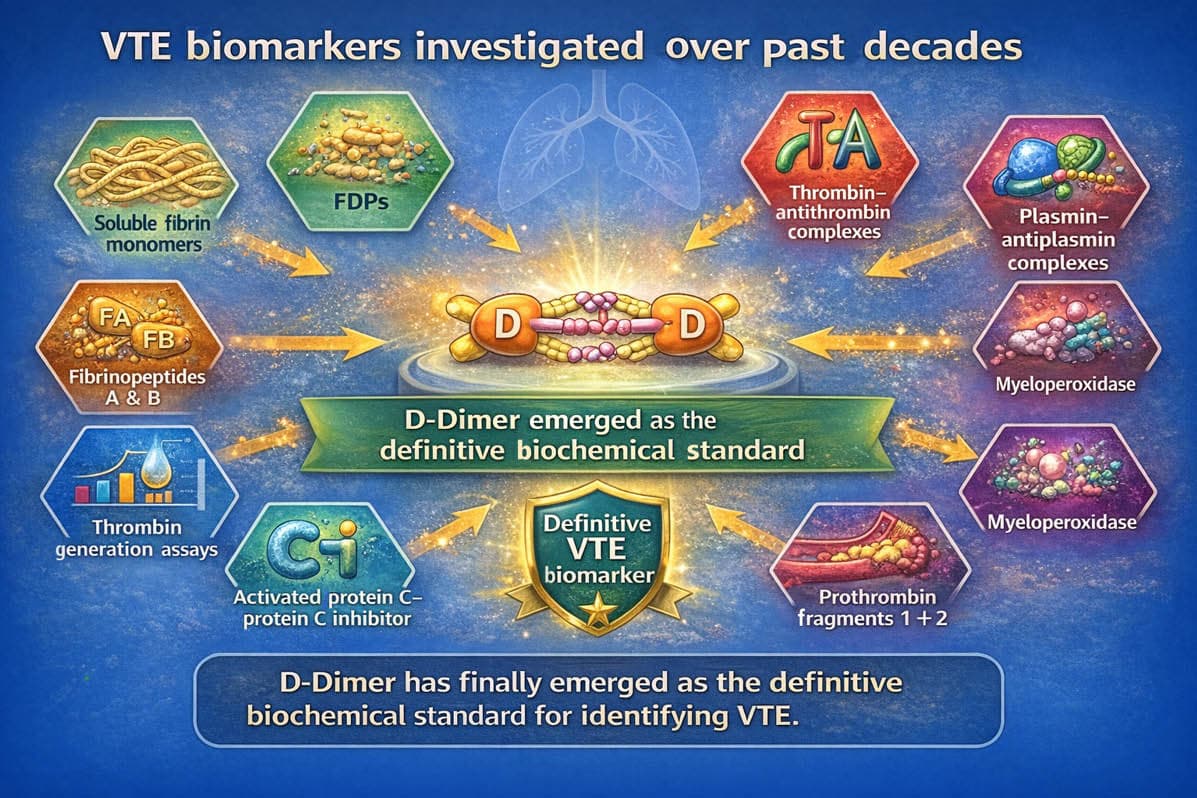
Abbreviations: FDPs, fibrin(ogen) degradation products; VTE, venous thromboembolism
Biochemical and physiological characteristics of D‑dimer
D‑dimer is a specific FDP composed of 2 D domains (each approximately 90–100 kDa) from adjacent fibrin monomers, covalently cross‑linked by activated factor XIII, resulting in stable fragments of varying molecular weight, typically between 180 and 340 kDa (Figure 2).11
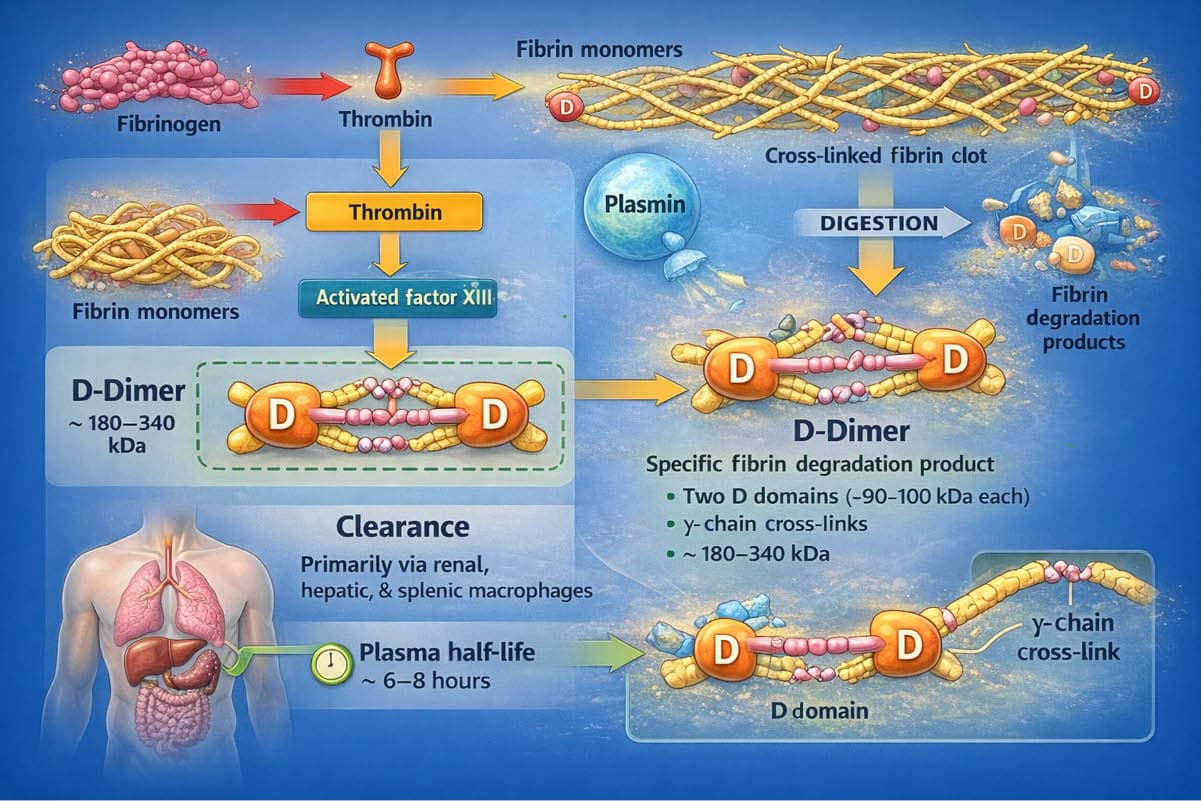
Unlike general FDPs, D‑dimer is uniquely generated through plasmin‑mediated degradation of cross‑linked fibrin. During coagulation, thrombin cleaves fibrinogen to form fibrin, which is subsequently stabilized by activated factor XIII–mediated cross‑linking between γ-chains of neighboring D domains. Plasmin then digests the clot, releasing a sequence of high- and intermediate–molecular‑weight polymers, ultimately yielding D‑dimer as the smallest distinct cross‑linked fragment.12 D‑dimer can hence be considered a biomarker of in vivo activation of both coagulation and fibrinolysis.13 Once formed in the circulation, the heterogenous mixture of D‑dimers is primarily cleared by the kidneys and the reticuloendothelial system, including hepatic and splenic macrophages, with a minor contribution from proteolytic degradation in the liver.14 The plasma half‑life of D‑dimer generally ranges from 6 to 8 hours, although it may extend considerably, up to 16 hours, especially in individuals with impaired renal function.15
D‑dimer testing
D‑dimer level measurement is predominantly performed using immunoassays that target the neoepitope generated by plasmin‑mediated cleavage of cross‑linked fibrin. A wide range of commercial assays is available, differing in sensitivity, specificity, and analytical format.16 Major methodologies include automated chemiluminescence immunoassays, which employ monoclonal antibodies for quantitative plasma detection and offer high sensitivity for excluding venous thrombosis; latex‑enhanced turbidimetric or immunoturbidimetric assays, in which antibody‑coated latex particles agglutinate proportionally to D‑dimer concentration, providing rapid, high‑throughput results; and whole‑blood agglutination tests using bispecific antibodies that bind both D‑dimer and red blood cell antigens for point‑of‑care qualitative assessment.16,17 Quantitative approaches have largely supplanted semiquantitative methods, although the current knowledge indicates that full standardization of D‑dimer assays remains unachieved, primarily due to the intrinsic biochemical heterogeneity of circulating FDPs and the lack of a commutable reference material.18 D‑dimer is not a single, uniform analyte but rather a mixture of fragments with variable molecular weight and structure, which are differentially recognized by assay‑specific monoclonal antibodies. Differences among assay calibrators is an additional source of variability, as commercial immunoassays use proprietary materials (eg, plasmin‑digested fibrin or synthetic analogues) that vary in composition and are often noncommutable with patient samples.18 This heterogeneity precludes the establishment of a true reference measurement procedure.18 A recent meta‑analysis pooling data from 34 studies with 22 849 participants19 assessed the diagnostic accuracy of various D‑dimer tests, concluding that chemiluminescent immunoassays have comparable sensitivity (97% vs 98%) and specificity (41% vs 40%) to the novel generation of high‑sensitivity immunoturbidimetric assays.
The International Society on Thrombosis and Haemostasis, through its Scientific and Standardization Committee on fibrinolysis, advocates for standardized reporting of D‑dimer values to improve comparability across assays and clinical contexts.18 Recommendations include explicitly stating the assay name and manufacturer, reporting results in fibrinogen equivalent units (FEU), using µg/l or mg/l, and avoiding D‑dimer units or other less common units, such as ng/ml. Laboratories are also encouraged to provide information about assay performance metrics, including functional sensitivity, imprecision, linearity, and potential interference from other FDPs, and to implement context‑specific thresholds, such as age‑adjusted cutoffs (as discussed in more details below), validated locally in a minimum of 200 individuals according to the British Committee for Standards in Haematology guidelines, rather than transferring cutoffs across different assays.20
Beside postanalytical factors, such as the lack of standardization and the use of heterogeneous cutoffs and nonstandardized units,21 the clinical reliability of D‑dimer testing is highly dependent on both preanalytical and analytical factors.22 Preanalytical variables, especially sample type, collection technique, anticoagulant choice, handling, storage, and centrifugation, can introduce variability that compromises assay accuracy. Analytical differences across platforms, such as antibody specificity, detection technology, assay linearity, and precision further contribute to interassay discrepancies and hinder comparability. These sources of variability are particularly critical near diagnostic thresholds, where minor deviations may lead to false‑positive or false‑negative results (as discussed in more details in a dedicated section of this article).
An important consideration is that D‑dimer levels increase with age. Consequently, the conventional 500 µg/l cutoff, which provides the highest negative predictive value for ruling out VTE, cannot be directly applied across the entire adult population. To address this limitation, an age‑adjusted D‑dimer threshold has been proposed. For patients older than 50 years, the age‑adjusted cutoff is calculated as follows: age‑adjusted D‑dimer cutoff (µg/l FEU) = patient age (years) × 10.23 The age‑adjusted cutoffs (age × 10 µg/l in patients >50 y) were initially validated in the ADJUST‑PE (Age‑Adjusted D‑Dimer Cutoff Levels to Rule Out Pulmonary Embolism) study,24 and have more recently been extended to DVT in the ADJUST‑DVT (Age‑Adjusted D‑Dimer Cutoff Levels to Rule Out Deep Vein Thrombosis) study.25 The clinical advantage of using the age‑adjusted cutoff over the fixed cutoff has recently been demonstrated in a meta‑analysis of 9 cohorts and 47 720 patients with nonhigh clinical probability of VTE.26 The pooled estimates showed that conventional D‑dimer testing achieved 98.8% sensitivity and 29.6% specificity, whereas the age‑adjusted D‑dimer approach maintained high sensitivity (96%), while consistently improving specificity (41.3%). These results reinforce the concept that both strategies are highly sensitive for ruling out VTE, but age‑adjusted D‑dimer cutoff offers a clinically meaningful increase in specificity. A subsequent systematic review, including 68 studies with 141 880 patients, also assessed the diagnostic accuracy of patient‑adjusted D‑dimer thresholds for excluding VTE.27 Using the standard D‑dimer cutoff, the pooled sensitivity was 99% and the pooled specificity 23%. The age‑adjusted thresholds retained high pooled sensitivity (97%), while confirming the substantially better pooled specificity (43%). These findings indicate that applying adjusted D‑dimer thresholds may reduce reliance on unnecessary imaging studies. The safety of using the age‑adjusted D‑dimer cutoff for VTE is different depending on the reagent used.28 This has been recently confirmed in a substudy of the multicenter prospective ADJUST‑PE study and should still be studied for DVT.29
D‑dimer levels increase physiologically along the pregnancy and postpartum period.30 In postpartum, the D‑dimer level returns to normal around the 6th week. D‑dimer testing may also be useful to exclude PE during pregnancy, particularly during the first and second trimesters.31
Although D‑dimers are primarily cleared by the kidneys, a previous study has not demonstrated any additional utility of renal function–adjusted D‑dimer thresholds for use in individuals suspected of VTE.32
Diagnostic algorithms for venous thromboembolism
Potential pitfalls of using D‑dimer level alone
D‑dimer level testing, as many laboratory assays, cannot be interpreted in isolation and must be applied within a Bayesian framework that integrates pretest probability, clinical signs, and symptoms.33 Its diagnostic value is maximized when used alongside validated clinical decision rules, allowing for safe exclusion of VTE, while minimizing unnecessary imaging. In fact, increased D‑dimer levels are observed in a wide spectrum of physiological and pathological conditions, mostly depending on the magnitude of thrombin generation, extent of cross‑linked fibrin formation, degree of systemic inflammation, and impaired clearance (renal / hepatic). Most of these conditions are summarized in Table 1, and classified by the relative frequency of D‑dimer level elevation.33
1 Conditions in which D‑dimer level is very frequently elevated |
|
|
ii) Venous thromboembolism |
iii) In situ pulmonary thrombosis |
|
|
|
|
|
2 Conditions in which D‑dimer level is very frequently elevated |
|
|
ii) Acute myocardial infarction |
iii) Atrial fibrillation with thrombus formation |
|
|
|
|
|
|
|
|
ii) Polytrauma |
iii) Large fractures |
3 Conditions in which D‑dimer level is commonly but inconsistently elevated |
|
|
ii) Pregnancy (especially 3rd trimester) |
iii) Postpartum period |
|
|
ii) Peripheral arterial disease |
|
|
ii) Sickle‑cell crisis |
|
|
ii) Chronic liver disease |
|
|
ii) Hemorrhagic stroke |
iii) Subarachnoid hemorrhage |
4 Conditions in which D‑dimer level can be occasionally elevated |
|
|
|
|
|
|
|
|
|
|
|
|
|
|
These nonthrombotic elevations contribute substantially to false‑positive results for VTE, if the clinical context is disregarded. Accordingly, the judicious interpretation of D‑dimer levels requires careful consideration of both clinical context and assay‑specific factors to enhance specificity without compromising sensitivity.
D‑dimer inclusion within diagnostic algorithms
A variety of diagnostic strategies have been proposed for the evaluation of suspected PE, differing primarily in the sequencing and integration of D‑dimer level testing within the clinical reasoning process (Figure 3).34
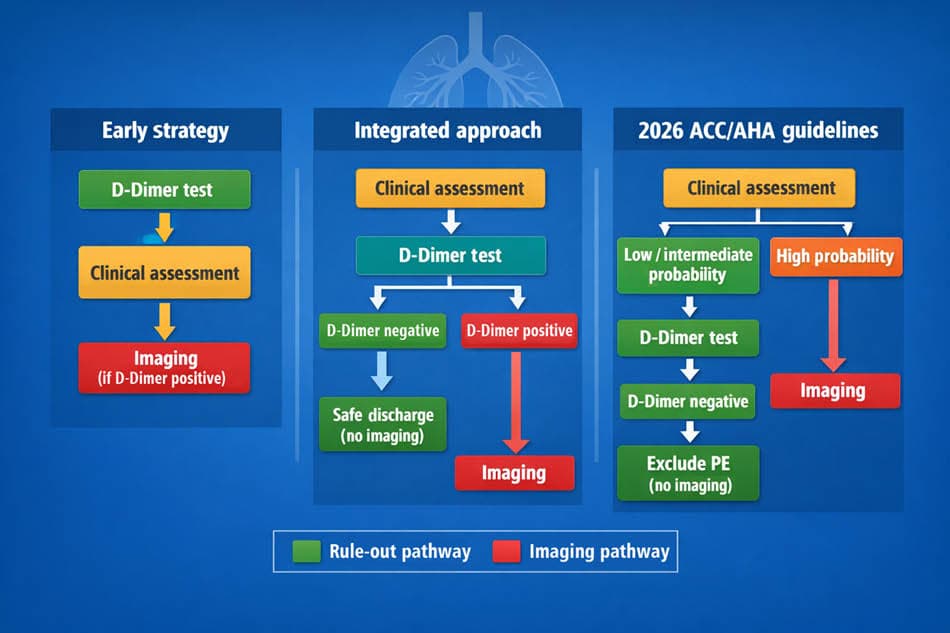
Abbreviations: ACC, American College of Cardiology; AHA, American Heart Association; PE, pulmonary embolism
In earlier strategies, D‑dimer level measurement was occasionally positioned as an initial screening test, with subsequent assessment of clinical probability and imaging reserved for patients with positive results. More contemporary approaches, however, emphasize the combined use of pretest probability assessment and D‑dimer measurement to guide management decisions, including safe discharge without imaging or progression to definitive radiologic testing. The 2026 guideline from the American College of Cardiology (ACC) / American Heart Association Joint Committee on Clinical Practice (AHAJCCP)35 has advocated a structured, probability‑driven approach, where D‑dimer testing is performed only after formal clinical assessment. Clinicians are advised to first stratify patients according to pretest probability based on symptoms, risk factors, and physical findings using a validated tool. In individuals with low or intermediate probability, D‑dimer level measurement serves as a rule‑out tool, as its negative result reliably excludes acute PE and allows for avoiding unnecessary imaging. Conversely, patients with high clinical probability or an elevated D‑dimer level should proceed directly to diagnostic imaging to confirm or exclude the diagnosis.35
Assessment of pretest probability
Concerning the assessment of pretest probability, the 2026 ACC/AHAJCCP guideline endorses the routine use of validated clinical decision instruments, including the Wells score, the Revised Geneva Score (RGS), and the Pulmonary Embolism Rule‑out Criteria (PERC).35 These tools are intended to standardize clinical estimation of disease likelihood prior to laboratory testing or imaging, thereby reducing unnecessary diagnostic procedures. Both the Wells score and the RGS stratify patients into low-, intermediate-, or high‑probability categories, which subsequently guide the appropriate use of D‑dimer testing or direct referral to imaging.35,36 The Wells score incorporates an element of physician gestalt, most notably the subjective item “pulmonary embolism more likely than alternative diagnoses,” which may enhance sensitivity in experienced hands but introduces interobserver variability. In contrast, the RGS relies exclusively on objective clinical variables (eg, age, heart rate, previous VTE, recent surgery), thereby improving reproducibility across different clinical settings. PERC differs conceptually from the above probability scores.35,36 Rather than stratifying the risk, it serves as a binary rule‑out tool applicable only to patients with an already established low clinical probability (eg, Wells <2 or RGS ≤3). In patients meeting low‑risk criteria, absence of all 8 PERC variables (ie, age <50 years, heart rate below 100 bpm, oxygen saturation above 94% on room air, absence of unilateral leg swelling, no history of hemoptysis, no recent surgery or trauma requiring hospitalization within the last 4 weeks, no prior history of PE or DVT, and no current use of oral hormones, such as estrogen or birth control) identifies a subgroup with an extremely low post‑test probability of PE, in whom neither D‑dimer testing nor imaging is required.37
Observed event rates increase progressively across probability strata. With the Wells model, the prevalence of PE approximates 10% in low‑risk patients and may exceed 70% in high‑risk categories; similar gradients have been reported with the RGS (approximately 9% in low‑risk and >80% in high‑risk groups).36 When applied appropriately, integration of structured probability assessment with PERC markedly improves rule‑out performance, achieving sensitivities approaching 99% in selected low‑risk populations, and outperforming reliance on D‑dimer testing alone, particularly in emergency settings.36-38 Collectively, these strategies underscore a probability‑driven diagnostic framework in which clinical assessment precedes biomarker testing, optimizing both safety and resource utilization in the evaluation of suspected VTE.
Advanced diagnostic strategies have refined the evaluation of patients with suspected VTE by combining structured clinical assessment with adjusted D‑dimer thresholds to minimize unnecessary imaging. The YEARS algorithm, developed to streamline PE workup, uses 3 clinical criteria (ie, clinical signs of DVT, hemoptysis, and PE considered the most likely diagnosis) with D‑dimer thresholds of below 1 000 µg/l if no YEARS criteria are present, and below 500 µg/l if at least 1 criterion is present.39 A recent meta‑analysis,40 based on 10 studies and involving approximately 14 000 participants, showed that this algorithm achieves a pooled sensitivity of approximately 96% and a specificity of approximately 50%, with a RR for use of advanced imaging modalities of 0.78 (95% CI, 0.67–0.9), thus indicating a significant decrease in imaging utilization, especially computed tomography pulmonary angiography (CTPA) in ED patients.40 In addition to diagnostic efficiency, YEARS has been shown to shorten ED turnaround times. Van der Pol et al39 analyzed data from the YEARS and ADJUST‑PE studies, and reported that patients could be discharged earlier from the ED, with a median reduction of 54 minutes for those managed without CTPA and 60 minutes across the entire cohort.39 Among the patients ultimately diagnosed with PE based on CTPA, initiation of anticoagulant therapy occurred 53 minutes earlier than in those following conventional diagnostic pathways. The implementation of the YEARS strategy was also associated with economic benefits, with a mean cost reduction of approximately 123 EUR per patient visit, reflecting both decreased imaging utilization and shorter ED length of stay.39
The Pulmonary Embolism Graduated D‑dimer (PEGeD) strategy is another probability‑adapted diagnostic algorithm designed to safely exclude PE while reducing reliance on imaging. PEGeD integrates clinical pretest probability, most commonly assessed with the Wells score, with graduated D‑dimer thresholds. Briefly, PE is considered ruled out without further testing in patients with low clinical probability (eg, Wells score, 0–4) and D‑dimer level below 1 000 µg/l, as well as in those with moderate clinical probability (Wells score, 4.5–6) and D‑dimer level below <500 µg/l.41,42 In the original multicenter Canadian cohort that evaluated this approach, the use of the PEGeD algorithm resulted in a 17.6% absolute reduction in CTPA utilization, as compared with conventional strategies, without compromising safety. The 3‑month symptomatic VTE rate in the patients excluded without imaging was 0.05%.41 Subsequent external validation in over 3300 patients demonstrated that approximately 49% could have had PE excluded based on PEGeD criteria alone; among these, 2.3% were found to have symptomatic PE at initial testing or during follow‑up, with most of the missed diagnoses occurring in the patients whose D‑dimer level was between 500 and 1 000 µg/l but above the age‑adjusted cutoff.42 This observation underscores an important caveat: while PEGeD increases efficiency by raising the rule‑out threshold in selected patients, caution may be warranted in older individuals or in those with D‑dimer values between the standard and probability‑adjusted cutoffs.
Comparative studies have hence generally found that YEARS or PEGeD achieve improved specificity and reduced imaging, as compared with conventional fixed D‑dimer diagnostic thresholds, albeit sometimes at the expense of a modest reduction in sensitivity relative to age‑adjusted strategies or standard cutoffs (Table 2).43
Algorithms | Clinical probability assessment | D‑dimer threshold / rule‑out criteria | Imaging requirement | Key notes / advantages |
Abbreviations: CTPA, computed tomography pulmonary angiography; DVT, deep vein thrombosis; ED, emergency department; FEU, fibrinogen equivalent units; HR, heart rate; PEGeD, pulmonary embolism graduated D‑dimer; PERC, pulmonary embolism rule‑out criteria; RGS, Revised Geneva Score; others, see Figures 1 and 3 | ||||
Wells Score | Stratifies patients as low, intermediate, or high probability, incorporates physician gestalt | – |
|
|
RGS | Objective clinical variables only (age, HR, previous VTE, recent surgery, etc.); low, intermediate, high probability | – |
|
|
PERC | Binary rule applied only to patients already classified as low clinical probability (eg, Wells <2, Geneva ≤3) | All 8 PERC criteria absent → no D‑dimer or imaging needed | Only PERC‑negative, low‑pretest probability patients may avoid D‑dimer measurement and imaging |
|
YEARS | Three clinical criteria: signs of DVT, hemoptysis, PE considered most likely |
|
| Reduces imaging, shortens ED stay, lowers costs |
PEGeD |
|
|
|
|
The promise of digital tools and artificial intelligence
Digital technologies and artificial intelligence (AI) are increasingly used to improve the accuracy of VTE diagnosis and risk stratification. Contemporary machine learning (ML) models have shown promising discriminatory performance, frequently surpassing conventional clinical risk scores, although their generalizability is often limited by methodological biases and lack of external validation.44 In particular, techniques such as gradient‑boosted trees and random forests have been applied to large‑scale clinical datasets, achieving areas under the receiver operating characteristic curve (AUC) of over 0.7, and demonstrating higher performance in selected patient subgroups. For example, a recent ML model developed to predict VTE in patients with sepsis achieved an AUC of 0.786 across the entire cohort, rising to 0.816 in patients with severe sepsis.45 Similarly, advanced ML algorithms have been applied to cancer‑associated VTE, achieving AUCs of up to 0.82, while preliminary neural network–based models designed to predict recurrent VTE yielded AUCs approaching 0.99 in some studies.46 These findings clearly underscore the potential of AI‑driven approaches to complement existing, widely used clinical tools, offering improved risk assessment and personalized decision support, even if prospective validation and careful integration into routine clinical practice remain essential before widespread clinical implementation.
Clinical pitfalls and diagnostic failures in the emergency setting
The evaluation of suspected VTE and PE in the emergency setting is intrinsically complex. Although structured clinical decision tools, such as the Wells score, the RGS, and the PERC have significantly improved diagnostic efficiency and safety, their performance in real‑world practice depends heavily on appropriate implementation and contextual interpretation.47 In particular, the diagnostic utility of D‑dimer testing, which forms the biochemical cornerstone of modern rule‑out strategies, is vulnerable to both false‑negative and false‑positive results, each of which may lead to clinically meaningful diagnostic failure.
Preanalytical issues
Preanalytical variables are universally regarded as the leading source of error in laboratory hemostasis and in D‑dimer testing, accounting for the majority of inaccuracies.48,49 These entail all steps from test ordering to the initiation of analysis. Vigilant adherence to preanalytical protocols is therefore critical to ensure reliable, clinically useful D‑dimer test results. Critical factors begin with specimen collection, and encompass prolonged tourniquet application, traumatic venipuncture, or the use of inappropriate needles, which can cause hemoconcentration, hemolysis, thrombin generation, or the introduction of air into the tubing of the butterfly collection system needle. The use of straight needle venipuncture or butterfly needles rather than sampling from intravenous catheters is recommended.50 Spurious hemolysis deeply influences the D‑dimer level when measured by an optical method.
Tube selection and anticoagulant type are also pivotal, with 3.2% buffered sodium citrate and a 9:1 blood‑to‑anticoagulant ratio being the reference practice. D‑dimer levels may be underestimated in the cases of underfilling.51 Thorough but gentle mixing of the blood tube (ie, by gentle inversion 4 to 6 times) immediately after collection is essential. Specimen transport should be rapid, upright, and at controlled ambient temperature, with pneumatic tube systems validated locally to minimize the potential for spurious activation of blood coagulation.52 On receipt, the samples must be evaluated for compliance, and plasma promptly separated by centrifugation. D‑dimer shows stability for at least 24 hours under proper conditions,53 but rapid processing is recommended for clinical decision‑making.
Finally, the selection and implementation of quality indicators / key performance indicators are recommended to support ED and laboratory teams to maintain / improve the preanalytical quality of blood sampling.50
False‑positive D‑dimer: leading mechanisms and clinical contexts
False‑positive D‑dimer test results may occur, in addition to the previously discussed biologically‑mediated factors.22,54 Circulating factors, such as heterophilic antibodies, monoclonal protein, or rheumatoid factor, may cross‑react with assay reagents, leading to artifactual signal amplification and an erroneously elevated reported value. The presence of monoclonal paraproteins may interfere with the optical or immunochemical properties of the specimen; this interference can affect commonly employed turbidimetric or automated latex agglutination assays, leading to falsely elevated measurements that may be clinically misleading. In particular, large discrepancies between D‑dimer assays, such as enzyme‑linked immunosorbent assay vs turbidimetric assays, often arise from the presence of interfering substances. In common laboratory practice, interference can be identified by performing serial dilutions, using heterophile‑blocking reagents, or testing with an alternative assay with different antibodies. Among available methods, high‑sensitivity automated chemiluminescence assays generally provide the most reliable and reproducible results. In patients with hyperfibrinogenemia related to inflammation, elevated D‑dimer levels are also common; in such cases, simultaneous measurement of fibrinogen level may help contextualize D‑dimer elevations and improve interpretation.54 Finally, spurious hemolysis,55 lipemia, and icterus may impair assay performance, necessitating thorough scrutiny and, if severe, sample rejection or recollection.56
False‑negative D‑dimer: leading mechanisms and clinical contexts
Although D‑dimer assays are highly sensitive for detecting acute VTE, false‑negative results may occur in specific clinical contexts. These situations are diagnostically challenging, because they may provide unwarranted reassurance and delay definitive imaging when clinical suspicion remains significant (Figure 4).22,54
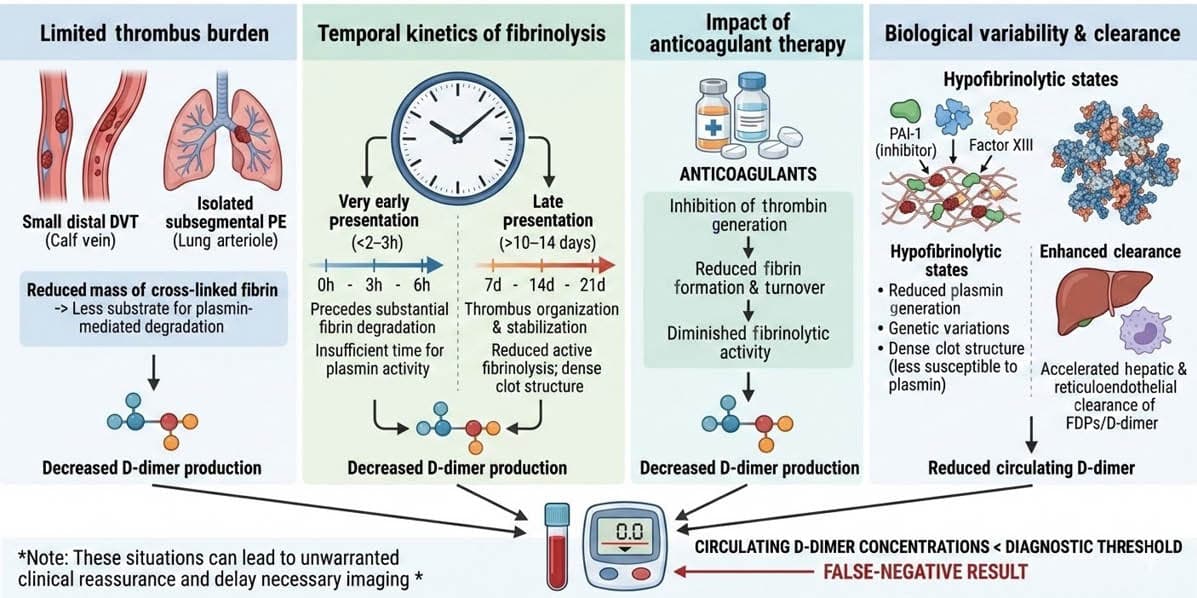
Abbreviations: PAI‑1, plasminogen activator inhibitor‑1; others, see Figures 1 and 3
One well‑recognized circumstance involves limited thrombus burden, such as in patients with isolated subsegmental PE or distal (calf) DVT.57-59 In these cases, the total mass of cross‑linked fibrin within the thrombus is relatively small, resulting in proportionally lower quantities of FDPs during fibrinolysis. Consequently, circulating D‑dimer concentrations may remain below conventional diagnostic thresholds despite the presence of an acute thrombus.
Another important determinant relates to the temporal kinetics of fibrin formation and degradation. D‑dimer reflects the plasmin‑mediated breakdown of cross‑linked fibrin, and therefore requires sufficient time for fibrinolytic activity to occur. Testing performed very early in the course of symptoms, such as within the first 2–3 hours after thrombus formation, may precede substantial fibrin degradation and yield falsely reassuring values.54 Conversely, in patients presenting late, typically beyond 10–14 days from symptom onset, progressive thrombus organization and stabilization may reduce active fibrinolysis.54 As a result, circulating D‑dimer concentrations may decline despite the continued presence of residual thrombotic material.
Anticoagulant therapy represents another important confounding factor. Both therapeutic and prophylactic anticoagulation attenuate thrombin generation and limit ongoing fibrin formation. The reduction in fibrin turnover subsequently diminishes fibrinolytic activity and circulating D‑dimer levels.60 In patients who have initiated anticoagulation prior to diagnostic testing, or in those who are chronically anticoagulated, D‑dimer concentrations may remain relatively low even in the presence of acute or evolving thrombotic disease.60
In addition to these clinical circumstances, individual biological variability in fibrinolytic pathways may contribute to rare false‑negative results. Reduced plasmin generation, increased activity of fibrinolytic inhibitors, such as plasminogen activator inhibitor‑1, or impaired tissue plasminogen activator–mediated fibrinolysis may limit the production of measurable FDPs.61 Alterations in fibrin architecture, such as those influenced by activated factor XIII cross‑linking or genetic variations affecting fibrin structure, may also produce denser clots that are less susceptible to plasmin‑mediated degradation, thereby reducing D‑dimer release into the circulation.62 Additional mechanisms include rare conditions associated with hypofibrinolytic states, including metabolic syndrome, severe inflammation, or elevated levels of lipoprotein(a), all of which may alter fibrinolytic efficiency.63,64 Finally, accelerated hepatic or reticuloendothelial clearance of FDPs may also contribute to an enhanced clearance of FDPs and D‑dimer, lowering their levels in the circulation.65
Taken together, these observations underscore an important diagnostic principle: D‑dimer testing should always be interpreted within the context of the clinical pretest probability. In patients with high clinical suspicion for VTE, a negative D‑dimer result should not supersede clinical judgment, and definitive imaging studies remain warranted when the probability of disease is substantial.
Conclusions
Despite advances in diagnosis and treatment, VTE remains a major contributor to cardiovascular and overall mortality, highlighting the need for continued awareness and timely management.66 D‑dimer testing remains an indispensable tool for rapid assessment and exclusion of VTE and PE, yet its clinical reliability relies on specific focus on both preanalytical and analytical variables, as well as integration with structured clinical probability assessment. In patients with cancer, for example, VTE (often referred to as cancer‑associated thrombosis), is the second leading cause of death, and is influenced by tumor type, stage, treatments, and comorbidities. Risk stratification using validated models, such as the Khorana or COMPASS‑CAT (Comprehensive Mortality Prediction and Anticoagulation Strategy for Cancer‑Associated Thrombosis) scores is critical to improve outcomes in this high‑risk population.67 Similarly, pregnancy markedly increases VTE risk due to a hypercoagulable state, venous stasis, and vascular changes, particularly postpartum. Emerging pregnancy‑adapted diagnostic algorithms, including D‑dimer–guided approaches and the pregnancy‑adapted YEARS criteria, alongside prophylaxis with low‑molecular‑weight heparin, are improving safety and reducing unnecessary imaging.68 Preanalytical errors represent the most frequent sources of inaccuracy and must be rigorously controlled to ensure assay reliability. Differences among analytical platforms, antibody specificity, and sources of interference further underscore the need for assay‑specific validation, context‑aware cutoffs, and standardized reporting in FEU. Clinically, D‑dimer values should never be interpreted in isolation; elevated levels can reflect a wide range of thrombotic and nonthrombotic conditions, while false‑negative results may occur in various circumstances. The adoption of age‑adjusted thresholds and probability‑adapted algorithms, such as YEARS and PEGeD, improves specificity, reduces unnecessary imaging, and optimizes resource utilization without compromising patient safety. Ultimately, the judicious application of D‑dimer testing, guided by validated clinical decision rules and reinforced by expert laboratory oversight, remains essential for accurate, timely, and safe diagnosis of VTE and PE in various patient populations.
- Lippi G, Favaloro EJ. Venous and arterial thromboses: two sides of the same coin? Semin Thromb Hemost. 2018; 44: 239‑248. | Crossref
- Lippi G, Favaloro EJ. What we know (and do not know) regarding the pathogenesis of pulmonary thrombosis in COVID‑19. Semin Thromb Hemost. 2023; 49: 27‑33. | Crossref
- Afzal A, Conyers FG, Sauk S, et al. Venous thromboembolism in unusual locations. Med Clin North Am. 2025; 109: 887‑905. | Crossref
- Palaniappan LP, Allen NB, Almarzooq ZI, et al; American Heart Association Council on Epidemiology and Prevention Statistics Committee and Stroke Statistics Committee. 2026 Heart disease and stroke statistics: a report of US and global data from the American Heart Association. Circulation. 2026; 153: e275‑e906. | Crossref
- Lippi G, Mattiuzzi C, Favaloro EJ. Recent monthly mortality for pulmonary embolism in the US. Thromb Res. 2024; 233: 99‑100. | Crossref
ARTICLE INFORMATION