
Mechanical thrombectomy as a bailout therapy for highly resistant coronary thrombus in a young patient with ST-segment elevation myocardial infarction

 CC BY 4.0
Mechanical thrombectomy as a bailout therapy for highly resistant coronary thrombus in a young patient with ST-segment elevation myocardial infarction
CC BY 4.0
Mechanical thrombectomy (MT) has emerged as an effective bailout strategy for the management of highly resistant intracoronary thrombi.1 Aspiration‑based devices, including the Penumbra system (Penumbra Inc., Alameda, California, United States), have demonstrated increasing applicability in coronary interventions, particularly in clinical scenarios, where effective thrombus removal is essential to achieve optimal reperfusion, especially after failure of conventional manual aspiration techniques.2,3
A 44‑year‑old previously untreated man was urgently admitted to a cardiology department with ST‑segment elevation myocardial infarction (STEMI). Electrocardiography performed on admission additionally showed atrial fibrillation. The patient reported no prior symptoms suggestive of coronary artery disease.
Emergency coronary angiography was performed (Figure 1A and 1B), identifying acute occlusion of the right coronary artery. The patient was qualified for primary percutaneous coronary intervention. An initial attempt at manual thrombectomy using a 7F catheter (Capturer, iVascular, Barcelona, Spain) was unsuccessful due to excessive thrombus burden. Subsequent intravascular ultrasonography confirmed extensive thrombus within the vessel lumen (Figure 1C). Therefore, MT was performed using the CAT RX system (Penumbra Inc.), followed by adjunctive intracoronary thrombolysis with alteplase (30 mg). This approach resulted in effective removal of the thromboembolic material and restoration of the coronary flow, achieving thrombolysis in myocardial infarction flow grade 3 (Figure 1D).
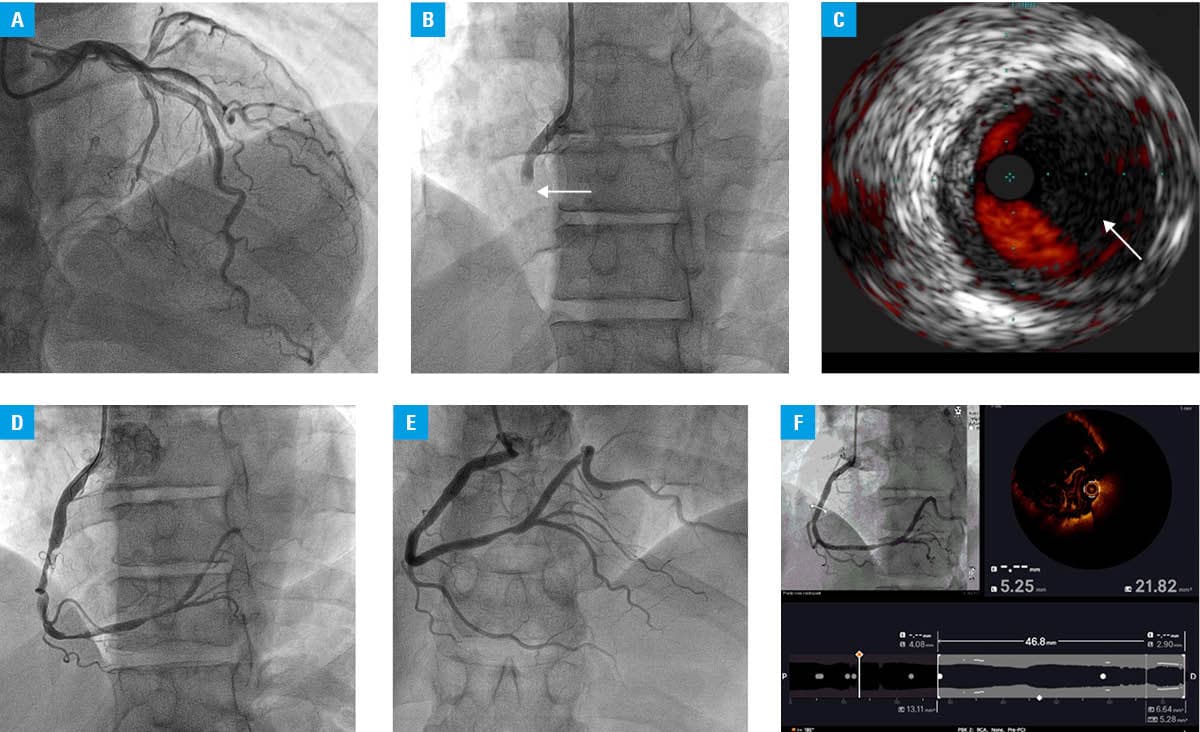
During the periprocedural period, the patient experienced cardiac arrest due to ventricular fibrillation. Immediate defibrillation was successful, and sinus rhythm was restored.
Follow‑up angiography of the right coronary artery performed 1 week later (Figure 1E) under optical coherence tomography guidance (Figure 1F) demonstrated only minor atherosclerotic lesions. Optical coherence tomography showed a small amount of residual thrombotic material without evidence of plaque rupture. Transesophageal echocardiography showed no thrombus within the cardiac chambers. Based on these findings, the patient was qualified for further conservative management.
Mechanical thrombus aspiration systems, such as the CAT RX device, are primarily used in neurovascular interventions, and data on their application in patients with acute coronary syndromes remain limited. In individuals presenting with STEMI without significant underlying atherosclerotic plaques, the need for adjunctive techniques, such as MT, is infrequent. Therefore, evidence regarding the use of these devices in such patients is scarce.
Moreover, STEMI is usually associated with heavily calcified lesions and smaller vessel lumen diameters,4 which further restricts the availability of clinical data on MT in this population.
Nevertheless, the existing evidence on mechanical thrombus aspiration systems, including the Penumbra platform, suggests that their use may reduce the incidence of the no‑reflow phenomenon.5 Furthermore, the CAT RX system has technical features that support its effectiveness. Its small distal profile facilitates coronary deliverability, while a dedicated pump provides continuous high negative pressure. Unlike manual syringe‑based systems, it enables sustained aspiration, potentially improving removal of large or organized thrombi, particularly in the cases of extensive and resistant intracoronary thrombus burden.
Therefore, such devices may represent a valuable therapeutic option in patients at an increased risk of no‑reflow, even in the presence of only a single risk factor, particularly in the cases of highly resistant intracoronary thrombi, as illustrated in this report.
- Fan X, Si DY, Yang H, He Y. Mechanical thrombectomy as a bailout reperfusion strategy for ST‑segment elevation myocardial infarction with refractory huge thrombus burden: a case report. Eur Heart J Case Rep. 2023; 7: ytad122. | Crossref
- Mathews SJ, Parikh SA, Wu W, et al. Sustained mechanical aspiration thrombectomy for high thrombus burden coronary vessel occlusion: the multicenter CHEETAH study. Circ Cardiovasc Interv. 2023; 16: e012433. | Crossref
- Glanowski S, Kapral G, Derewońko M, et al. Mechanical thrombectomy with the Penumbra system in a patient with acute myocardial infarction. Postepy Kardiol Interwencyjnej. 2025; 21: 606‑607 | Crossref
- Dong L, Mintz GS, Witzenbichler B, et al. Comparison of plaque characteristics in narrowings with ST‑elevation myocardial infarction (STEMI), non‑STEMI/unstable angina pectoris and stable coronary artery disease (from the ADAPT‑DES IVUS Substudy). Am J Cardiol. 2015; 115: 860‑866. | Crossref
- d’Entremont MA, Alazzoni A, Dzavik V, et al. No‑reflow after primary percutaneous coronary intervention in patients with ST‑elevation myocardial infarction: an angiographic core laboratory analysis of the TOTAL Trial. EuroIntervention. 2023; 19: e394‑e401. | Crossref
ARTICLE INFORMATION