
Secondary fungal coinfection(s) in influenza A–associated acute respiratory distress syndrome during venovenous extracorporeal membrane oxygenation: diagnostic challenges

 CC BY 4.0
Secondary fungal coinfection(s) in influenza A–associated acute respiratory distress syndrome during venovenous extracorporeal membrane oxygenation: diagnostic challenges
CC BY 4.0
A 41‑year‑old man was admitted to an intensive care unit with severe acute respiratory distress syndrome (ARDS) secondary to influenza A infection confirmed with a polymerase chain reaction test. The patient required invasive mechanical ventilation and deep sedation. A lung‑protective strategy with positive end‑expiratory pressure titrations guided by electrical impedance tomography was adopted. Due to refractory hypoxemia, venovenous extracorporeal membrane oxygenation (VV‑ECMO) was initiated. Broad‑spectrum antimicrobial therapy was started and subsequently modified based on microbiological test results.
Lung ultrasound showed diffuse B‑lines, pleural line irregularities, and consolidations consistent with ARDS. High‑resolution computed tomography yielded an image of bilateral ground‑glass opacities with interlobular septal thickening and confluent consolidations involving 80%–90% of the lung parenchyma (Figure 1A and 1B). A thick‑walled, pleural‑based cavitary lesion communicating with a segmental bronchus was visualized in the apical segment of the left upper lobe, which represented a nonspecific finding.
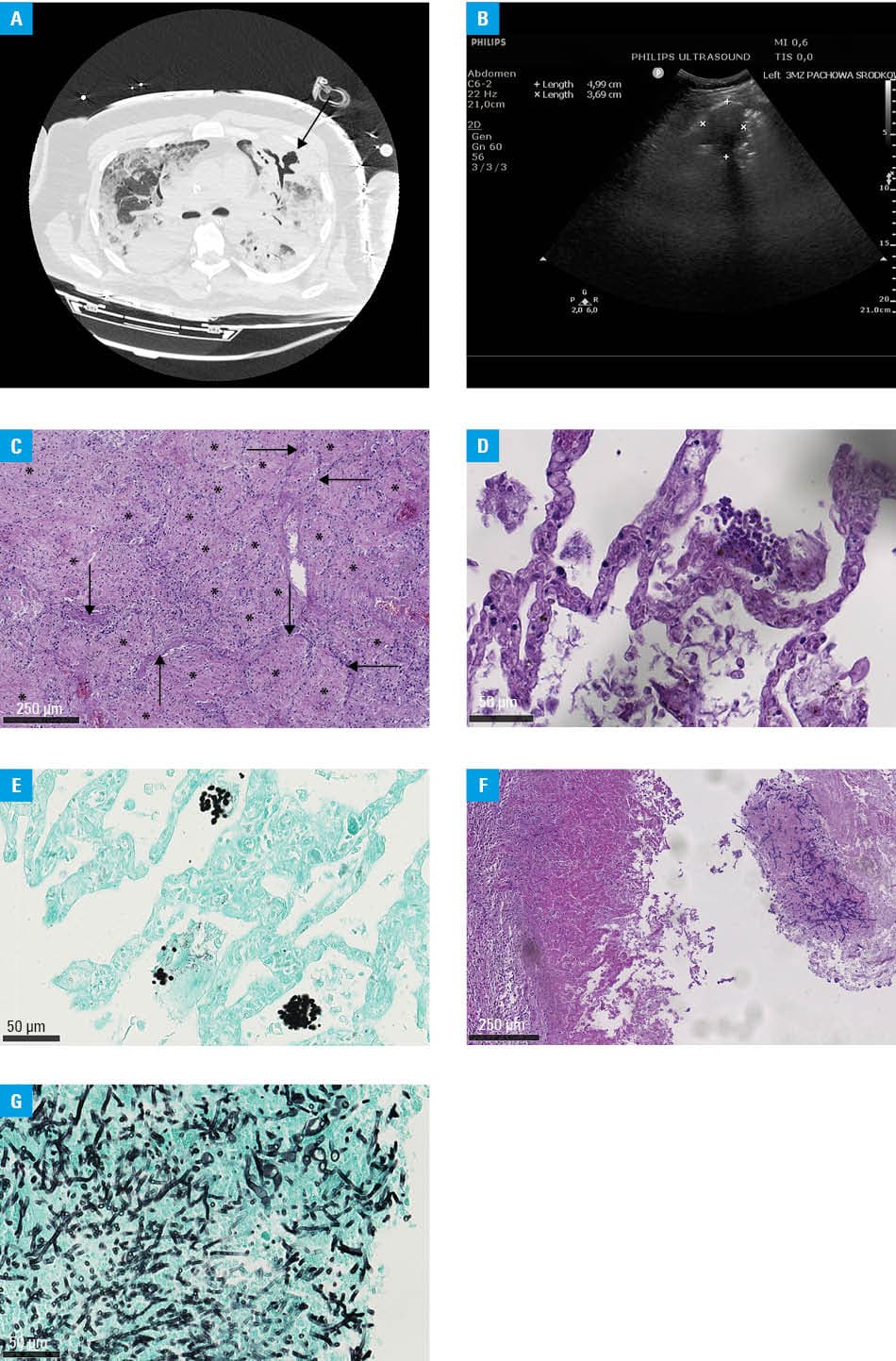
After 19 days of hospitalization, the patient developed marked neutropenia (neutrophil count, 120/µl; reference range, 1900–7000/µl). Bronchoscopy demonstrated hyperemic and darkened bronchial mucosa, particularly in the left bronchial tree, suggesting mucosal necrosis and possible fungal invasion. Bronchoalveolar lavage (BAL) cultures confirmed the presence of Candida albicans and Aspergillus fumigatus, and a subsequent BAL culture identified Mucor spp. A diagnosis of Candida colonization and probable influenza‑associated pulmonary aspergillosis with suspected mucormycosis was made.1 Antifungal therapy was empirically switched from voriconazole to isavuconazole to cover potential Mucorales. Despite antifungal therapy, VV‑ECMO support, and continuous renal replacement therapy for acute kidney injury, the patient’s clinical condition continued to deteriorate, ultimately resulting in death.
Post mortem lung histopathologic examination showed the fibrotic phase of ARDS, intra‑alveolar fungal colonies in both yeast and septate filamentous forms, necrotic destruction of the bronchial walls, and fungal aggregates within the bronchial lumen (Figure 1C–1G). Only Candida and Aspergillus colonies were identified post mortem; therefore, mucormycosis could not be confirmed. In the case of confirmed mucormycosis, liposomal amphotericin B would have been the first‑line agent supported by the strongest evidence.2 As mucormycosis was only suspected and not histopathologically proven, isavuconazole, which carries moderate‑strength evidence for this fungal infection,2 was used empirically in our patient. Another limitation is the lack of azole blood level monitoring during VV‑ECMO and continuous renal replacement therapy.
Severe influenza A pneumonia complicated by ARDS can trigger profound immune dysfunction and secondary neutropenia, significantly increasing susceptibility to opportunistic fungal infections, most notably influenza‑associated pulmonary aspergillosis.1,3 This vulnerability may extend to mixed‑species infections involving Candida, Aspergillus, and Mucorales. Pulmonary mucormycosis is an uncommon but highly lethal form of fungal pneumonia characterized by rapid angioinvasion, with mortality exceeding 50%–80%.2,4 Diagnosis of pulmonary mucormycosis is often confounded by nonspecific radiologic features that overlap with those of invasive aspergillosis.5,6 Furthermore, the low sensitivity of BAL cultures often necessitates histopathologic confirmation to differentiate true infection from colonization or other ARDS‑related complications. Breakthrough mucormycosis during voriconazole therapy is a recognized clinical phenomenon, but the lack of histopathologic evidence in this case makes such a diagnosis speculative rather than definitive.2,4 These findings underscore the need for a high index of clinical suspicion of secondary fungal complications in ARDS, emphasizing that microbiological findings must be contextualized within diagnostic frameworks to guide therapy.
- Verweij PE, Rijnders BJA, Brüggemann RJM, et al. Review of influenza‑associated pulmonary aspergillosis in ICU patients and proposal for a case definition: an expert opinion. Intensive Care Med. 2020; 46: 1524‑1535. | Crossref
- Cornely OA, Alastruey‑Izquierdo A, Arenz D, et al. Global guideline for the diagnosis and management of mucormycosis: an initiative of the European Confederation of Medical Mycology in cooperation with the Mycoses Study Group Education and Research Consortium. Lancet Infect Dis. 2019; 19: e405‑e421. | Crossref
- Schauwvlieghe AFAD, Rijnders BJA, Philips N, et al. Invasive aspergillosis in patients admitted to the intensive care unit with severe influenza: a retrospective cohort study. Lancet Respir Med. 2018; 6: 782‑792. | Crossref
- Danion F, Coste A, Le Hyaric C, et al. What is new in pulmonary mucormycosis? J Fungi (Basel). 2023; 9: 307. | Crossref
- McAdams HP, Rosado de Christenson M, Strollo DC, Patz EF. Pulmonary mucormycosis: radiologic findings in 32 cases. AJR Am J Roentgenol. 1997; 168: 1541‑1548. | Crossref
ARTICLE INFORMATION